Virginia SOL LS.1
SOL Standard (Key Ideas Cluster)
The student will demonstrate an understanding of scientific and engineering practices by asking questions and defining problems ask questions and develop hypotheses to determine relationships between independent and dependent variables offer simple solutions to design problems planning and carrying out investigations independently and collaboratively plan and conduct observational and experimental investigations; identify variables, constants, and controls where appropriate and include the safe use of chemicals and equipment evaluate the accuracy of various methods for collecting data take metric measurements using appropriate tools and technologies including the use of microscopes interpreting, analyzing, and evaluating data identify, interpret, and evaluate patterns in data construct, analyze, and interpret graphical displays of data compare and contrast data collected by different groups and discuss similarities and differences in their findings consider limitations of data analysis and/or seek to improve precision and accuracy of data use data to evaluate and refine design solutions constructing and critiquing conclusions and explanations construct explanations that include qualitative or quantitative relationships between variables construct scientific explanations based on valid and reliable evidence obtained from sources (including the students’ own investigations) differentiate between a scientific hypothesis and theory developing and using models construct and use models and simulations to illustrate, predict, and/or explain observable and unobservable phenomena, life processes, or mechanisms evaluate limitations of models obtaining, evaluating, and communicating information read scientific texts, including those adapted for classroom use, to obtain scientific and/or technical information gather, read, and synthesize information from multiple appropriate sources and assess the credibility, accuracy, and possible bias of each publication construct, use, and/or present an argument supported by empirical evidence and scientific reasoning
Virginia Standards of Learning for Science
Cluster contents
Key Ideas in This Standard
LS.1 is a Standards of Learning science standard. These are the key ideas and practices under it.
- LS.1.a
asking questions and defining problems
- LS.1.a.i
ask questions and develop hypotheses to determine relationships between independent and dependent variables
- LS.1.a.ii
offer simple solutions to design problems
- LS.1.b
planning and carrying out investigations
- LS.1.b.i
independently and collaboratively plan and conduct observational and experimental investigations; identify variables, constants, and controls where appropriate ...
- LS.1.b.ii
evaluate the accuracy of various methods for collecting data
- LS.1.b.iii
take metric measurements using appropriate tools and technologies including the use of microscopes
- LS.1.c
interpreting, analyzing, and evaluating data
- LS.1.c.i
identify, interpret, and evaluate patterns in data
- LS.1.c.ii
construct, analyze, and interpret graphical displays of data
- LS.1.c.iii
compare and contrast data collected by different groups and discuss similarities and differences in their findings
- LS.1.c.iv
consider limitations of data analysis and/or seek to improve precision and accuracy of data
- LS.1.c.v
use data to evaluate and refine design solutions
- LS.1.d
constructing and critiquing conclusions and explanations
- LS.1.d.i
construct explanations that include qualitative or quantitative relationships between variables
- LS.1.d.ii
construct scientific explanations based on valid and reliable evidence obtained from sources (including the students' own investigations)
- LS.1.d.iii
differentiate between a scientific hypothesis and theory
- LS.1.e
developing and using models
- LS.1.e.i
construct and use models and simulations to illustrate, predict, and/or explain observable and unobservable phenomena, life processes, or mechanisms
- LS.1.e.ii
evaluate limitations of models
- LS.1.f
obtaining, evaluating, and communicating information
- LS.1.f.i
read scientific texts, including those adapted for classroom use, to obtain scientific and/or technical information
- LS.1.f.ii
gather, read, and synthesize information from multiple appropriate sources and assess the credibility, accuracy, and possible bias of each publication
- LS.1.f.iii
construct, use, and/or present an argument supported by empirical evidence and scientific reasoning
Teacher's field guide
What This Cluster Means
What Students Need to Do
- Students ask testable questions, form hypotheses, identify variables, and plan safe investigations. They collect metric data, make graphs, compare results, and examine accuracy. They use models, reliable sources, and evidence to explain findings and defend conclusions.
What Mastery Looks Like
- Given a question, students can plan and carry out a controlled investigation with appropriate tools. They can graph results, identify patterns and limits, and revise a method or design. Their explanations connect evidence to claims and distinguish hypotheses from scientific theories.
Common Misconceptions
- Students may confuse independent and dependent variables or treat constants as controls. They may think a hypothesis is a guess, a theory is unproven, or correlation proves causation. They may also treat models as exact copies, confuse accuracy with precision, or trust any published source.
How to Assess It
- On an exit ticket, ask, "How does daily light duration affect bean plant height over 14 days?" Students name variables and a control, select metric tools, label graph axes, and state what evidence would support a conclusion.
Lesson moves
Ways to Teach It
Teams test how water temperature affects yeast balloon inflation, measure circumference in centimeters, hold amounts constant, and compare results.
Have students write a claim from two conflicting data tables, cite evidence, and explain which collection method is more reliable.
Run a variable-sorting card game where students label independent variables, dependent variables, constants, controls, and untestable questions.
Compare two health product claims online, check source credentials and evidence, then revise each claim to match the data.
Free download
Printable LS.1 Worksheet
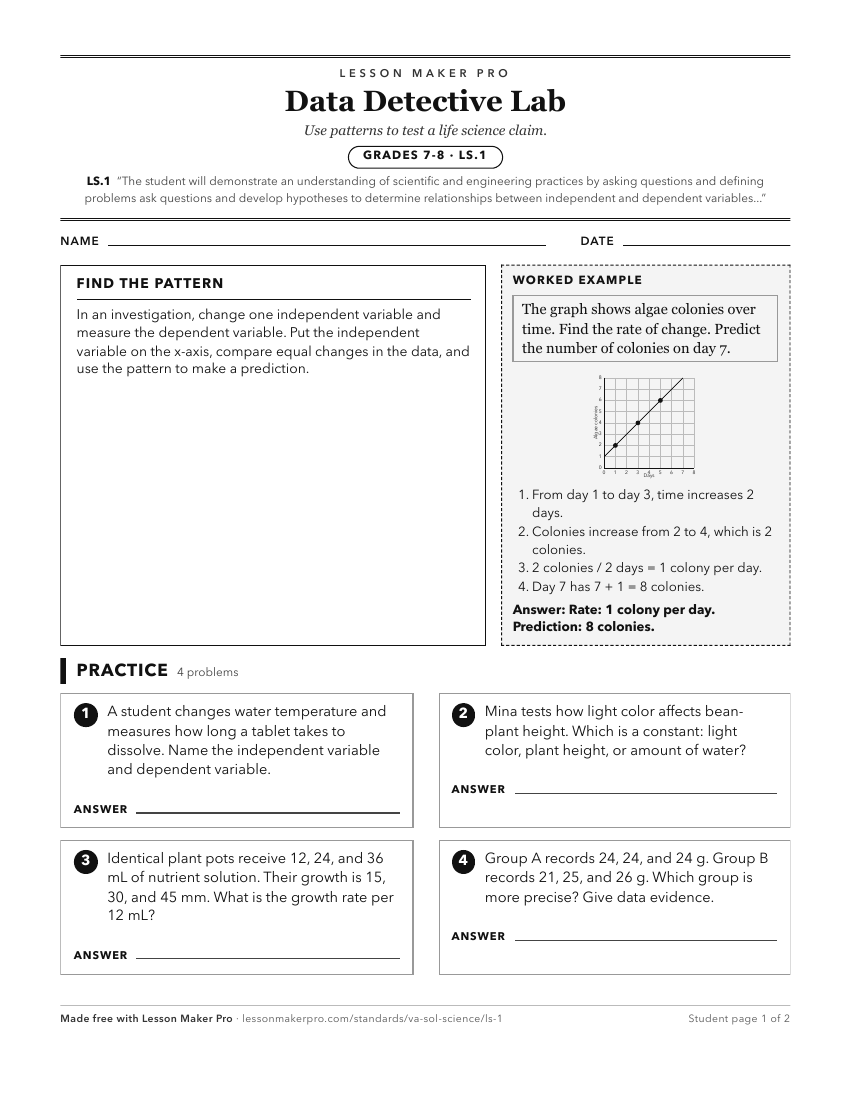
A ready-to-print activity worksheet aligned to LS.1, with an answer key for the teacher on its own page. No account needed.
PDF, US Letter, prints cleanly in black and white.
Download the worksheetKeep exploring
Related Standards
- 1.1
The student will demonstrate an understanding of scientific and engineering practices by
- 4.1
The student will demonstrate an understanding of scientific and engineering practices by
- 2.1
The student will demonstrate an understanding of scientific and engineering practices by
- 3.1
The student will demonstrate an understanding of scientific and engineering practices by
Turn this cluster into a lesson
Grade, subject, topic, and the complete cluster are prefilled. Create one free, no account needed.
Also for this cluster:Make a WorksheetMake a QuizMake a Sub Lesson