Virginia SOL 3.1
SOL Standard (Key Ideas Cluster)
The student will demonstrate an understanding of scientific and engineering practices by asking questions and defining problems ask questions that can be investigated and predict reasonable outcomes ask questions about what would happen if a variable is changed define a simple design problem that can be solved through the development of an object, tool, process, or system planning and carrying out investigations with guidance, plan and conduct investigations use appropriate methods and/or tools for collecting data estimate length, mass, volume, and temperature measure length, mass, volume, and temperature in metric and U.S. Customary units using proper tools measure elapsed time use tools and/or materials to design and/or build a device that solves a specific problem interpreting, analyzing, and evaluating data organize and represent data in pictographs or bar graphs read, interpret, and analyze data represented in pictographs and bar graphs analyze data from tests of an object or tool to determine if it works as intended constructing and critiquing conclusions and explanations use evidence (measurements, observations, patterns) to construct or support an explanation generate and/or compare multiple solutions to a problem describe how scientific ideas apply to design solutions developing and using models use models to demonstrate simple phenomena and natural processes develop a model (e.g., diagram or simple physical prototype) to illustrate a proposed object, tool, or process obtaining, evaluating, and communicating information read and comprehend reading-level appropriate texts and/or other reliable media communicate scientific information, design ideas, and/or solutions with others
Virginia Standards of Learning for Science
Cluster contents
Key Ideas in This Standard
3.1 is a Standards of Learning science standard. These are the key ideas and practices under it.
- 3.1.a
asking questions and defining problems
- 3.1.a.i
ask questions that can be investigated and predict reasonable outcomes
- 3.1.a.ii
ask questions about what would happen if a variable is changed
- 3.1.a.iii
define a simple design problem that can be solved through the development of an object, tool, process, or system
- 3.1.b
planning and carrying out investigations
- 3.1.b.i
with guidance, plan and conduct investigations
- 3.1.b.ii
use appropriate methods and/or tools for collecting data
- 3.1.b.iii
estimate length, mass, volume, and temperature
- 3.1.b.iv
measure length, mass, volume, and temperature in metric and U.S. Customary units using proper tools
- 3.1.b.v
measure elapsed time
- 3.1.b.vi
use tools and/or materials to design and/or build a device that solves a specific problem
- 3.1.c
interpreting, analyzing, and evaluating data
- 3.1.c.i
organize and represent data in pictographs or bar graphs
- 3.1.c.ii
read, interpret, and analyze data represented in pictographs and bar graphs
- 3.1.c.iii
analyze data from tests of an object or tool to determine if it works as intended
- 3.1.d
constructing and critiquing conclusions and explanations
- 3.1.d.i
use evidence (measurements, observations, patterns) to construct or support an explanation
- 3.1.d.ii
generate and/or compare multiple solutions to a problem
- 3.1.d.iii
describe how scientific ideas apply to design solutions
- 3.1.e
developing and using models
- 3.1.e.i
use models to demonstrate simple phenomena and natural processes
- 3.1.e.ii
develop a model (e.g., diagram or simple physical prototype) to illustrate a proposed object, tool, or process
- 3.1.f
obtaining, evaluating, and communicating information
- 3.1.f.i
read and comprehend reading-level appropriate texts and/or other reliable media
- 3.1.f.ii
communicate scientific information, design ideas, and/or solutions with others
Teacher's field guide
What This Cluster Means
What Students Need to Do
- Students ask testable questions, change one variable, predict an outcome, and plan a fair investigation. They choose tools to measure length, mass, volume, temperature, and time, then display results in pictographs or bar graphs. They use evidence to explain results, test designs, build models, compare solutions, and share findings.
What Mastery Looks Like
- Given a question about paper towel absorbency, a student can plan repeated tests, measure water volume, and record results clearly. The student can make an accurate graph, describe a pattern, and support a claim with data. Given a design challenge, the student can build, test, revise, and explain why the solution meets the goal.
Common Misconceptions
- Students may ask questions that cannot be tested in class or change several factors at once. Common errors include starting a ruler at 1, reading scales incorrectly, choosing the wrong tool, or mixing units. Students may use unequal graph intervals, report their prediction as the result, or judge a design without test data.
How to Assess It
- Show a table stating that paper bridges A, B, and C held 8, 12, and 10 cubes. Students draw a bar graph, choose the best design, cite evidence, and write one testable question about changing bridge width.
Lesson moves
Ways to Teach It
Pairs build aluminum foil boats, predict capacity, count pennies held, graph results, then revise one feature and retest.
Ask, "Which evidence makes your conclusion convincing?" Students write a claim about plant growth and cite two measurements from a class data table.
Run a tool-matching relay where teams pair rulers, balances, thermometers, graduated cylinders, and stopwatches with measurement cards and suitable units.
Have students compare playground shade temperatures, map the readings, and recommend where to place a bench using measured evidence.
Free download
Printable 3.1 Worksheet
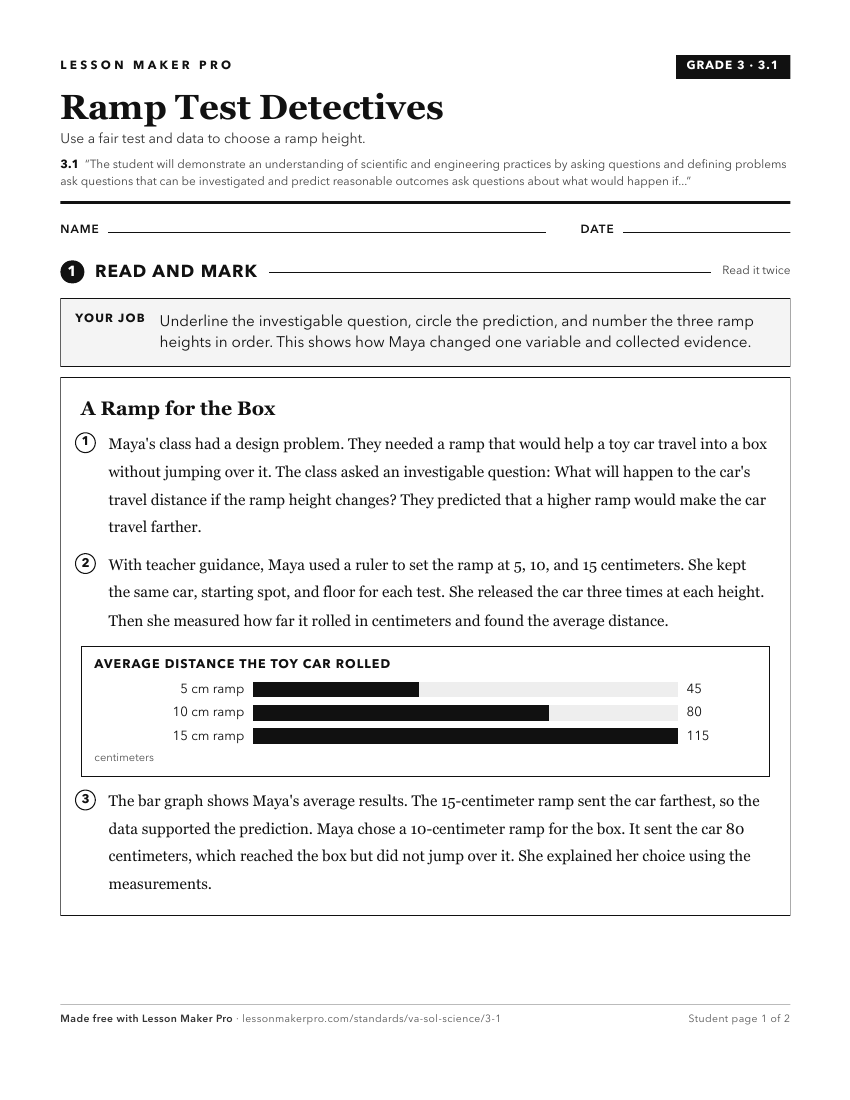
A ready-to-print activity worksheet aligned to 3.1, with an answer key for the teacher on its own page. No account needed.
PDF, US Letter, prints cleanly in black and white.
Download the worksheetKeep exploring
Related Standards
Turn this cluster into a lesson
Grade, subject, topic, and the complete cluster are prefilled. Create one free, no account needed.
Also for this cluster:Make a WorksheetMake a QuizMake a Sub Lesson