Virginia SOL 3.1.b.iii
The Standard
- 3.1
- The student will demonstrate an understanding of scientific and engineering practices by
planning and carrying out investigations estimate length, mass, volume, and temperature
Virginia Standards of Learning for Science · The student will demonstrate an understanding of scientific and engineering practices by
Teacher's field guide
What This Standard Means
What Students Need to Do
- Students make reasonable estimates of length, mass, volume, and temperature before using measuring tools. They choose a suitable unit and use familiar objects or values as benchmarks.
What Mastery Looks Like
- Students give an estimate with a unit and explain the benchmark they used. Their estimates are close enough to the measured values to be reasonable.
Common Misconceptions
- Students may guess without using a benchmark or leave units off their answers. They may confuse mass with volume or choose unreasonable units, such as centimeters for a classroom's length.
How to Assess It
- Show a water bottle, book, pencil, and cup of warm water. Ask students to estimate one relevant measurement for each and name the benchmark they used.
Lesson moves
Ways to Teach It
Set up stations with a string, bag of cubes, filled jar, and water cup, then have students estimate each measurement before checking.
Ask students to write which benchmark would help estimate a desk's length, an apple's mass, a bottle's volume, and room temperature.
Play Benchmark Match by having teams pair measurement cards with reasonable estimates, then explain and revise any mismatches.
Plan a picnic by estimating the cooler's volume, food mass, table length, and outdoor temperature using pictures and familiar benchmarks.
Free download
Printable 3.1.b.iii Worksheet
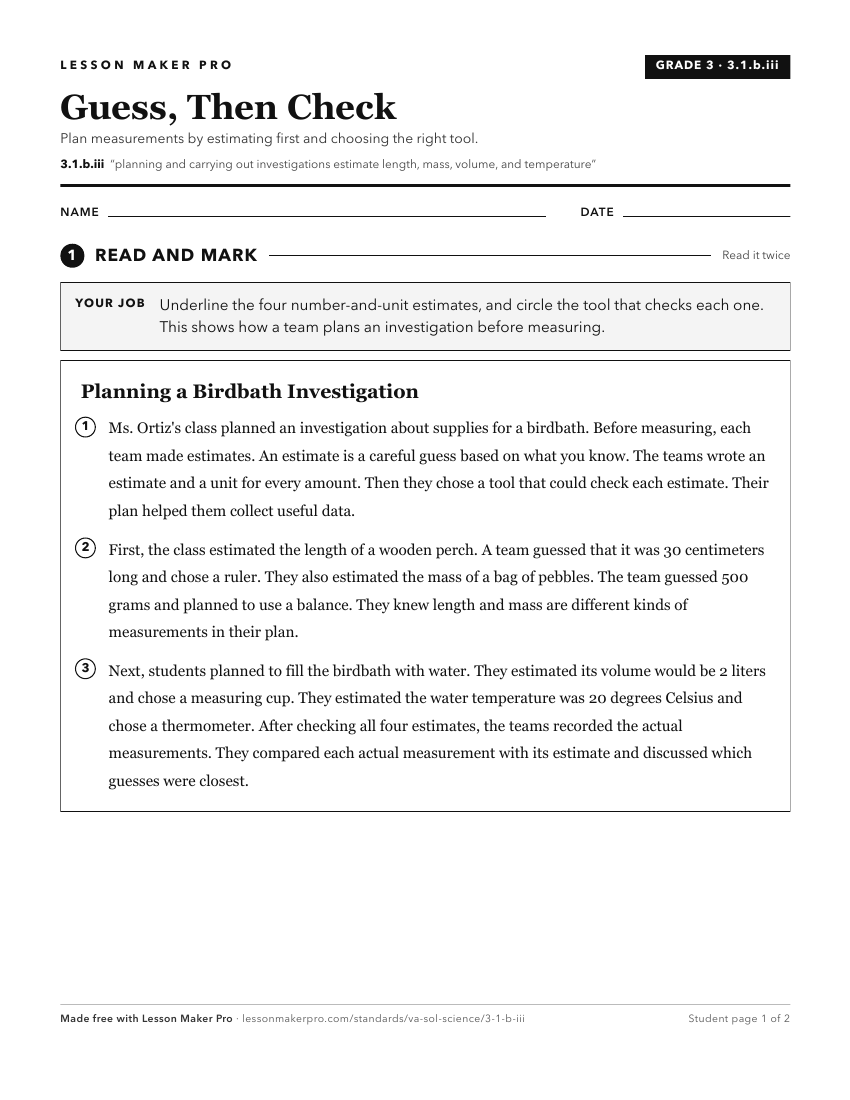
A ready-to-print activity worksheet aligned to 3.1.b.iii, with an answer key for the teacher on its own page. No account needed.
PDF, US Letter, prints cleanly in black and white.
Download the worksheetKeep exploring
Related Standards
- 2.1.b.ii
use appropriate tools to measure length, weight, and temperature of common objects using U.S. Customary units
- 3.1.b.iv
measure length, mass, volume, and temperature in metric and U.S. Customary units using proper tools
- 1.1.b.iii
use tools to measure relative length, weight, volume, and temperature of common objects
- K.1.b.iii
measure the relative length and weight of common objects
Turn this exact standard into a lesson
Grade, subject, topic, and the complete standard are prefilled. Create one free, no account needed.
Also for this standard:Make a WorksheetMake a QuizMake a Sub Lesson