Virginia SOL 1.1.b.iii
The Standard
- 1.1
- The student will demonstrate an understanding of scientific and engineering practices by
planning and carrying out investigations use tools to measure relative length, weight, volume, and temperature of common objects
Virginia Standards of Learning for Science · The student will demonstrate an understanding of scientific and engineering practices by
Teacher's field guide
What This Standard Means
What Students Need to Do
- Students choose a ruler or cubes, a balance, a measuring cup, or a thermometer for the property they need to compare. They measure two common objects and tell which is longer, heavier, holds more, or is warmer. They record the result with numbers, marks, or simple words.
What Mastery Looks Like
- A student picks the tool that matches the question. The student lines up a ruler at zero, places objects on separate balance pans, and reads marked levels on cups or thermometers. The student uses the readings to make an accurate comparison.
Common Misconceptions
- Students may start a ruler at its edge instead of zero, or think the raised balance pan holds the heavier object. They may assume a taller cup always holds more and use touch alone to judge temperature. They may choose a tool based on the object instead of the property being measured.
How to Assess It
- At four mini stations, students compare two pencils with cubes, two erasers on a balance, two water amounts in measuring cups, and two water samples with thermometers. They record longer, heavier, more, or warmer for each pair.
Lesson moves
Ways to Teach It
Set up stations to compare pencil lengths with cubes, eraser weights with a pan balance, water amounts with cups, and temperatures with thermometers.
Ask, “Can a tall cup hold less than a short cup, and how could measuring cups and water prove your answer?”
Play a tool-match relay: teams pair question cards with a ruler, balance, measuring cup, or thermometer, then explain each choice.
Measure two packed lunch bags with a ruler and balance, then choose which one would fit and feel lighter to carry.
Free download
Printable 1.1.b.iii Worksheet
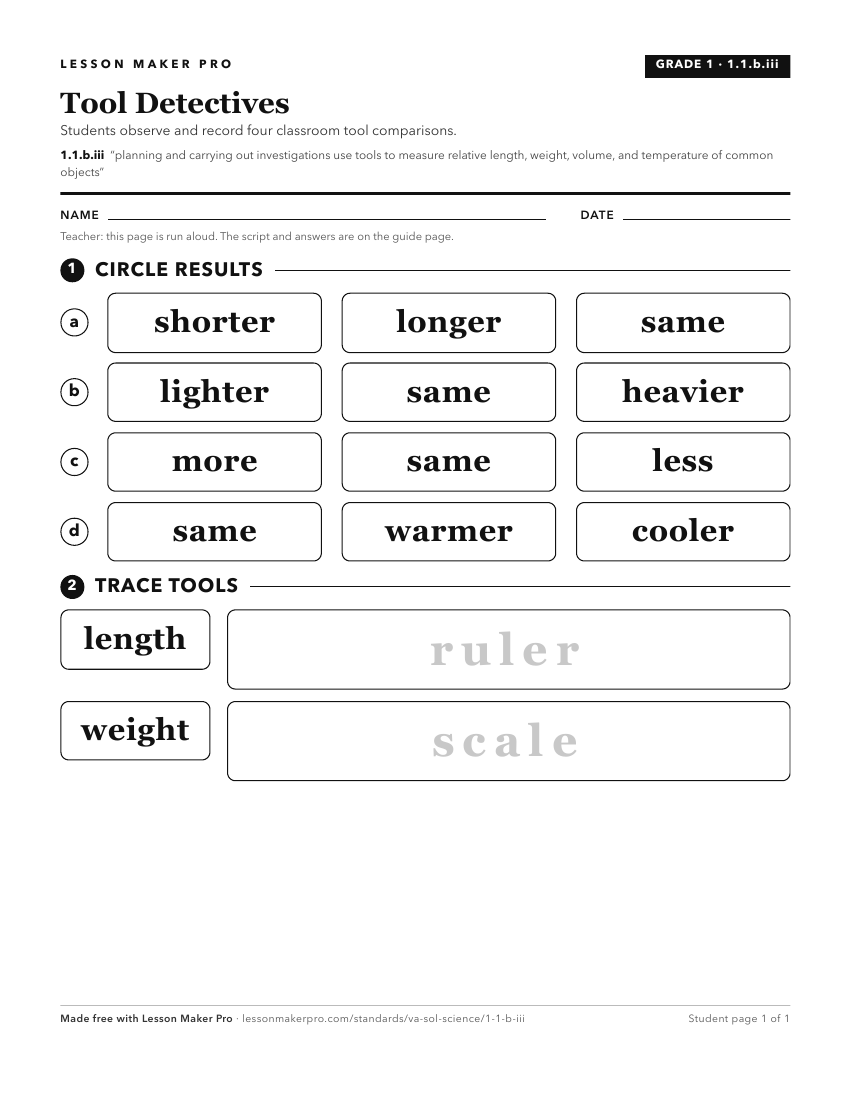
A ready-to-print activity worksheet aligned to 1.1.b.iii, with an answer key for the teacher on its own page. No account needed.
PDF, US Letter, prints cleanly in black and white.
Download the worksheetKeep exploring
Related Standards
- 2.1.b.ii
use appropriate tools to measure length, weight, and temperature of common objects using U.S. Customary units
- 3.1.b.iv
measure length, mass, volume, and temperature in metric and U.S. Customary units using proper tools
- 4.1.b.iv
take metric measurements using appropriate tools
- K.1.b.iii
measure the relative length and weight of common objects
Turn this exact standard into a lesson
Grade, subject, topic, and the complete standard are prefilled. Create one free, no account needed.
Also for this standard:Make a WorksheetMake a QuizMake a Sub Lesson