Virginia SOL 6.1
SOL Standard (Key Ideas Cluster)
The student will demonstrate an understanding of scientific and engineering practices by asking questions and defining problems ask questions to determine relationships between independent and dependent variables develop hypotheses and identify independent and dependent variables offer simple solutions to design problems planning and carrying out investigations independently and collaboratively plan and conduct observational and experimental investigations; identify variables, constants, and controls where appropriate, and include the safe use of chemicals and equipment evaluate the accuracy of various methods for collecting data take metric measurements using appropriate tools use tools and materials to design and/or build a device to solve a specific problem interpreting, analyzing, and evaluating data organize data sets to reveal patterns that suggest relationships construct, analyze, and interpret graphical displays of data compare and contrast data collected by different groups and discuss similarities and differences in findings use data to evaluate and refine design solutions constructing and critiquing conclusions and explanations construct explanations that includes qualitative or quantitative relationships between variables construct scientific explanations based on valid and reliable evidence obtained from sources (including the students’ own investigations) generate and compare multiple solutions to problems based on how well they meet the criteria and constraints developing and using models use scale models to represent and estimate distance use, develop, and revise models to predict and explain phenomena evaluate limitations of models obtaining, evaluating, and communicating information read scientific texts, including those adapted for classroom use, to obtain scientific and/or technical information gather, read, and synthesize information from multiple appropriate sources and assess the credibility, accuracy, and possible bias of each publication construct, use, and/or present an argument supported by empirical evidence and scientific reasoning
Virginia Standards of Learning for Science
Cluster contents
Key Ideas in This Standard
6.1 is a Standards of Learning science standard. These are the key ideas and practices under it.
- 6.1.a
asking questions and defining problems
- 6.1.a.i
ask questions to determine relationships between independent and dependent variables
- 6.1.a.ii
develop hypotheses and identify independent and dependent variables
- 6.1.a.iii
offer simple solutions to design problems
- 6.1.b
planning and carrying out investigations
- 6.1.b.i
independently and collaboratively plan and conduct observational and experimental investigations; identify variables, constants, and controls where appropriate,...
- 6.1.b.ii
evaluate the accuracy of various methods for collecting data
- 6.1.b.iii
take metric measurements using appropriate tools
- 6.1.b.iv
use tools and materials to design and/or build a device to solve a specific problem
- 6.1.c
interpreting, analyzing, and evaluating data
- 6.1.c.i
organize data sets to reveal patterns that suggest relationships
- 6.1.c.ii
construct, analyze, and interpret graphical displays of data
- 6.1.c.iii
compare and contrast data collected by different groups and discuss similarities and differences in findings
- 6.1.c.iv
use data to evaluate and refine design solutions
- 6.1.d
constructing and critiquing conclusions and explanations
- 6.1.d.i
construct explanations that includes qualitative or quantitative relationships between variables
- 6.1.d.ii
construct scientific explanations based on valid and reliable evidence obtained from sources (including the students' own investigations)
- 6.1.d.iii
generate and compare multiple solutions to problems based on how well they meet the criteria and constraints
- 6.1.e
developing and using models
- 6.1.e.i
use scale models to represent and estimate distance
- 6.1.e.ii
use, develop, and revise models to predict and explain phenomena
- 6.1.e.iii
evaluate limitations of models
- 6.1.f
obtaining, evaluating, and communicating information
- 6.1.f.i
read scientific texts, including those adapted for classroom use, to obtain scientific and/or technical information
- 6.1.f.ii
gather, read, and synthesize information from multiple appropriate sources and assess the credibility, accuracy, and possible bias of each publication
- 6.1.f.iii
construct, use, and/or present an argument supported by empirical evidence and scientific reasoning
Teacher's field guide
What This Cluster Means
What Students Need to Do
- Students ask testable questions, define design problems, and plan safe investigations with variables, constants, controls, and metric measurements. They organize and graph data, compare results, and explain patterns with evidence. They also build, test, and revise models or solutions while checking sources for accuracy and bias.
What Mastery Looks Like
- A student can write a testable question and hypothesis, then plan a fair test using suitable tools. The student selects a useful graph and explains relationships using measured evidence. The student can identify model limits and improve a design using stated criteria, constraints, and test data.
Common Misconceptions
- Students may change several factors, label the measured outcome as independent, or confuse constants with a control group. They may choose graphs by appearance, treat every source as trustworthy, or claim results prove a hypothesis. They may view models as exact copies rather than useful representations with limits.
How to Assess It
- Give students a four-row table showing how ramp height affects toy car distance. Ask them to name both variables, identify one constant, sketch a labeled graph, and write an evidence based conclusion.
Lesson moves
Ways to Teach It
Teams test how ramp height affects toy car distance, keep the car and surface constant, measure in centimeters, and graph results.
Give pairs two short articles making the same claim, then ask which source is more credible and what evidence supports that judgment.
Play Variable Sort with cards naming changed factors, measured outcomes, constants, and controls from three investigation scenarios.
Challenge teams to build a foil and cotton sleeve that slows ice melting within ten minutes, then revise it using ice mass data.
Free download
Printable 6.1 Worksheet
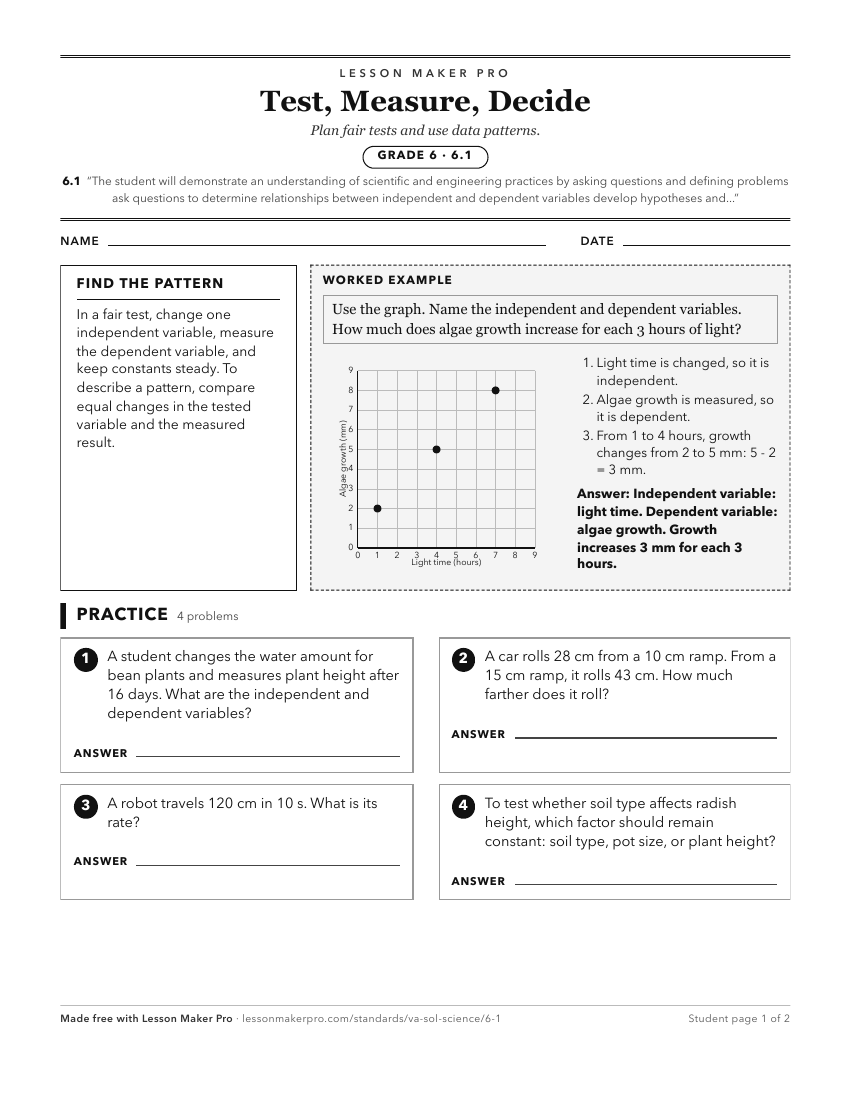
A ready-to-print activity worksheet aligned to 6.1, with an answer key for the teacher on its own page. No account needed.
PDF, US Letter, prints cleanly in black and white.
Download the worksheetKeep exploring
Related Standards
Turn this cluster into a lesson
Grade, subject, topic, and the complete cluster are prefilled. Create one free, no account needed.
Also for this cluster:Make a WorksheetMake a QuizMake a Sub Lesson