Virginia SOL 6.1.e.i
The Standard
- 6.1
- The student will demonstrate an understanding of scientific and engineering practices by
developing and using models use scale models to represent and estimate distance
Virginia Standards of Learning for Science · The student will demonstrate an understanding of scientific and engineering practices by
Teacher's field guide
What This Standard Means
What Students Need to Do
- Students read the scale on a map, diagram, or physical model. They measure between points and use the scale ratio to estimate the actual distance, with correct units.
What Mastery Looks Like
- Given a scale of 1 centimeter to 5 meters, a student can convert a model length of 3.6 centimeters to 18 meters. The student can explain how measurement precision affects the estimate.
Common Misconceptions
- Students may add the scale value instead of multiplying, reverse the ratio, or forget to convert units. They may also assume a model measurement gives an exact actual distance.
How to Assess It
- Give students a map with two points 7.5 centimeters apart and a scale of 1 centimeter to 4 kilometers. Ask for the actual distance and calculation.
Lesson moves
Ways to Teach It
Measure the classroom, then draw a floor plan where 1 centimeter represents 1 meter and label two calculated distances.
Ask students to explain why a small measuring error on a model can create a much larger error in actual distance.
Give teams cards showing model lengths, scales, and actual distances, then race to assemble correct sets.
Use a local road map to estimate the distance from school to a library, park, or fire station.
Free download
Printable 6.1.e.i Worksheet
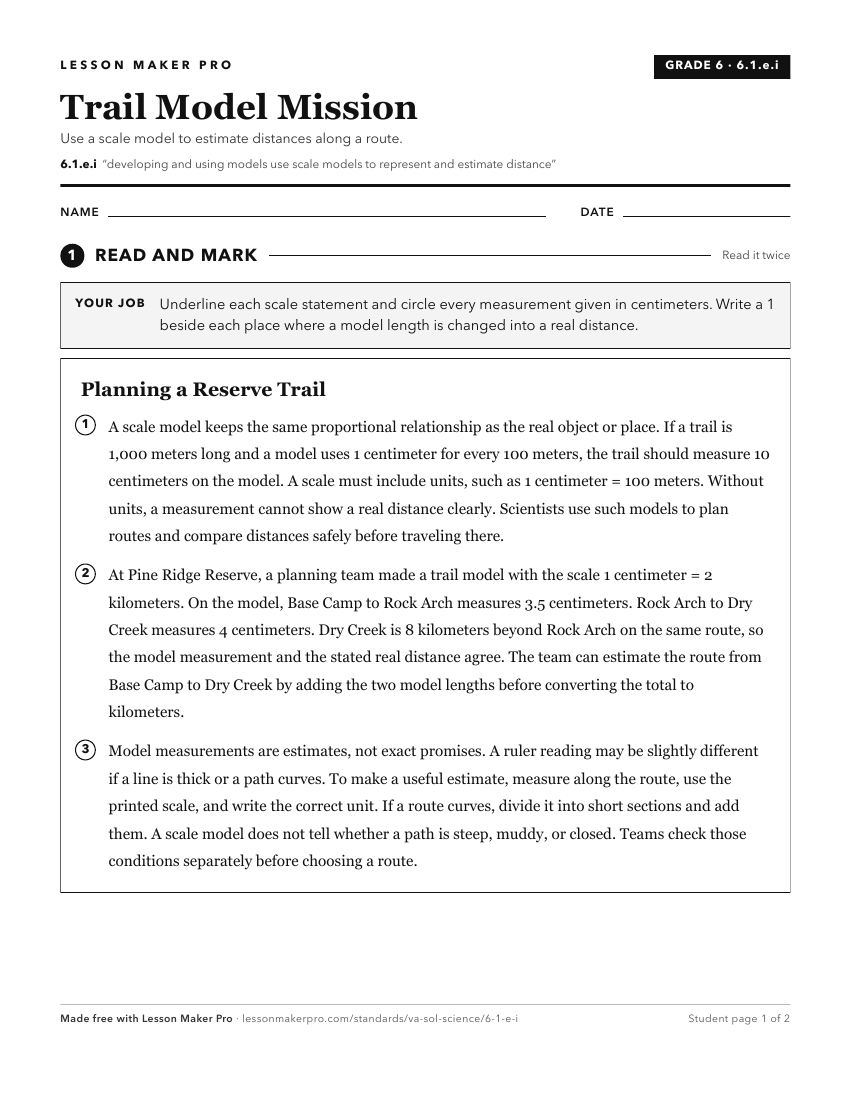
A ready-to-print activity worksheet aligned to 6.1.e.i, with an answer key for the teacher on its own page. No account needed.
PDF, US Letter, prints cleanly in black and white.
Download the worksheetKeep exploring
Related Standards
Turn this exact standard into a lesson
Grade, subject, topic, and the complete standard are prefilled. Create one free, no account needed.
Also for this standard:Make a WorksheetMake a QuizMake a Sub Lesson