Virginia SOL 3.1.b.v
The Standard
- 3.1
- The student will demonstrate an understanding of scientific and engineering practices by
planning and carrying out investigations measure elapsed time
Virginia Standards of Learning for Science · The student will demonstrate an understanding of scientific and engineering practices by
Teacher's field guide
What This Standard Means
What Students Need to Do
- Students choose when to start and stop a timer during an investigation. They record how long an event lasts using suitable units, such as seconds or minutes.
What Mastery Looks Like
- Students use a stopwatch correctly and record repeated trials in a data table. They label units and can compare the recorded durations accurately.
Common Misconceptions
- Students may confuse elapsed time with the clock time shown when an event ends. They may start or stop the timer late, omit units, or mix seconds and minutes.
How to Assess It
- Have each student time a ball rolling down a ramp for three trials, then record the results in seconds and circle the longest trial.
Lesson moves
Ways to Teach It
Time three toy cars traveling down the same ramp, then record each result in a labeled data table.
Ask students to write when a timer should start and stop during an ice-melting investigation.
Play Timer Match by pairing event cards, such as blinking or sharpening a pencil, with reasonable elapsed times.
Time classroom routines, such as lining up or packing bags, and compare results across several days.
Free download
Printable 3.1.b.v Worksheet
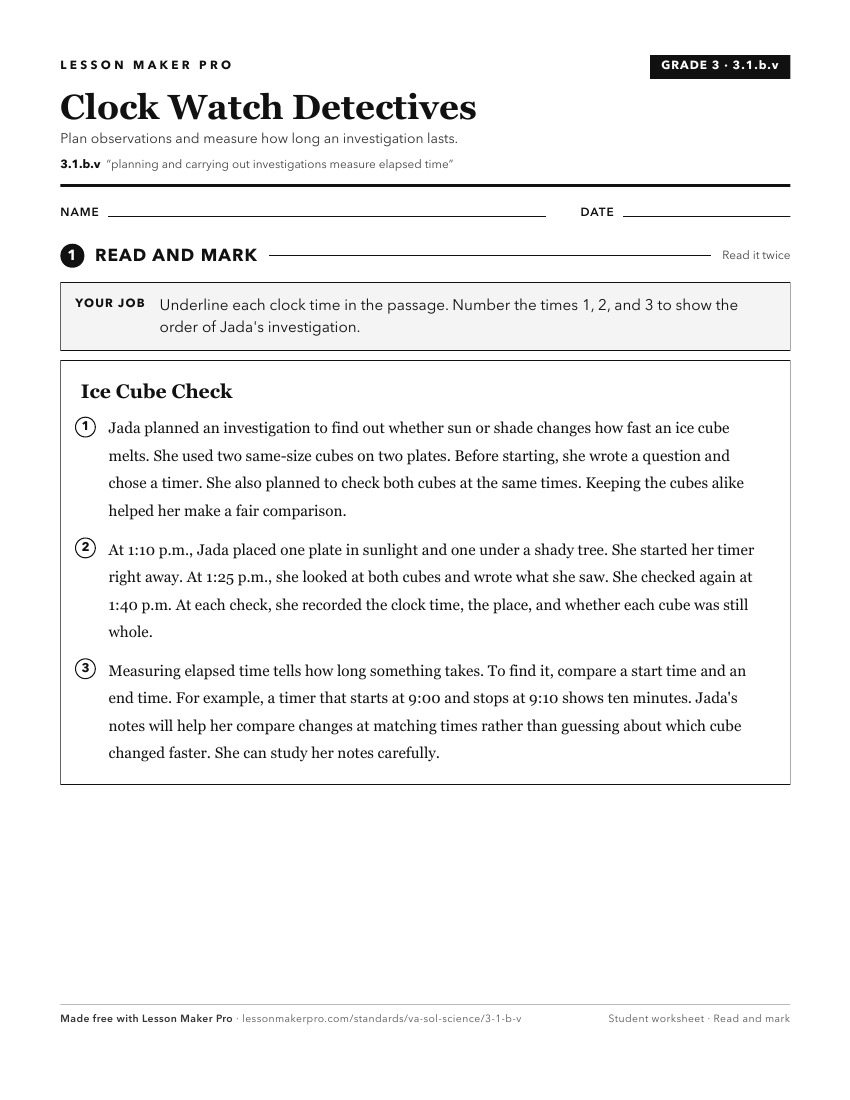
A ready-to-print activity worksheet aligned to 3.1.b.v, with an answer key for the teacher on its own page. No account needed.
PDF, US Letter, prints cleanly in black and white.
Download the worksheetKeep exploring
Related Standards
Turn this exact standard into a lesson
Grade, subject, topic, and the complete standard are prefilled. Create one free, no account needed.
Also for this standard:Make a WorksheetMake a QuizMake a Sub Lesson