Virginia SOL 2.1.b.iii
The Standard
- 2.1
- The student will demonstrate an understanding of scientific and engineering practices by
planning and carrying out investigations measure time intervals using proper tools
Virginia Standards of Learning for Science · The student will demonstrate an understanding of scientific and engineering practices by
Teacher's field guide
What This Standard Means
What Students Need to Do
- Students choose a stopwatch, timer, or clock to measure how long an event lasts. They start and stop the tool at clear points, then record the duration with the correct unit.
What Mastery Looks Like
- Students can plan repeated trials and measure each trial from the same starting and ending points. Their records include sensible durations and labels such as seconds or minutes.
Common Misconceptions
- Students may record the clock time instead of the amount of time that passed. They may start late, stop early, confuse seconds with minutes, or change the start and end points between trials.
How to Assess It
- Ask students to time a partner stacking 10 cubes twice, record both durations in seconds, and explain when they started and stopped the timer.
Lesson moves
Ways to Teach It
Release a toy car down a ramp three times, timing each run with a stopwatch and recording the results in seconds.
Ask students to write which tool they would use to time a sneeze, a song, and recess, then explain each choice.
Play Timer Match by pairing event cards with tool and unit cards, such as stopwatch and seconds for tying a shoe.
Time a classroom cleanup, compare the duration across three days, and discuss what changed while keeping the starting and ending points the same.
Free download
Printable 2.1.b.iii Worksheet
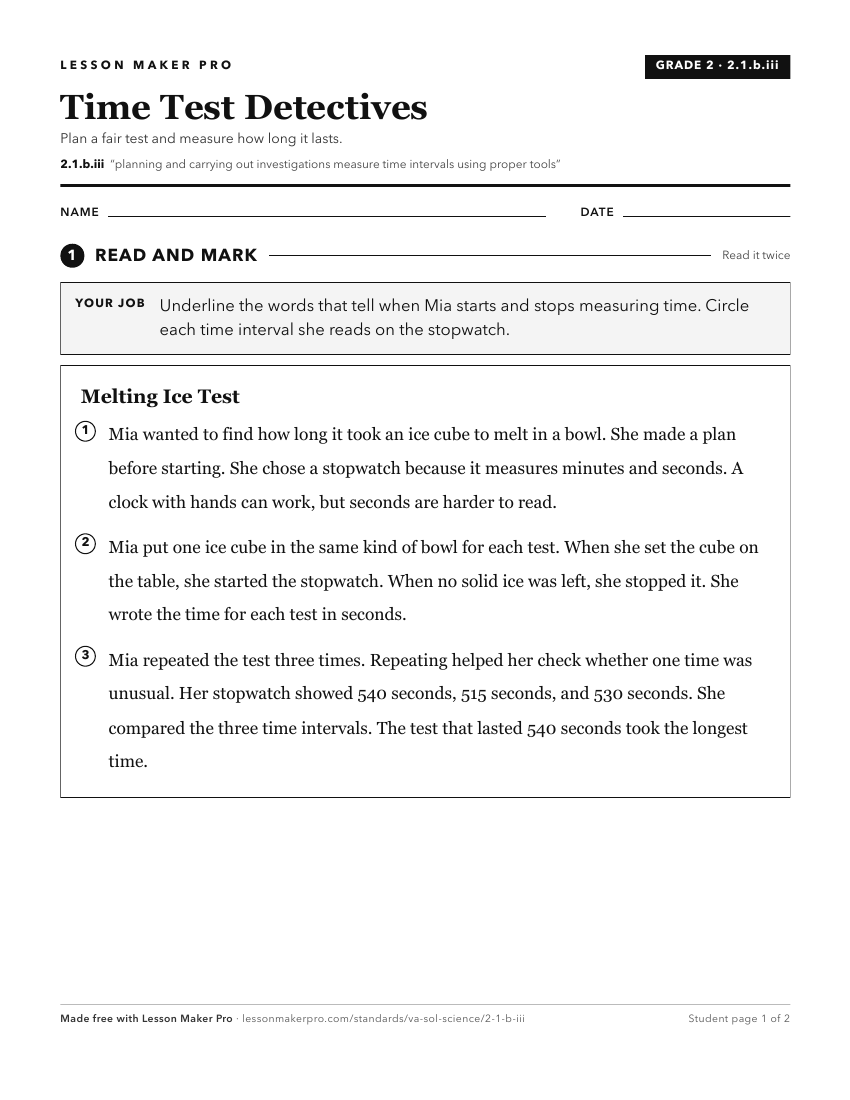
A ready-to-print activity worksheet aligned to 2.1.b.iii, with an answer key for the teacher on its own page. No account needed.
PDF, US Letter, prints cleanly in black and white.
Download the worksheetKeep exploring
Related Standards
Turn this exact standard into a lesson
Grade, subject, topic, and the complete standard are prefilled. Create one free, no account needed.
Also for this standard:Make a WorksheetMake a QuizMake a Sub Lesson