Virginia SOL 3.1.b
SOL Standard (Key Ideas Cluster)
- 3.1
- The student will demonstrate an understanding of scientific and engineering practices by
planning and carrying out investigations with guidance, plan and conduct investigations use appropriate methods and/or tools for collecting data estimate length, mass, volume, and temperature measure length, mass, volume, and temperature in metric and U.S. Customary units using proper tools measure elapsed time use tools and/or materials to design and/or build a device that solves a specific problem
Virginia Standards of Learning for Science · The student will demonstrate an understanding of scientific and engineering practices by
Cluster contents
Key Ideas in This Standard
3.1.b is a Standards of Learning science standard. These are the key ideas and practices under it.
- 3.1.b.i
with guidance, plan and conduct investigations
- 3.1.b.ii
use appropriate methods and/or tools for collecting data
- 3.1.b.iii
estimate length, mass, volume, and temperature
- 3.1.b.iv
measure length, mass, volume, and temperature in metric and U.S. Customary units using proper tools
- 3.1.b.v
measure elapsed time
- 3.1.b.vi
use tools and/or materials to design and/or build a device that solves a specific problem
Teacher's field guide
What This Cluster Means
What Students Need to Do
- Students turn a testable question into a simple plan with teacher guidance, then choose safe methods, materials, and tools. They estimate and measure length, mass, liquid volume, temperature, and elapsed time, recording numbers with correct units. They also use materials and test data to build or improve a device for a stated problem.
What Mastery Looks Like
- A student can explain what will change, what will be observed, and how results will be recorded. The student selects the correct measuring tool, makes a reasonable estimate, and reports a careful measurement with units. During a design task, the student builds, tests, identifies a weakness, and makes a useful change.
Common Misconceptions
- Students may choose a familiar tool instead of one that measures the needed property, such as using a ruler for volume. They often mix units, read a scale from the wrong starting point, or confuse elapsed time with the clock's ending time. Some begin building without defining the problem, or change several test conditions and cannot tell what caused the result.
How to Assess It
- Exit ticket: A paper bridge must hold pennies for 30 seconds. Name the tools and units, estimate how many pennies it will hold, and write a fair three-step test.
Lesson moves
Ways to Teach It
Set up stations where students estimate and measure a pencil’s length, clay’s mass, water’s volume, water temperature, and a one-minute interval.
Ask, "Which tool would give the best evidence for comparing two ice-melting containers, and what data should we record?"
Play Tool Match: teams pair measurement cards with rulers, balances, graduated cylinders, thermometers, or timers, then justify each unit.
Build a lunchbox liner from foil, paper, and fabric, then test which design keeps an ice cube cold longest.
Free download
Printable 3.1.b Worksheet
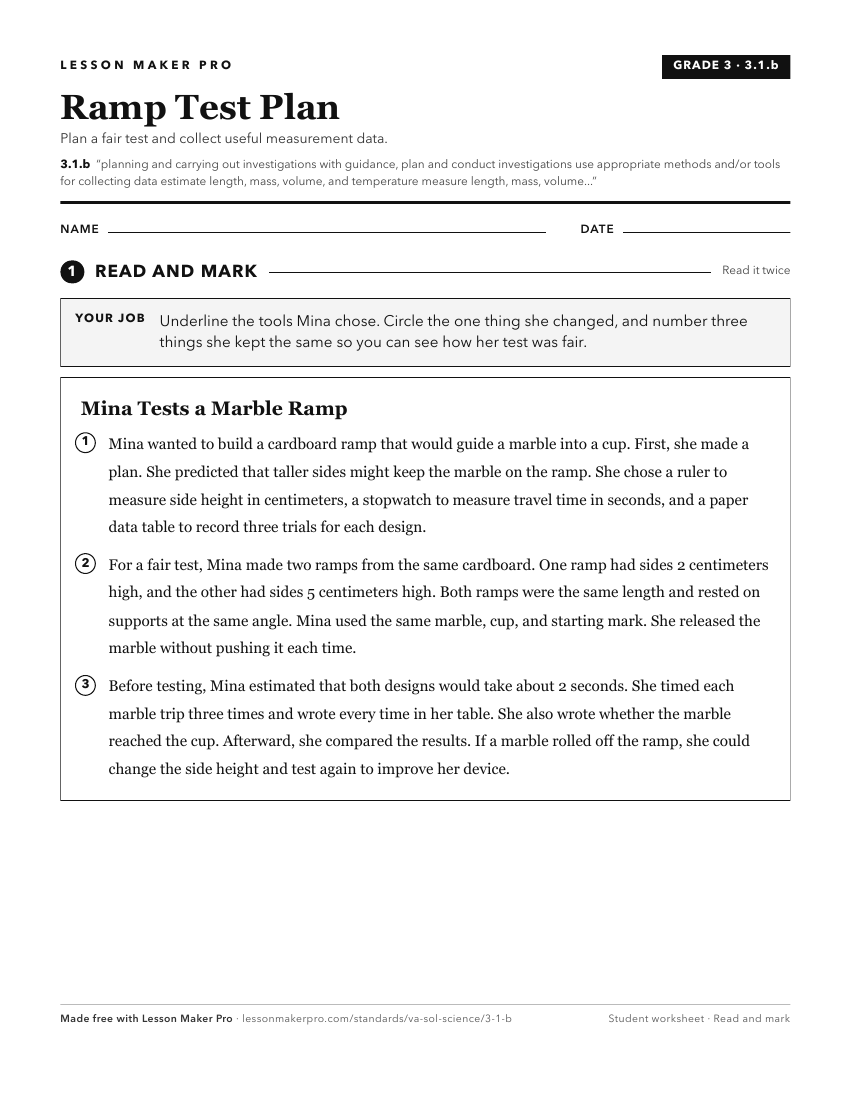
A ready-to-print activity worksheet aligned to 3.1.b, with an answer key for the teacher on its own page. No account needed.
PDF, US Letter, prints cleanly in black and white.
Download the worksheetKeep exploring
Related Standards
Turn this cluster into a lesson
Grade, subject, topic, and the complete cluster are prefilled. Create one free, no account needed.
Also for this cluster:Make a WorksheetMake a QuizMake a Sub Lesson