Virginia SOL PS.1.b
SOL Standard (Key Ideas Cluster)
- PS.1
- The student will demonstrate an understanding of scientific and engineering practices by
planning and carrying out investigations independently and collaboratively plan and conduct observational and experimental investigations; identify variables, constants, and controls where appropriate and include the safe use of chemicals and equipment evaluate the accuracy of various methods for collecting data take metric measurements using appropriate tools and technologies apply scientific ideas or principles to design, construct, and/or test a design of an object, tool, process or system
Virginia Standards of Learning for Science · The student will demonstrate an understanding of scientific and engineering practices by
Cluster contents
Key Ideas in This Standard
PS.1.b is a Standards of Learning science standard. These are the key ideas and practices under it.
- PS.1.b.i
independently and collaboratively plan and conduct observational and experimental investigations; identify variables, constants, and controls where appropriate ...
- PS.1.b.ii
evaluate the accuracy of various methods for collecting data
- PS.1.b.iii
take metric measurements using appropriate tools and technologies
- PS.1.b.iv
apply scientific ideas or principles to design, construct, and/or test a design of an object, tool, process or system
Teacher's field guide
What This Cluster Means
What Students Need to Do
- Students turn a testable question into a safe, fair investigation they can carry out alone or with a team. They identify variables, constants, and a control when one fits, then collect metric data with suitable tools. They judge whether a method gives accurate data and use science ideas to build, test, and revise a solution.
What Mastery Looks Like
- A student writes a repeatable procedure that changes one factor and explains what will be measured. The student uses equipment safely, records metric measurements with units, repeats trials, and spots weak data collection methods. Given a design problem, the student tests a solution and uses evidence to suggest a change.
Common Misconceptions
- Students may call every unchanged factor a control instead of distinguishing constants from a comparison group. They may change several factors, complete only one trial, or record measurements without units. They may choose a familiar tool and assume every digital reading is accurate.
How to Assess It
- Exit ticket: “You are testing whether water temperature changes how fast a tablet dissolves. Name the variables, two constants, a control, a metric tool, a safety step, and one way to improve accuracy.”
Lesson moves
Ways to Teach It
Teams test how ramp height affects toy-car distance, measure in centimeters, keep the car and surface constant, and compare repeated trials.
Ask students to compare a ruler and phone measurement app: Which gives more accurate length data, and what evidence supports that claim?
Run a card sort where students label scenarios as independent variable, dependent variable, constant, control, tool, or safety step.
Students design and test a foil-and-felt cup sleeve, recording water temperature every two minutes and revising the sleeve from their data.
Free download
Printable PS.1.b Worksheet
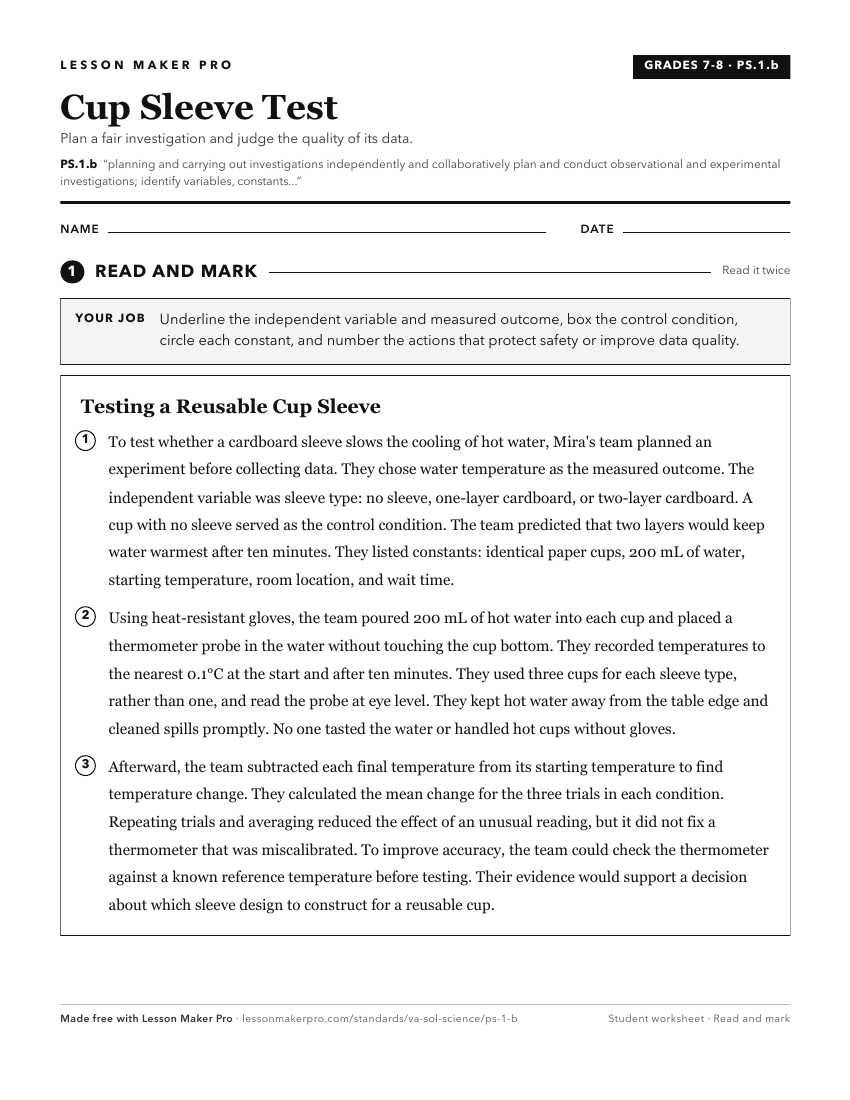
A ready-to-print activity worksheet aligned to PS.1.b, with an answer key for the teacher on its own page. No account needed.
PDF, US Letter, prints cleanly in black and white.
Download the worksheetKeep exploring
Related Standards
Turn this cluster into a lesson
Grade, subject, topic, and the complete cluster are prefilled. Create one free, no account needed.
Also for this cluster:Make a WorksheetMake a QuizMake a Sub Lesson