Virginia SOL 3.1.d.iii
The Standard
- 3.1
- The student will demonstrate an understanding of scientific and engineering practices by
constructing and critiquing conclusions and explanations describe how scientific ideas apply to design solutions
Virginia Standards of Learning for Science · The student will demonstrate an understanding of scientific and engineering practices by
Teacher's field guide
What This Standard Means
What Students Need to Do
- Students use test results to explain why a design works or fails. They connect each design choice to a science idea and point out weak or unsupported explanations.
What Mastery Looks Like
- Students name the science idea used in a design and cite test evidence. They can compare two explanations and identify which one fits the evidence better.
Common Misconceptions
- Students may describe what a design looks like instead of explaining how it works. They may choose the best result without citing evidence or reject a claim simply because they disagree.
How to Assess It
- Give students this exit prompt: “A sloped gutter moved more water than a flat gutter. Explain why the sloped design worked better, using a science idea and evidence.”
Lesson moves
Ways to Teach It
Build and test flat and folded paper bridges, then explain how each shape affects the number of blocks the bridge holds.
Write a response to this prompt: Which lunchbox lining best slows ice melting, and what science idea supports your choice?
Play a card match game pairing design solutions with science ideas, then have partners challenge any match that lacks a clear explanation.
Examine a school gutter and explain how its slope uses gravity to move rainwater away from the building.
Free download
Printable 3.1.d.iii Worksheet
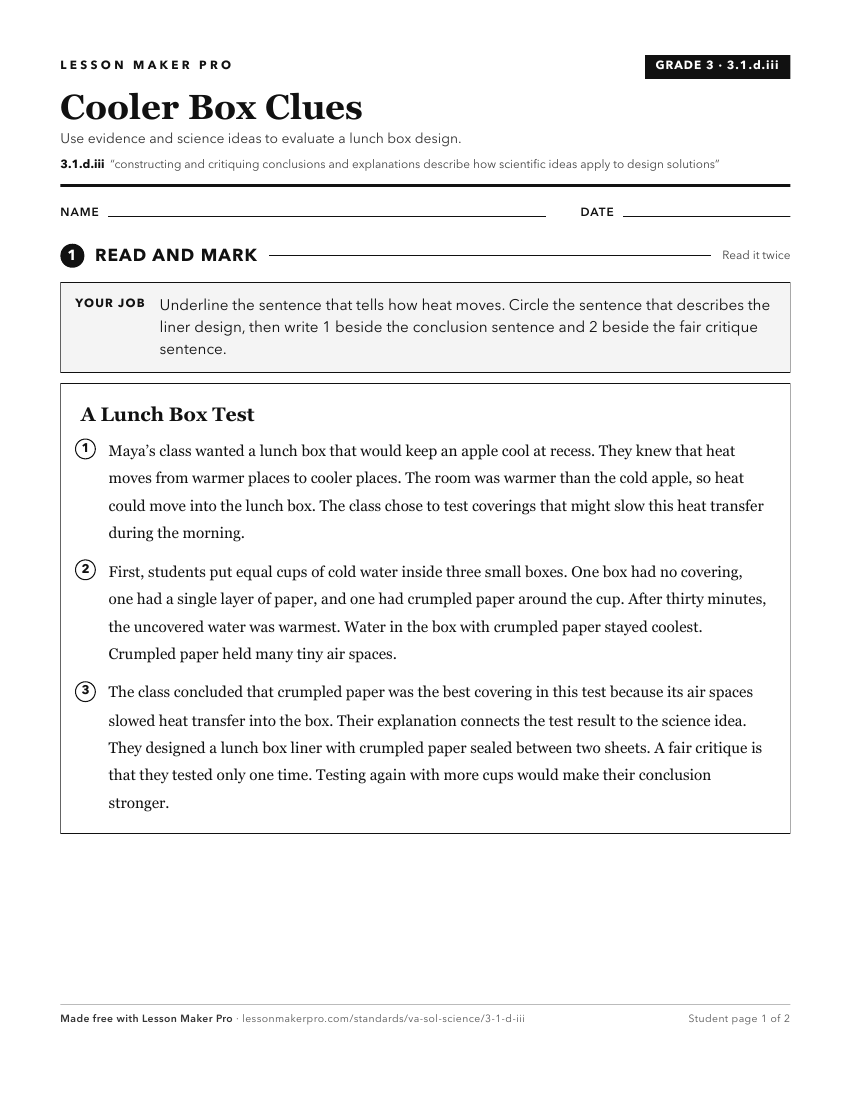
A ready-to-print activity worksheet aligned to 3.1.d.iii, with an answer key for the teacher on its own page. No account needed.
PDF, US Letter, prints cleanly in black and white.
Download the worksheetKeep exploring
Related Standards
- 6.1.c.iv
use data to evaluate and refine design solutions
- PS.1.b.iv
apply scientific ideas or principles to design, construct, and/or test a design of an object, tool, process or system
- 5.1.d.ii
describe how scientific ideas apply to design solutions
- LS.1.c.v
use data to evaluate and refine design solutions
Turn this exact standard into a lesson
Grade, subject, topic, and the complete standard are prefilled. Create one free, no account needed.
Also for this standard:Make a WorksheetMake a QuizMake a Sub Lesson