Virginia SOL LS.1.d
SOL Standard (Key Ideas Cluster)
- LS.1
- The student will demonstrate an understanding of scientific and engineering practices by
constructing and critiquing conclusions and explanations construct explanations that include qualitative or quantitative relationships between variables construct scientific explanations based on valid and reliable evidence obtained from sources (including the students’ own investigations) differentiate between a scientific hypothesis and theory
Virginia Standards of Learning for Science · The student will demonstrate an understanding of scientific and engineering practices by
Cluster contents
Key Ideas in This Standard
LS.1.d is a Standards of Learning science standard. These are the key ideas and practices under it.
- LS.1.d.i
construct explanations that include qualitative or quantitative relationships between variables
- LS.1.d.ii
construct scientific explanations based on valid and reliable evidence obtained from sources (including the students' own investigations)
- LS.1.d.iii
differentiate between a scientific hypothesis and theory
Teacher's field guide
What This Cluster Means
What Students Need to Do
- Students explain how one variable affects another using observations, measurements, graphs, or data tables. They support explanations with reliable evidence from investigations and other sources. They critique conclusions and distinguish a testable hypothesis from a well-supported scientific theory.
What Mastery Looks Like
- Students identify a relationship between variables, cite specific evidence, and explain how the evidence supports a conclusion. They spot claims that exceed the data or rely on weak sources. They know a theory is not simply a guess or a proven hypothesis.
Common Misconceptions
- Students often treat a theory as an unsupported guess and think hypotheses become theories after enough testing. They may assume correlation proves causation or choose only data that support their claim. Some repeat results without explaining the relationship between variables.
How to Assess It
- Exit ticket: Plants receiving eight hours of light averaged 14 cm, while plants receiving four hours averaged 9 cm across three trials. Explain the relationship, critique the claim “light always determines growth,” name one reliability check, and classify the claim as a hypothesis or theory.
Lesson moves
Ways to Teach It
Grow seedlings under two light conditions, measure height for one week, and write an evidence-based explanation of the results.
Discuss why the germ theory of disease is not a guess, then write two sentences distinguishing theories from hypotheses.
Play a card sort matching claims, evidence, variable relationships, hypotheses, and theories, then defend disputed matches.
Compare two health product advertisements, check their evidence sources, and identify which conclusions are supported by the reported data.
Free download
Printable LS.1.d Worksheet
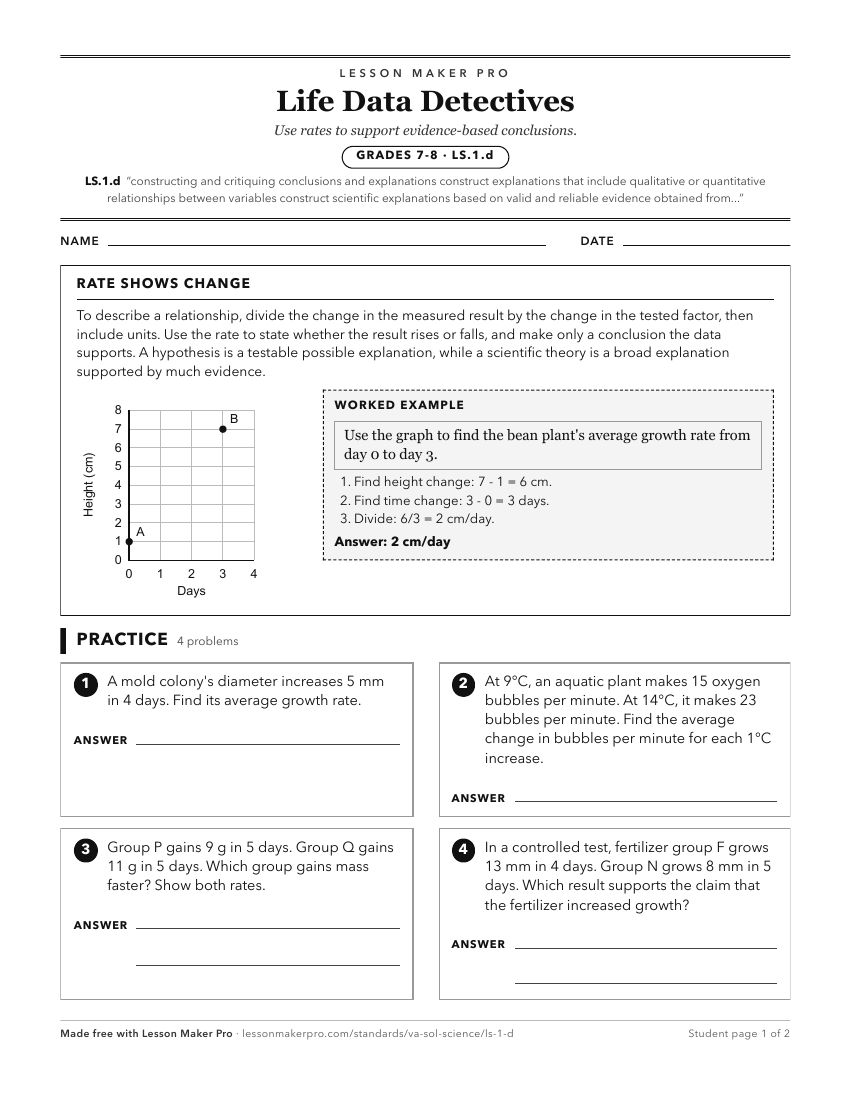
A ready-to-print activity worksheet aligned to LS.1.d, with an answer key for the teacher on its own page. No account needed.
PDF, US Letter, prints cleanly in black and white.
Download the worksheetKeep exploring
Related Standards
Turn this cluster into a lesson
Grade, subject, topic, and the complete cluster are prefilled. Create one free, no account needed.
Also for this cluster:Make a WorksheetMake a QuizMake a Sub Lesson