TEKS ELAR K.2
Knowledge and Skills Statement (Standard Cluster)
The student develops word structure knowledge through phonological awareness, print concepts, phonics, and morphology to communicate, decode, and spell.
Texas Essential Knowledge and Skills for English Language Arts and Reading
Cluster contents
Student Expectations in This Statement
K.2 is a knowledge and skills statement. These are the student expectations under it.
- K.2.A.i
identifying and producing rhyming words
- K.2.A.ii
recognizing spoken alliteration or groups of words that begin with the same spoken onset or initial sound
- K.2.A.iii
identifying the individual words in a spoken sentence
- K.2.A.iv
identifying syllables in spoken words
- K.2.A.ix
manipulating syllables within a multisyllabic word
- K.2.A.v
blending syllables to form multisyllabic words
- K.2.A.vi
segmenting multisyllabic words into syllables
- K.2.A.vii
blending spoken onsets and rimes to form simple words
- K.2.A.viii
blending spoken phonemes to form one-syllable words
- K.2.A.x
segmenting spoken one-syllable words into individual phonemes
- K.2.B.i
identifying and matching the common sounds that letters represent
- K.2.B.ii
using letter-sound relationships to decode, including VC, CVC, CCVC, and CVCC words
- K.2.B.iii
recognizing that new words are created when letters are changed, added, or deleted such as it - pit - tip - tap
- K.2.B.iv
identifying and reading at least 25 high-frequency words from a research-based list
- K.2.C.i
spelling words with VC, CVC, and CCVC
- K.2.C.ii
spelling words using sound-spelling patterns
- K.2.C.iii
spelling high-frequency words from a research-based list
- K.2.D.i
identifying the front cover, back cover, and title page of a book
- K.2.D.ii
holding a book right side up, turning pages correctly, and knowing that reading moves from top to bottom and left to right with return sweep
- K.2.D.iii
recognizing that sentences are comprised of words separated by spaces and recognizing word boundaries
- K.2.D.iv
recognizing the difference between a letter and a printed word
- K.2.D.v
identifying all uppercase and lowercase letters
- K.2.E
develop handwriting by accurately forming all uppercase and lowercase letters using appropriate directionality.
Teacher's field guide
What This Cluster Means
What Students Need to Do
- Students listen for rhymes, beginning sounds, words, syllables, and individual sounds in speech. They connect sounds to letters to read and spell simple words. They also track print, handle books, recognize common words, and form uppercase and lowercase letters.
What Mastery Looks Like
- A student can hear rhymes, syllables, and individual sounds, then blend or separate them accurately. The student uses letter sounds to read and spell simple words, recognizes familiar words, handles books correctly, tracks print, and forms letters clearly.
Common Misconceptions
- Students may confuse letter names with letter sounds or treat a whole syllable as one sound. They may guess words from pictures, overlook spaces, reverse tracking direction, or form letters from the wrong starting point.
How to Assess It
- Say “sunset” and ask the student to clap its parts, then say /m/ /a/ /p/ and ask the student to blend and write the word. Show a short sentence and ask the student to track each word while reading.
Lesson moves
Ways to Teach It
Give students letter tiles to build cat, then change one tile at a time to make cap, clap, and clip.
Say three rhyming words and one odd word, then ask students to name the odd word and explain their choice.
Play syllable hopscotch: say a word, and students jump once for each syllable before blending the parts aloud.
During a classroom sign hunt, students find labels, point to spaces and letters, and read familiar words such as stop or exit.
Free download
Printable K.2 Worksheet
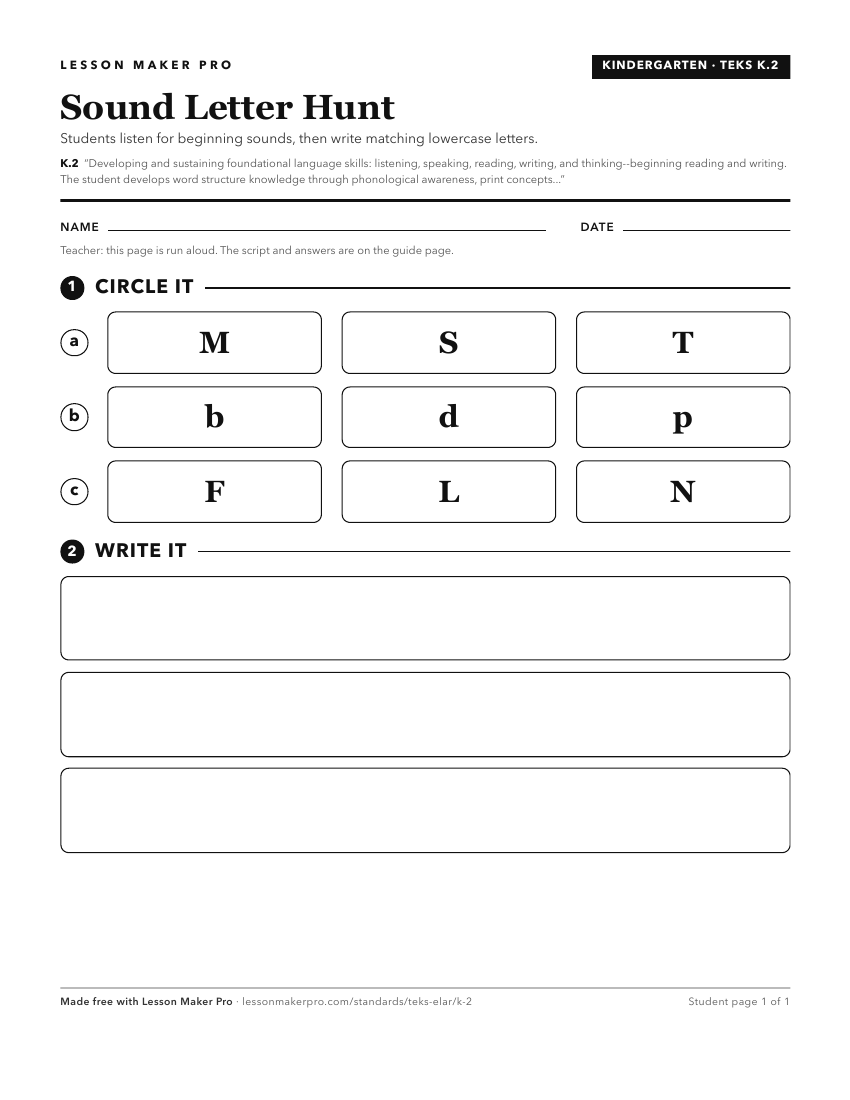
A ready-to-print activity worksheet aligned to K.2, with an answer key for the teacher on its own page. No account needed.
PDF, US Letter, prints cleanly in black and white.
Download the worksheetKeep exploring
Related Standards
Turn this cluster into a lesson
Grade, subject, topic, and the complete cluster are prefilled. Create one free, no account needed.
Also for this cluster:Make a WorksheetMake a QuizMake a Sub Lesson