TEKS ELAR K.2.E
The Standard
develop handwriting by accurately forming all uppercase and lowercase letters using appropriate directionality.
Texas Essential Knowledge and Skills for English Language Arts and Reading
Teacher's field guide
What This Standard Means
What Students Need to Do
- Students write all uppercase and lowercase letters with recognizable shapes. They begin each letter in the correct place and move the pencil in the correct direction.
What Mastery Looks Like
- Students form every uppercase and lowercase letter clearly and from the correct starting point. Their strokes move in the expected direction, and letters sit correctly on writing lines.
Common Misconceptions
- Students may reverse letters such as b, d, p, and q. They may start strokes at the bottom, mix uppercase and lowercase forms, or ignore writing lines.
How to Assess It
- Give students a blank alphabet strip and lined paper. Ask them to write five named uppercase letters and five named lowercase letters, then check formation and stroke direction.
Lesson moves
Ways to Teach It
Build letters with craft sticks and curved yarn, then trace each shape with one finger in the correct direction.
Ask students to write one uppercase and lowercase letter, then explain where each letter starts and how the pencil moves.
Play letter formation bingo by calling a letter for students to write correctly in the matching uppercase or lowercase box.
Create classroom name tags, checking that each name begins with a clear uppercase letter followed by correctly formed lowercase letters.
Free download
Printable K.2.E Worksheet
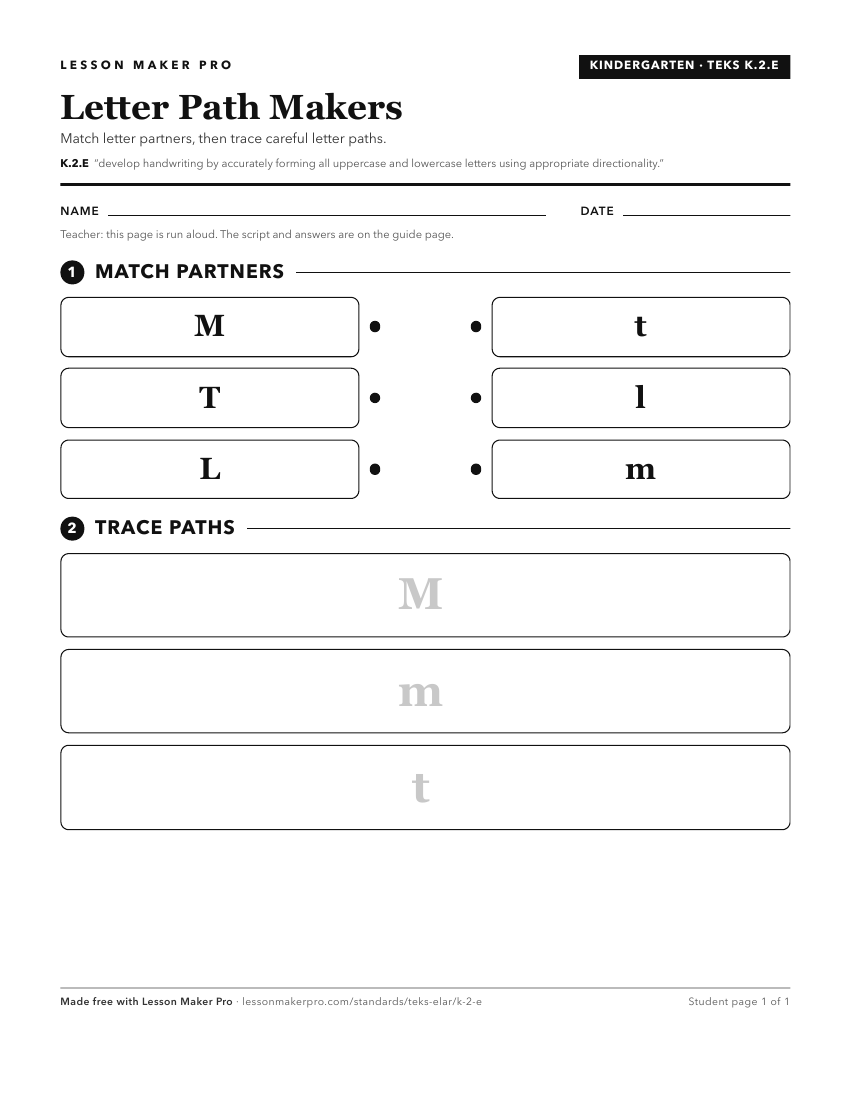
A ready-to-print activity worksheet aligned to K.2.E, with an answer key for the teacher on its own page. No account needed.
PDF, US Letter, prints cleanly in black and white.
Download the worksheetKeep exploring
Related Standards
- 1.2.F
develop handwriting by printing words, sentences, and answers legibly leaving appropriate spaces between words.
- 4.2.C
write legibly in cursive to complete assignments.
- 2.2.E
develop handwriting by accurately forming all cursive letters using appropriate strokes when connecting letters.
- 3.2.D
write complete words, thoughts, and answers legibly in cursive leaving appropriate spaces between words.
Turn this exact standard into a lesson
Grade, subject, topic, and the complete standard are prefilled. Create one free, no account needed.
Also for this standard:Make a WorksheetMake a QuizMake a Sub Lesson