TEKS ELAR 1.2
Knowledge and Skills Statement (Standard Cluster)
The student develops word structure knowledge through phonological awareness, print concepts, phonics, and morphology to communicate, decode, and spell.
Texas Essential Knowledge and Skills for English Language Arts and Reading
Cluster contents
Student Expectations in This Statement
1.2 is a knowledge and skills statement. These are the student expectations under it.
- 1.2.A.i
producing a series of rhyming words
- 1.2.A.ii
recognizing spoken alliteration or groups of words that begin with the same spoken onset or initial sound
- 1.2.A.iii
distinguishing between long and short vowel sounds in one-syllable words
- 1.2.A.iv
recognizing the change in spoken word when a specified phoneme is added, changed, or removed
- 1.2.A.v
blending spoken phonemes to form one-syllable words, including initial and/or final consonant blends
- 1.2.A.vi
manipulating phonemes within base words
- 1.2.A.vii
segmenting spoken one-syllable words of three to five phonemes into individual phonemes, including words with initial and/or final consonant blends
- 1.2.B.i
decoding words in isolation and in context by applying common letter sound correspondences
- 1.2.B.ii
decoding words with initial and final consonant blends, digraphs, and trigraphs
- 1.2.B.iii
decoding words with closed syllables; open syllables; VCe syllables; vowel teams, including vowel digraphs and diphthongs; and r-controlled syllables
- 1.2.B.iv
using knowledge of base words to decode common compound words and contractions
- 1.2.B.v
decoding words with inflectional endings, including -ed, -s, and -es
- 1.2.B.vi
identifying and reading at least 100 high-frequency words from a research-based list
- 1.2.C.i
spelling words with closed syllables, open syllables, VCe syllables, vowel teams, and r-controlled syllables
- 1.2.C.ii
spelling words with initial and final consonant blends, digraphs, and trigraphs
- 1.2.C.iii
spelling words using sound-spelling patterns
- 1.2.C.iv
spelling high-frequency words from a research-based list
- 1.2.D
demonstrate print awareness by identifying the information that different parts of a book provide
- 1.2.E
alphabetize a series of words to the first or second letter and use a dictionary to find words
- 1.2.F
develop handwriting by printing words, sentences, and answers legibly leaving appropriate spaces between words.
Teacher's field guide
What This Cluster Means
What Students Need to Do
- Students recognize rhymes and beginning sounds, then blend, segment, and change sounds in one-syllable words. They use spelling patterns, word parts, and high-frequency words to read and spell. They also use book parts, alphabetical order, dictionaries, and clear handwriting with spaces.
What Mastery Looks Like
- A student can build, read, and spell words such as ship, clap, bike, rain, her, jumped, and can't. The student can explain a sound change, read common words automatically, locate a dictionary word, and write a spaced, legible sentence.
Common Misconceptions
- Students may name letters instead of saying sounds, treat a blend as one sound, or count the letters in ship rather than its three phonemes. They may apply one vowel rule to every word, omit endings, confuse contractions with compounds, or alphabetize only by the first letter.
How to Assess It
- Give each student the spoken word clap. Have them segment it, change /k/ to /s/, read hope, rain, and jumped, spell bird, alphabetize cat, cup, and dog, then write a sentence using cup.
Lesson moves
Ways to Teach It
Use counters in sound boxes, then letter tiles, to build, segment, blend, and change words such as stop, ship, and cake.
Have students explain aloud how adding silent e changes cap to cape, then write and illustrate one matching word pair.
Play a card sort where students group words by closed, open, VCe, vowel team, or r-controlled pattern and read each group.
Use a classroom dictionary to find lunch, then copy its guide words and write a spaced sentence for a class lunch menu.
Free download
Printable 1.2 Worksheet
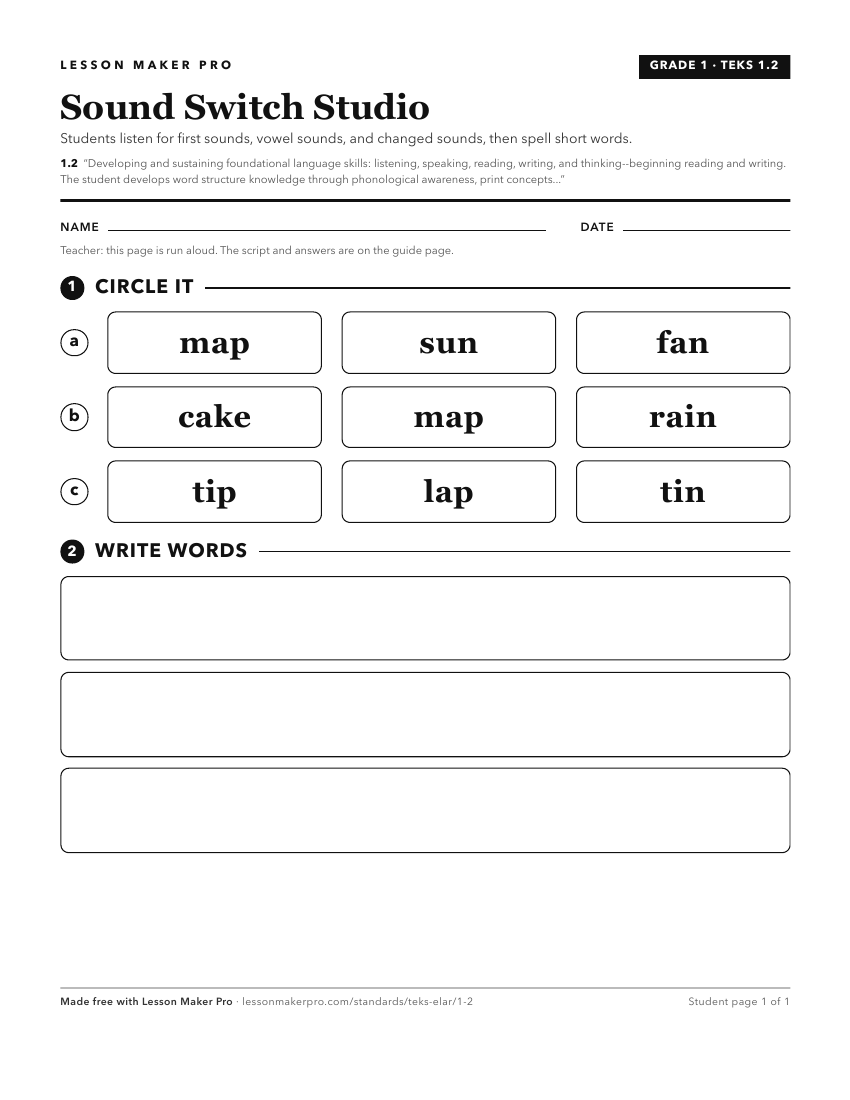
A ready-to-print activity worksheet aligned to 1.2, with an answer key for the teacher on its own page. No account needed.
PDF, US Letter, prints cleanly in black and white.
Download the worksheetKeep exploring
Related Standards
Turn this cluster into a lesson
Grade, subject, topic, and the complete cluster are prefilled. Create one free, no account needed.
Also for this cluster:Make a WorksheetMake a QuizMake a Sub Lesson