TEKS ELAR 1.2.D
The Standard
demonstrate print awareness by identifying the information that different parts of a book provide
Texas Essential Knowledge and Skills for English Language Arts and Reading
Teacher's field guide
What This Standard Means
What Students Need to Do
- Students identify common parts of a book and tell what information each part gives. They use features such as the cover and table of contents to locate information.
What Mastery Looks Like
- Students point to the cover, title page, and table of contents and name the information each provides. They explain that the author writes and the illustrator creates pictures.
Common Misconceptions
- Students may think the author and illustrator have the same job. They may also expect the cover, title page, and table of contents to provide identical information.
How to Assess It
- Hand students a book and ask, "Show me where you would find the author, illustrator, and chapter starting pages." Have them explain each choice.
Lesson moves
Ways to Teach It
Give pairs a book and sticky notes to label the cover, title page, author, illustrator, and table of contents.
Ask, "Which book part would help you find a chapter quickly, and why?" Let students discuss, then write one sentence.
Play Book Part Hunt by calling out information, such as the author's name, for students to locate and point to quickly.
Compare a cookbook, storybook, and nonfiction book to see which parts help readers find recipes, stories, or facts.
Free download
Printable 1.2.D Worksheet
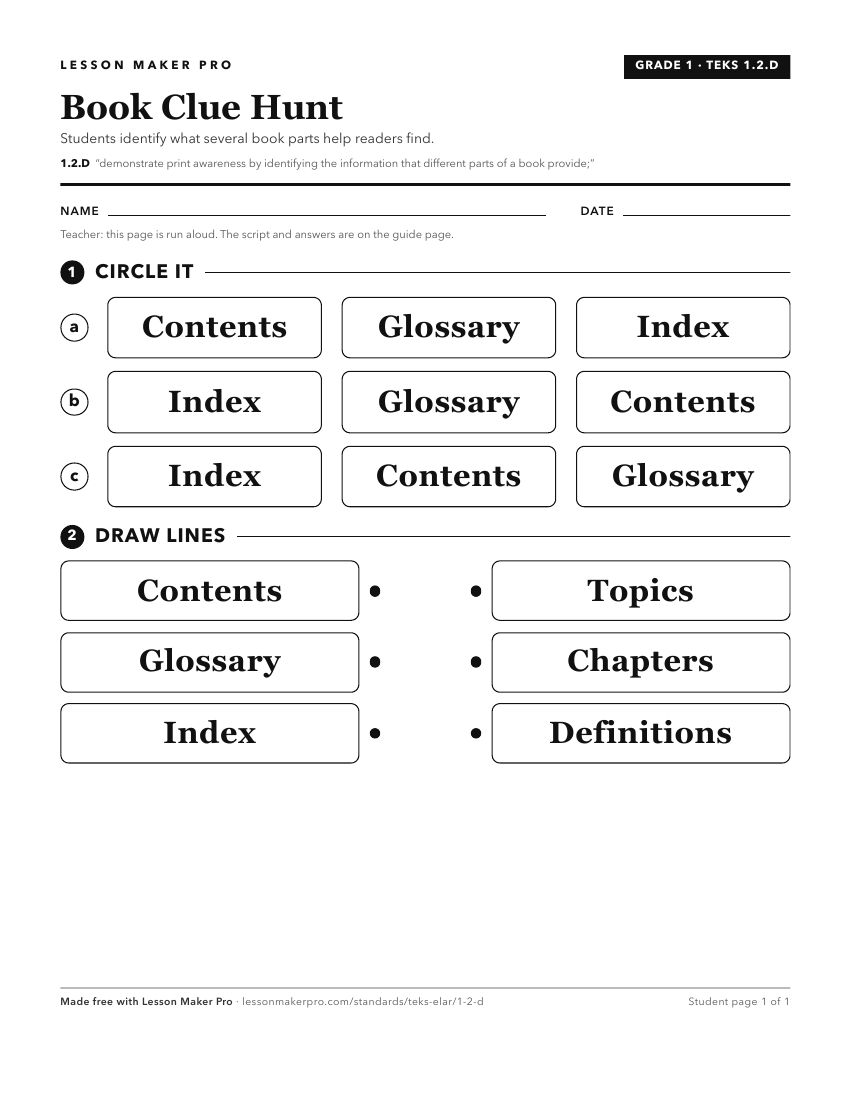
A ready-to-print activity worksheet aligned to 1.2.D, with an answer key for the teacher on its own page. No account needed.
PDF, US Letter, prints cleanly in black and white.
Download the worksheetKeep exploring
Related Standards
- 1.10.C
discuss with adult assistance the author's use of print and graphic features to achieve specific purposes;
- 2.10.C
discuss the author's use of print and graphic features to achieve specific purposes;
- K.2.D.i
identifying the front cover, back cover, and title page of a book;
- K.9.C
discuss with adult assistance the author's use of print and graphic features to achieve specific purposes;
Turn this exact standard into a lesson
Grade, subject, topic, and the complete standard are prefilled. Create one free, no account needed.
Also for this standard:Make a WorksheetMake a QuizMake a Sub Lesson