TEKS ELAR 5.2
Knowledge and Skills Statement (Standard Cluster)
The student develops word structure knowledge through phonological awareness, print concepts, phonics, and morphology to communicate, decode, and spell.
Texas Essential Knowledge and Skills for English Language Arts and Reading
Cluster contents
Student Expectations in This Statement
5.2 is a knowledge and skills statement. These are the student expectations under it.
- 5.2.A.i
decoding words with consonant changes, including /t/ to /sh/ such as in select and selection and /k/ to/sh/ such as music and musician
- 5.2.A.ii
decoding multisyllabic words with closed syllables; open syllables; VCe syllable; vowel teams, including digraphs and diphthongs; r-controlled syllables; and fi...
- 5.2.A.iii
decoding words using advanced knowledge of syllable division patterns
- 5.2.A.iv
decoding words using advanced knowledge of the influence of prefixes and suffixes on base words
- 5.2.A.v
identifying and reading high-frequency words from a research-based list
- 5.2.B.i
spelling multisyllabic words with closed syllables; open syllables; VCe syllables; vowel teams, including digraphs and diphthongs; r-controlled syllables; and f...
- 5.2.B.ii
spelling words with consonant changes, including /t/ to /sh/ such as in select and selection and /k/ to /sh/ such as music and musician
- 5.2.B.iii
spelling multisyllabic words with multiple sound-spelling patterns
- 5.2.B.iv
spelling words using advanced knowledge of syllable division patterns
- 5.2.B.v
spelling words using knowledge of prefixes
- 5.2.B.vi
spelling words using knowledge of suffixes, including how they can change base words such as dropping e, changing y to i, and doubling final consonants
- 5.2.C
write legibly in cursive.
Teacher's field guide
What This Cluster Means
What Students Need to Do
- Students break long words into readable syllables and use vowel patterns and word parts to pronounce them. They adjust base words when prefixes or suffixes change sounds or spellings. They quickly read common words and write clear, connected cursive.
What Mastery Looks Like
- A student can read a new multisyllabic word, show where it divides, and explain which patterns support the pronunciation. The student spells words such as selection, musician, hoping, carried, and running without guessing. Cursive writing is readable, evenly spaced, and joined consistently.
Common Misconceptions
- Students may split words by appearance instead of vowel patterns, or pronounce the c in musician as /k/. They may keep the final e in hoping, write carryed, or miss the doubled consonant in running. Some form cursive letters inconsistently or leave joins unclear.
How to Assess It
- Give this exit ticket: divide and read musician and complete, then spell selection, hoping, carried, and running from dictation. Finish by writing "The musician carried the drum" in cursive, then write the base word for carried.
Lesson moves
Ways to Teach It
Give pairs word cards to cut at syllable breaks, label each syllable type, and rebuild words such as complete, musician, and candle.
Ask, "Why does hope become hoping but hop become hopping?" Students explain the spelling rule and add two examples.
Play a word building relay where teams add prefix and suffix tiles to base words, pronounce each result, and spell it on whiteboards.
Have students examine a school lunch menu, circle multisyllabic words, mark syllable breaks, and copy one menu item neatly in cursive.
Free download
Printable 5.2 Worksheet
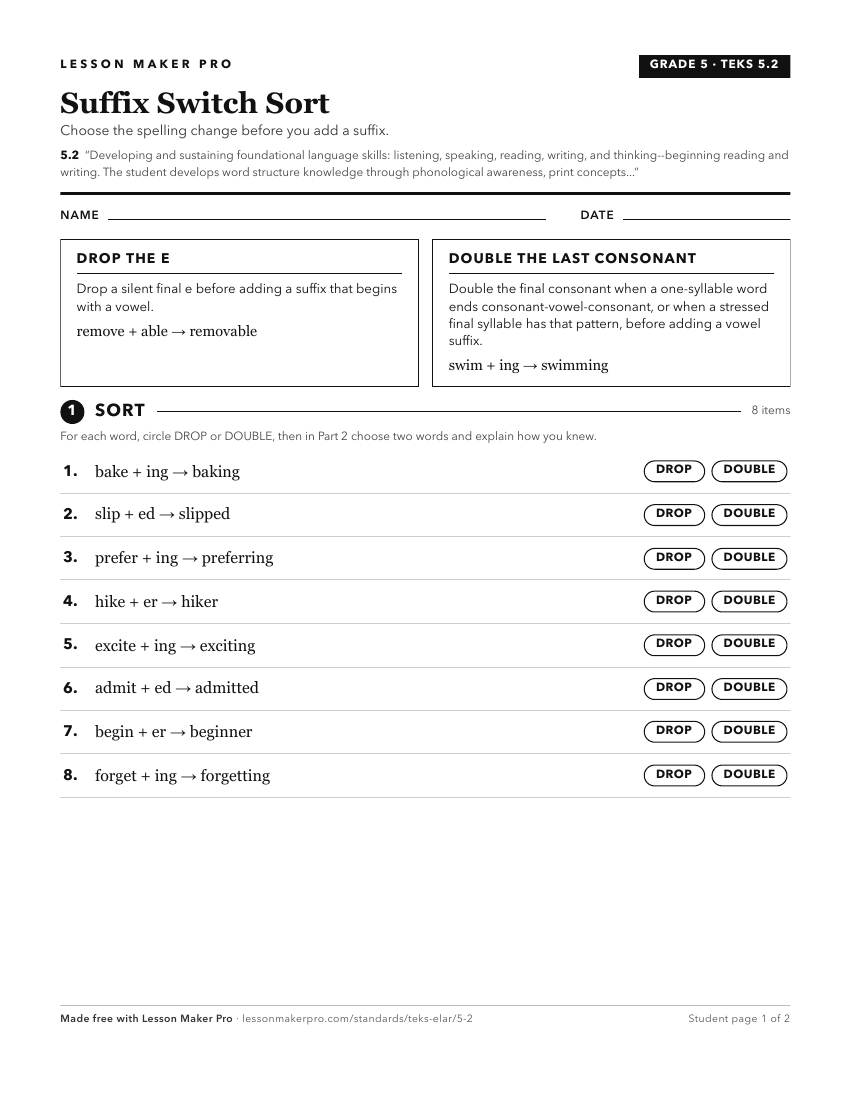
A ready-to-print activity worksheet aligned to 5.2, with an answer key for the teacher on its own page. No account needed.
PDF, US Letter, prints cleanly in black and white.
Download the worksheetKeep exploring
Related Standards
Turn this cluster into a lesson
Grade, subject, topic, and the complete cluster are prefilled. Create one free, no account needed.
Also for this cluster:Make a WorksheetMake a QuizMake a Sub Lesson