TEKS ELAR 5.2.C
The Standard
write legibly in cursive.
Texas Essential Knowledge and Skills for English Language Arts and Reading
Teacher's field guide
What This Standard Means
What Students Need to Do
- Students form uppercase and lowercase cursive letters with clear shapes and smooth connections. They control size, slant, spacing, and placement on the line so others can read their writing.
What Mastery Looks Like
- A student produces cursive that a classmate can read without help. Letters have consistent size, slant, spacing, and connections, with capitals and punctuation formed clearly.
Common Misconceptions
- Students may connect every letter, including capitals that should remain separate. They may mix print and cursive, reverse letters, or crowd words so closely that spacing disappears.
How to Assess It
- Give students two lines to copy in cursive: “My favorite place is the library. I found three new books there.” Check formation, connections, spacing, and readability.
Lesson moves
Ways to Teach It
Have students use dry-erase boards to copy letter families, then circle their clearest example and explain what makes it readable.
Ask students to write one cursive sentence, trade papers, and mark any letter or word that is hard to read.
Play Cursive Relay by having teams correctly write connected words from cards, earning points for accuracy, spacing, and readability.
Students write a short thank-you note in cursive, then address an envelope clearly for a real or classroom recipient.
Free download
Printable 5.2.C Worksheet
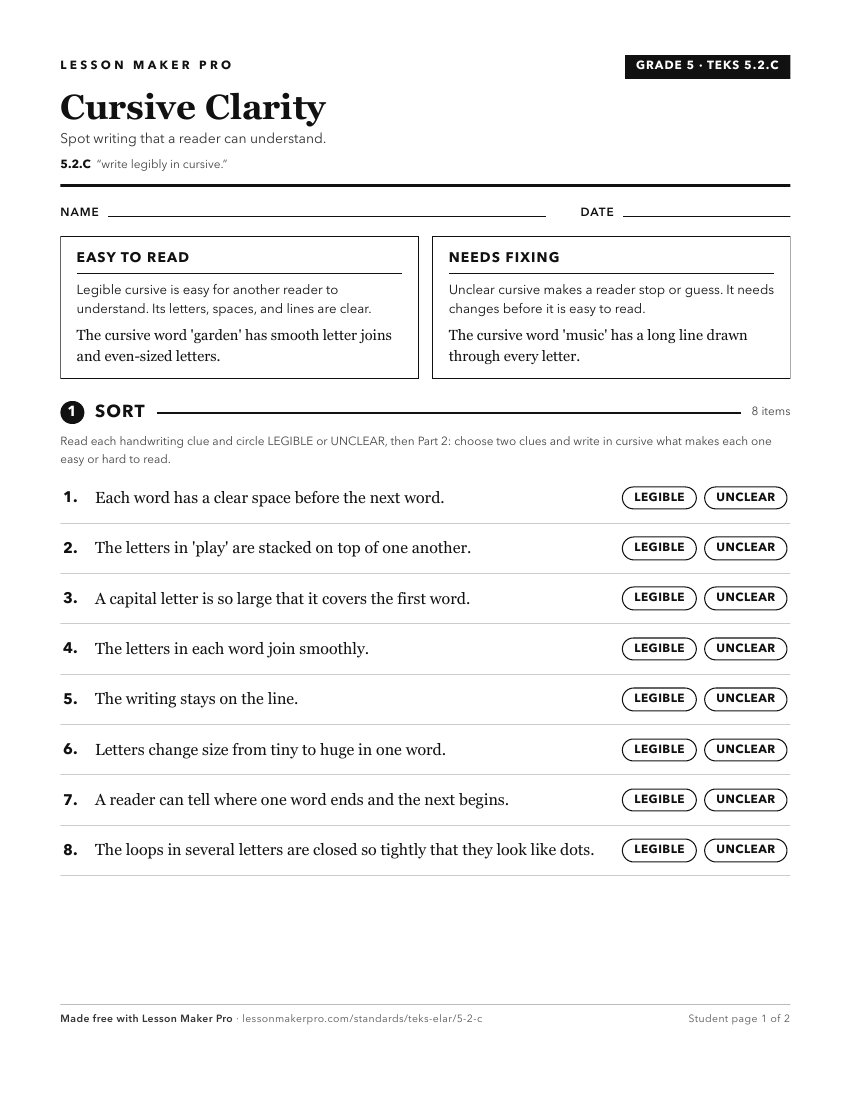
A ready-to-print activity worksheet aligned to 5.2.C, with an answer key for the teacher on its own page. No account needed.
PDF, US Letter, prints cleanly in black and white.
Download the worksheetKeep exploring
Related Standards
- 1.2.F
develop handwriting by printing words, sentences, and answers legibly leaving appropriate spaces between words.
- 4.2.C
write legibly in cursive to complete assignments.
- 2.2.E
develop handwriting by accurately forming all cursive letters using appropriate strokes when connecting letters.
- 3.2.D
write complete words, thoughts, and answers legibly in cursive leaving appropriate spaces between words.
Turn this exact standard into a lesson
Grade, subject, topic, and the complete standard are prefilled. Create one free, no account needed.
Also for this standard:Make a WorksheetMake a QuizMake a Sub Lesson