TEKS ELAR 5.2.A.ii
The Standard
decoding multisyllabic words with closed syllables; open syllables; VCe syllable; vowel teams, including digraphs and diphthongs; r-controlled syllables; and final stable syllables
Texas Essential Knowledge and Skills for English Language Arts and Reading · The student develops word structure knowledge through phonological awareness, print concepts, phonics, and morphology to communicate, decode, and spell.
Teacher's field guide
What This Standard Means
What Students Need to Do
- Students break long words into syllables and use vowel patterns to pronounce each part. They blend the parts, check the pronunciation, and try another division when needed.
What Mastery Looks Like
- Students divide an unfamiliar word into useful syllables, identify the vowel pattern in each part, and blend the parts accurately. They can adjust when their first pronunciation does not make sense.
Common Misconceptions
- Students may divide words at the wrong place or treat every vowel pair as one sound. They may also pronounce final stable syllables exactly as spelled or overlook silent e.
How to Assess It
- Give students the words “reptile,” “sailboat,” “market,” and “candle.” Ask them to divide each word, label its syllable patterns, and read it aloud.
Lesson moves
Ways to Teach It
Have pairs sort word cards by syllable pattern, mark vowels, draw syllable breaks, and read each word aloud.
Ask students to explain in writing how they would divide and decode “confusion,” naming the clues they used.
Play a relay where students draw a word card, divide it, label each vowel pattern, and pronounce the whole word.
Students scan a science paragraph for unfamiliar long words, mark syllable breaks, and practice reading the words with a partner.
Free download
Printable 5.2.A.ii Worksheet
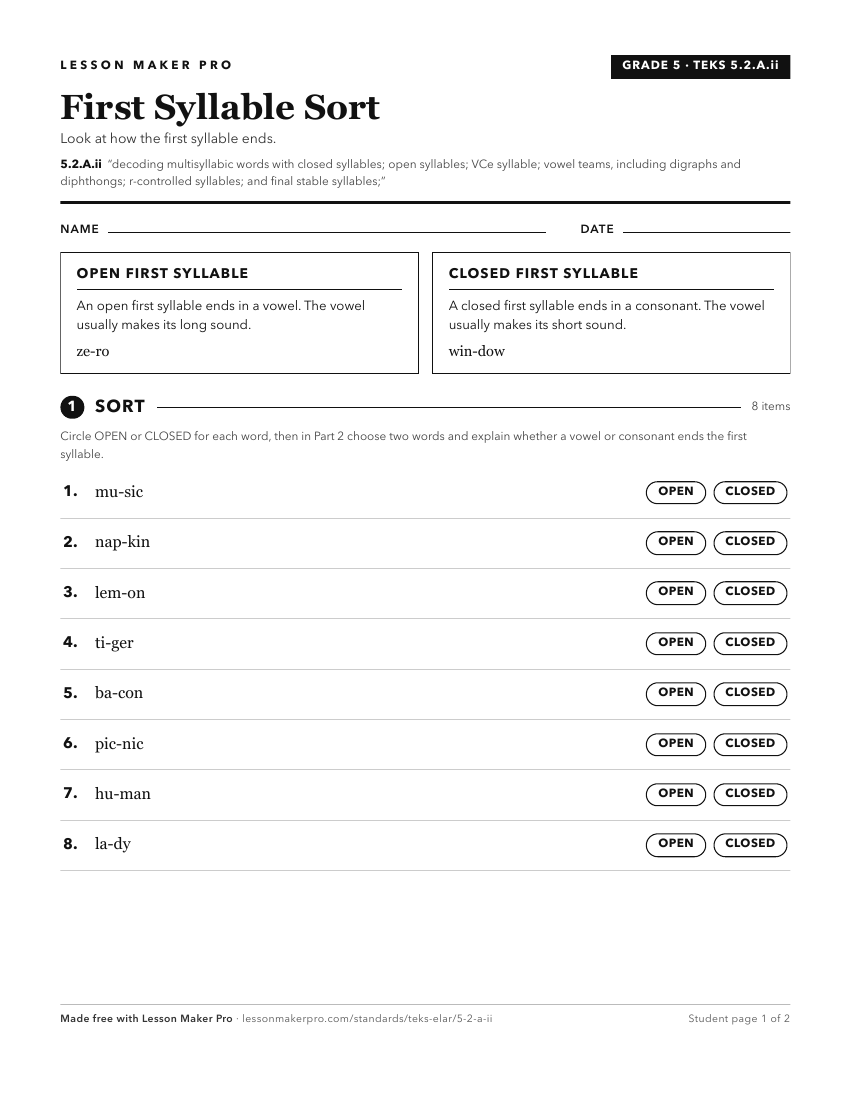
A ready-to-print activity worksheet aligned to 5.2.A.ii, with an answer key for the teacher on its own page. No account needed.
PDF, US Letter, prints cleanly in black and white.
Download the worksheetKeep exploring
Related Standards
- 3.2.A.ii
decoding multisyllabic words with closed syllables; open syllables; VCe syllables; vowel teams, including digraphs and diphthongs; r-controlled syllables; and f...
- 4.2.A.ii
decoding multisyllabic words with closed syllables; open syllables; VCe syllables; vowel teams, including digraphs and diphthongs; r-controlled syllables; and f...
- 1.2.B.iii
decoding words with closed syllables; open syllables; VCe syllables; vowel teams, including vowel digraphs and diphthongs; and r-controlled syllables;
- 2.2.B.iii
decoding multisyllabic words with closed syllables; open syllables; VCe syllables; vowel teams, including digraphs and diphthongs; r-controlled syllables; and f...
Turn this exact standard into a lesson
Grade, subject, topic, and the complete standard are prefilled. Create one free, no account needed.
Also for this standard:Make a WorksheetMake a QuizMake a Sub Lesson