TEKS ELAR 5.2.A.v
The Standard
identifying and reading high-frequency words from a research-based list
Texas Essential Knowledge and Skills for English Language Arts and Reading · The student develops word structure knowledge through phonological awareness, print concepts, phonics, and morphology to communicate, decode, and spell.
Teacher's field guide
What This Standard Means
What Students Need to Do
- Students recognize and pronounce commonly used words quickly, both alone and in connected text. They use known spelling patterns and remember irregular parts instead of sounding out every word.
What Mastery Looks Like
- A student reads a grade-appropriate word list accurately and with little hesitation. In a short passage, the student recognizes those words automatically and maintains a smooth pace.
Common Misconceptions
- Students may guess from the first letter or sentence context instead of checking the whole word. They may sound out irregular words exactly as spelled, or recognize words on cards but miss them in passages.
How to Assess It
- Give each student 15 words from your adopted list, then a 60-word passage containing five of them. Check for accurate reading within three seconds per word.
Lesson moves
Ways to Teach It
Write 12 common words on cards, then have pairs sort them by regular and irregular spelling parts and read each card aloud.
Ask students to explain in writing which part of “because” is easy to decode and which part must be remembered.
Play Word Hunt Bingo: students scan a short passage, cover listed words, and read the full sentence to claim each square.
Have students collect common words from menus, signs, and school notices, then build a class wall ranked by frequency.
Free download
Printable 5.2.A.v Worksheet
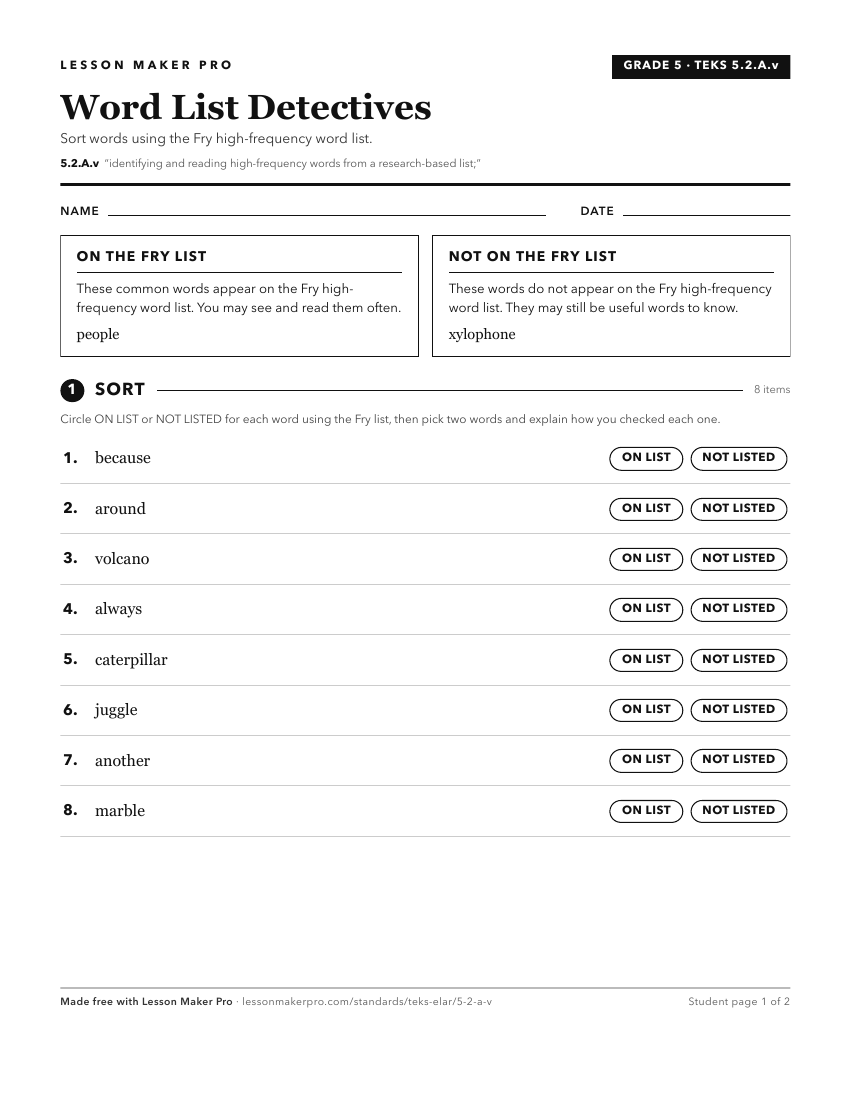
A ready-to-print activity worksheet aligned to 5.2.A.v, with an answer key for the teacher on its own page. No account needed.
PDF, US Letter, prints cleanly in black and white.
Download the worksheetKeep exploring
Related Standards
Turn this exact standard into a lesson
Grade, subject, topic, and the complete standard are prefilled. Create one free, no account needed.
Also for this standard:Make a WorksheetMake a QuizMake a Sub Lesson