TEKS ELAR 1.2.C.ii
The Standard
spelling words with initial and final consonant blends, digraphs, and trigraphs
Texas Essential Knowledge and Skills for English Language Arts and Reading · The student develops word structure knowledge through phonological awareness, print concepts, phonics, and morphology to communicate, decode, and spell.
Teacher's field guide
What This Standard Means
What Students Need to Do
- Students listen for consonant sounds at the beginnings and endings of words, then choose the letters that represent them. They spell words such as clap, fish, nest, and match without dropping sounds or letters.
What Mastery Looks Like
- Given a dictated list, students correctly spell words such as stop, hand, chin, brush, and match. They keep both sounds in a blend and use every letter in a digraph or trigraph.
Common Misconceptions
- Students often write sop for stop or han for hand because they miss one sound in a blend. They may write sip for ship or mach for match because they leave out part of a letter team.
How to Assess It
- Dictate clap, nest, ship, brush, and match. Have students write each word and circle the beginning or ending consonant pattern.
Lesson moves
Ways to Teach It
Use letter tiles to build clap, stop, fish, brush, and match, then have students touch each sound and check every letter.
Ask, "Why does stop need both s and t?" Students write one similar word and explain which sounds the consonants show.
Play a word-sort relay where students place picture cards under blend, digraph, or trigraph headings, then spell each pictured word.
Give students a grocery flyer and highlighters; they find five target consonant patterns, copy the words, and circle the relevant letters.
Free download
Printable 1.2.C.ii Worksheet
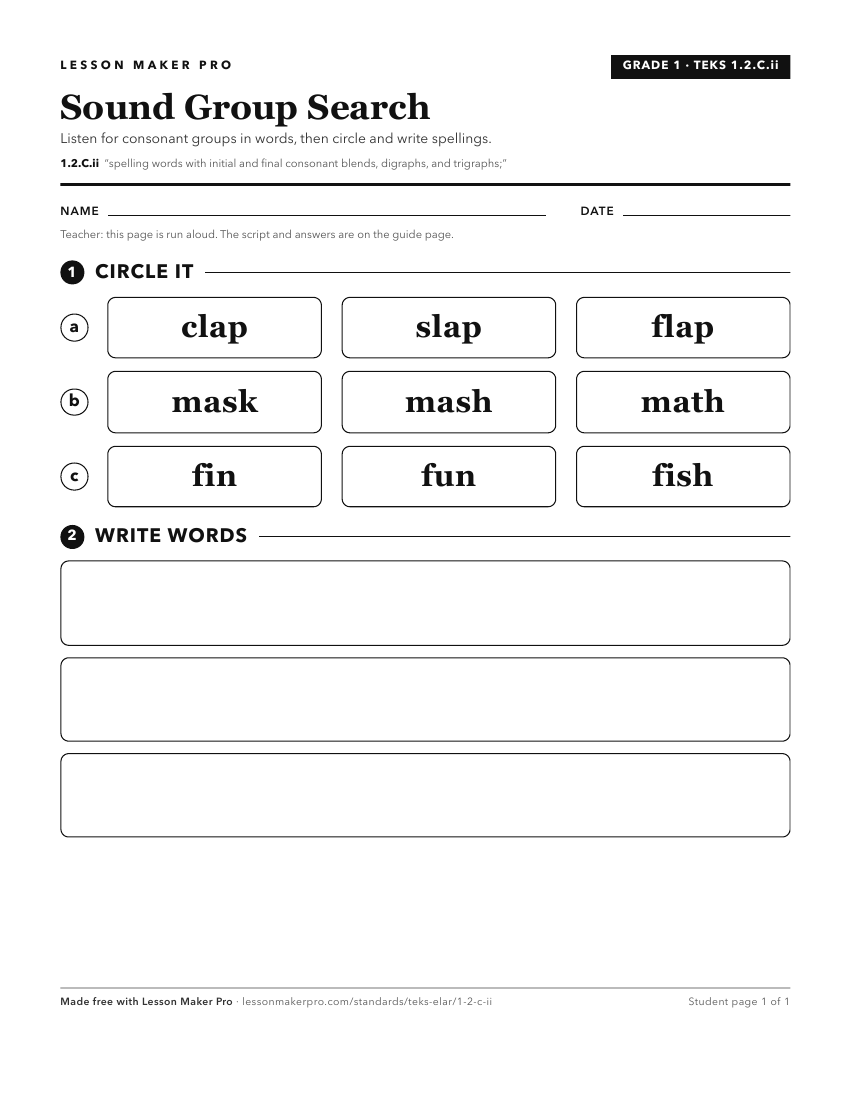
A ready-to-print activity worksheet aligned to 1.2.C.ii, with an answer key for the teacher on its own page. No account needed.
PDF, US Letter, prints cleanly in black and white.
Download the worksheetKeep exploring
Related Standards
- 1.2.B.ii
decoding words with initial and final consonant blends, digraphs, and trigraphs;
- 2.2.B.i
decoding words with short, long, or variant vowels, trigraphs, and blends;
- 1.2.A.v
blending spoken phonemes to form one-syllable words, including initial and/or final consonant blends;
- 2.2.C.v
spelling words using knowledge of syllable division patterns, including words with double consonants in the middle of the word; and
Turn this exact standard into a lesson
Grade, subject, topic, and the complete standard are prefilled. Create one free, no account needed.
Also for this standard:Make a WorksheetMake a QuizMake a Sub Lesson