TEKS ELAR 2.2.B.i
The Standard
decoding words with short, long, or variant vowels, trigraphs, and blends
Texas Essential Knowledge and Skills for English Language Arts and Reading · The student develops word structure knowledge through phonological awareness, print concepts, phonics, and morphology to communicate, decode, and spell.
Teacher's field guide
What This Standard Means
What Students Need to Do
- Students use groups of letters and vowel patterns to work out spoken words from print. They blend sounds in order, read the whole word, and check whether the result sounds right.
What Mastery Looks Like
- Students read familiar and unfamiliar words without guessing from the first letter or picture. They blend the full word smoothly and use vowel patterns and consonant groups to correct mistakes.
Common Misconceptions
- Students may read every vowel as short or assume a silent e always makes the vowel long. They may split blends or trigraphs into unrelated sounds, such as reading splash without the l or patch as pat.
How to Assess It
- Ask each student to read these words aloud: slip, cake, moon, coin, night, and patch. Have the student underline the letter pattern used in each word.
Lesson moves
Ways to Teach It
Use letter tiles to build cap, cape, rain, night, and splash, then ask students to point to the pattern guiding each pronunciation.
Ask students to compare hop and hope, then write one sentence explaining how the final e changes the vowel sound.
Play a card sort where partners group and read words by short vowels, long vowels, other vowel sounds, trigraphs, or blends.
Give students a grocery flyer and ask them to circle, read, and label five words containing the target spelling patterns.
Free download
Printable 2.2.B.i Worksheet
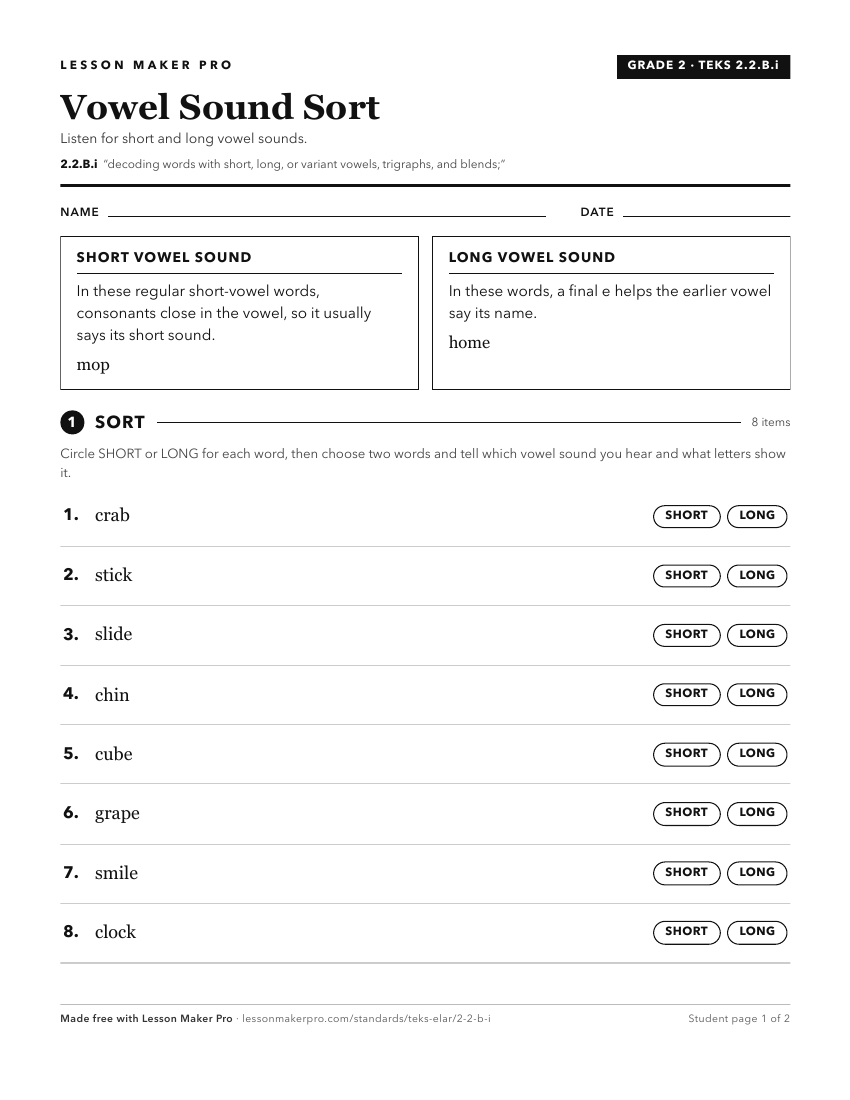
A ready-to-print activity worksheet aligned to 2.2.B.i, with an answer key for the teacher on its own page. No account needed.
PDF, US Letter, prints cleanly in black and white.
Download the worksheetKeep exploring
Related Standards
- 1.2.B.ii
decoding words with initial and final consonant blends, digraphs, and trigraphs;
- 3.2.A.iv
decoding words using knowledge of syllable division patterns such as VCCV, VCV, and VCCCV with accent shifts;
- 4.2.A.iii
decoding words using advanced knowledge of syllable division patterns such as VV;
- 1.2.B.iii
decoding words with closed syllables; open syllables; VCe syllables; vowel teams, including vowel digraphs and diphthongs; and r-controlled syllables;
Turn this exact standard into a lesson
Grade, subject, topic, and the complete standard are prefilled. Create one free, no account needed.
Also for this standard:Make a WorksheetMake a QuizMake a Sub Lesson