TEKS ELAR K.2.D.iii
The Standard
recognizing that sentences are comprised of words separated by spaces and recognizing word boundaries
Texas Essential Knowledge and Skills for English Language Arts and Reading · The student develops word structure knowledge through phonological awareness, print concepts, phonics, and morphology to communicate, decode, and spell.
Teacher's field guide
What This Standard Means
What Students Need to Do
- Students point to individual words in a printed sentence and show where one word ends and the next begins. They use spaces to count and separate words.
What Mastery Looks Like
- Given a short printed sentence, a student points to each word once and counts the words correctly. The student can rebuild the sentence from word cards with clear gaps.
Common Misconceptions
- Students may count letters instead of words, or count punctuation as a word. They may miss small words such as “a” and “I,” or split one long word into parts.
How to Assess It
- Write “I see a red cat.” Ask students to circle each word and write the total number of words.
Lesson moves
Ways to Teach It
Give pairs word cards for “We like blue fish,” then have them build the sentence with a finger-width gap between cards.
Display “My dog can run” and ask, “How can you prove this sentence has four words?”
Play Word Detective: show sentence strips, and students tap once under each word while a partner checks the spaces.
Read a classroom sign or snack label, then let students place sticky notes under each word they find.
Free download
Printable K.2.D.iii Worksheet
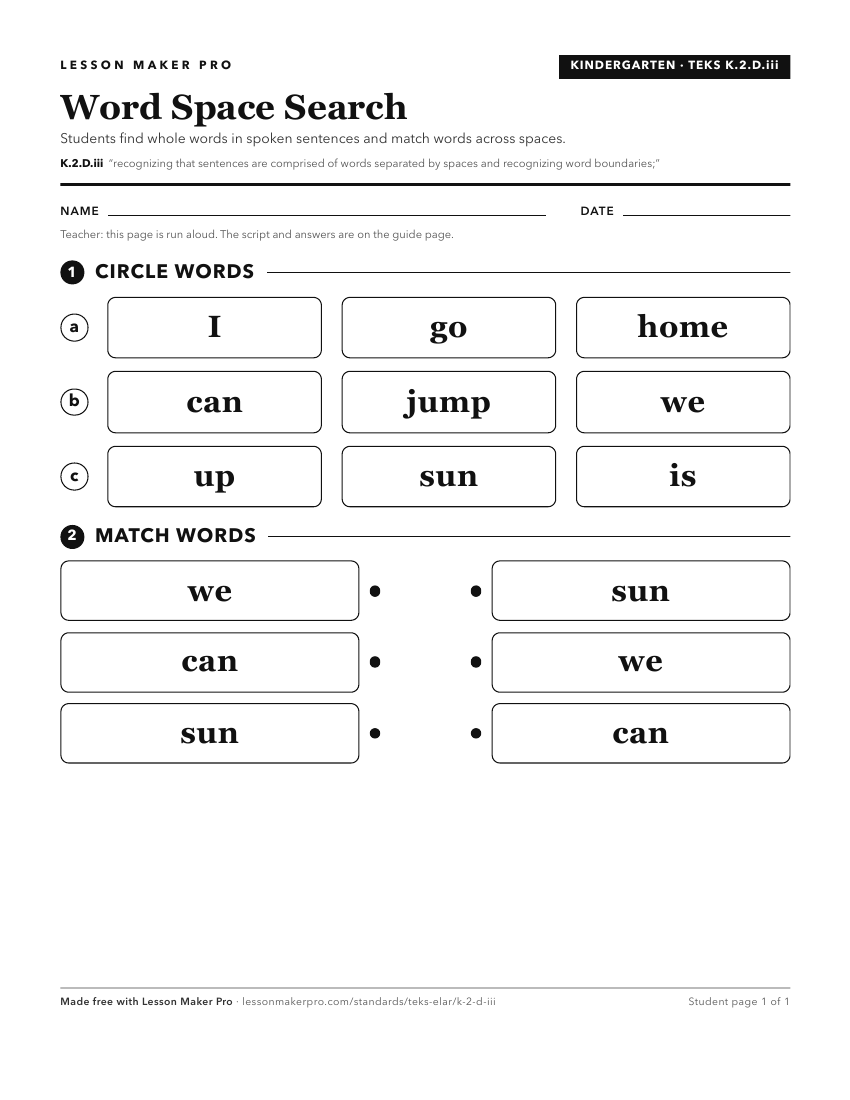
A ready-to-print activity worksheet aligned to K.2.D.iii, with an answer key for the teacher on its own page. No account needed.
PDF, US Letter, prints cleanly in black and white.
Download the worksheetKeep exploring
Related Standards
- 2.2.A.iii
recognizing the change in spoken word when a specified phoneme is added, changed, or removed; and
- K.2.A.iii
identifying the individual words in a spoken sentence;
- 5.2.A.iii
decoding words using advanced knowledge of syllable division patterns;
- K.2.D.iv
recognizing the difference between a letter and a printed word; and
Turn this exact standard into a lesson
Grade, subject, topic, and the complete standard are prefilled. Create one free, no account needed.
Also for this standard:Make a WorksheetMake a QuizMake a Sub Lesson