TEKS ELAR K.2.B.i
The Standard
identifying and matching the common sounds that letters represent
Texas Essential Knowledge and Skills for English Language Arts and Reading · The student develops word structure knowledge through phonological awareness, print concepts, phonics, and morphology to communicate, decode, and spell.
Teacher's field guide
What This Standard Means
What Students Need to Do
- Students connect familiar uppercase and lowercase letters with their common sounds. They say a sound when shown a letter and choose a letter when they hear its sound.
What Mastery Looks Like
- A student sees a familiar uppercase or lowercase letter and gives its common sound. The student also hears a sound or a pictured word’s first sound and selects the matching letter.
Common Misconceptions
- Students may say a letter name instead of its sound. They may use a picture’s ending sound, confuse similar sounds such as /b/ and /p/, or rely on alphabet order.
How to Assess It
- Show m, s, t, and p in mixed order. Ask each student to say the sound and place one picture under its matching letter.
Lesson moves
Ways to Teach It
Place letter cards and small objects on a table, then have students match each object’s first sound to a letter.
Show a picture and ask, “What sound starts this word, and which letter spells that sound?”
Play letter-sound bingo by calling sounds while students cover the matching letters on their boards.
Take a classroom sound walk and label objects with sticky notes showing their beginning letters.
Free download
Printable K.2.B.i Worksheet
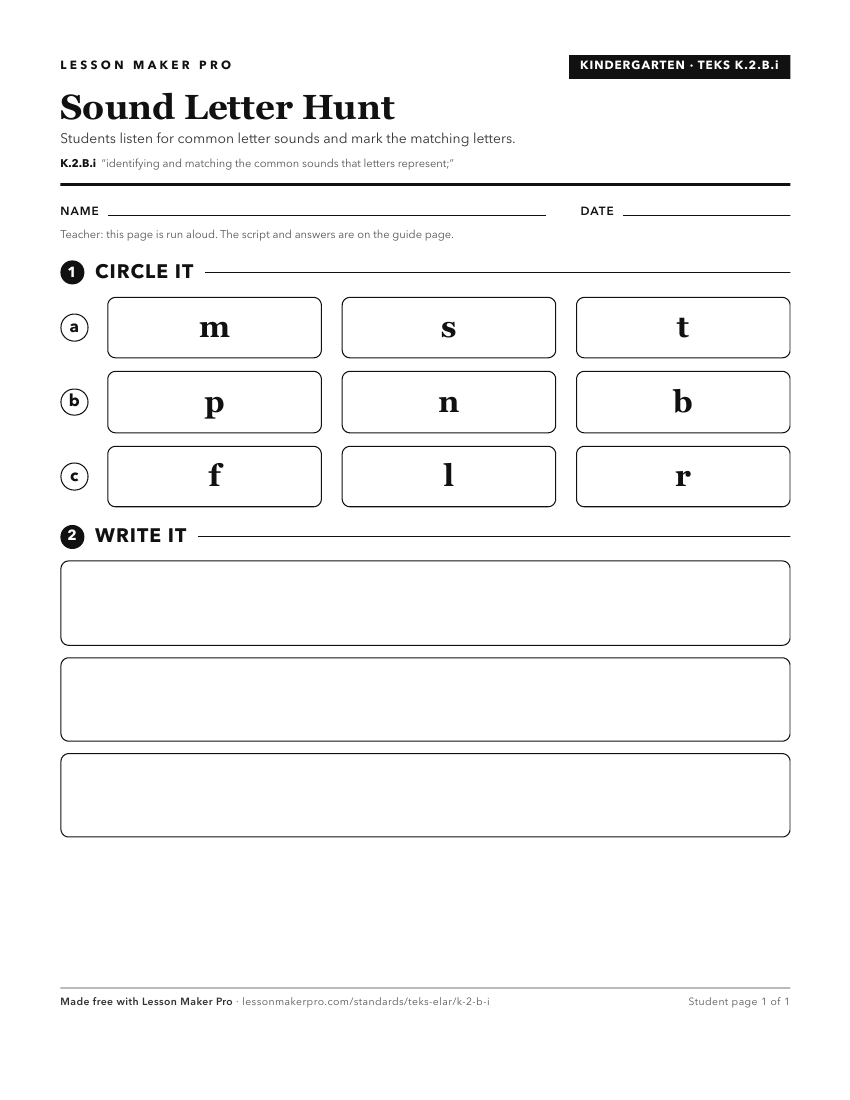
A ready-to-print activity worksheet aligned to K.2.B.i, with an answer key for the teacher on its own page. No account needed.
PDF, US Letter, prints cleanly in black and white.
Download the worksheetKeep exploring
Related Standards
- 1.2.B.i
decoding words in isolation and in context by applying common letter sound correspondences;
- K.2.B.ii
using letter-sound relationships to decode, including VC, CVC, CCVC, and CVCC words;
- K.2.A.iv
identifying syllables in spoken words;
- K.2.D.iv
recognizing the difference between a letter and a printed word; and
Turn this exact standard into a lesson
Grade, subject, topic, and the complete standard are prefilled. Create one free, no account needed.
Also for this standard:Make a WorksheetMake a QuizMake a Sub Lesson