TEKS ELAR K.2.A.iv
The Standard
identifying syllables in spoken words
Texas Essential Knowledge and Skills for English Language Arts and Reading · The student develops word structure knowledge through phonological awareness, print concepts, phonics, and morphology to communicate, decode, and spell.
Teacher's field guide
What This Standard Means
What Students Need to Do
- Students listen for the separate beats in spoken words. They clap, tap, or move once for each beat, then tell how many they heard.
What Mastery Looks Like
- A student can say a familiar word slowly, clap each beat, and tell how many beats it has. The student can sort spoken words into one, two, or three beat groups.
Common Misconceptions
- Students may count individual sounds or letters instead of spoken beats. They may also add extra beats when stretching a word or miss unstressed parts, such as the second beat in "pencil."
How to Assess It
- Say five words: "cat," "apple," "banana," "fish," and "computer." Have students clap each word and show the number of beats with fingers.
Lesson moves
Ways to Teach It
Give students picture cards to name, clap, and sort into hoops marked one, two, or three beats.
Ask, "How many beats are in your name?" Partners say, clap, and compare their names.
Play Syllable Hop by saying a word and having students hop once for each beat they hear.
Read a lunch menu aloud and have students count the beats in words such as milk, pizza, banana, and spaghetti.
Free download
Printable K.2.A.iv Worksheet
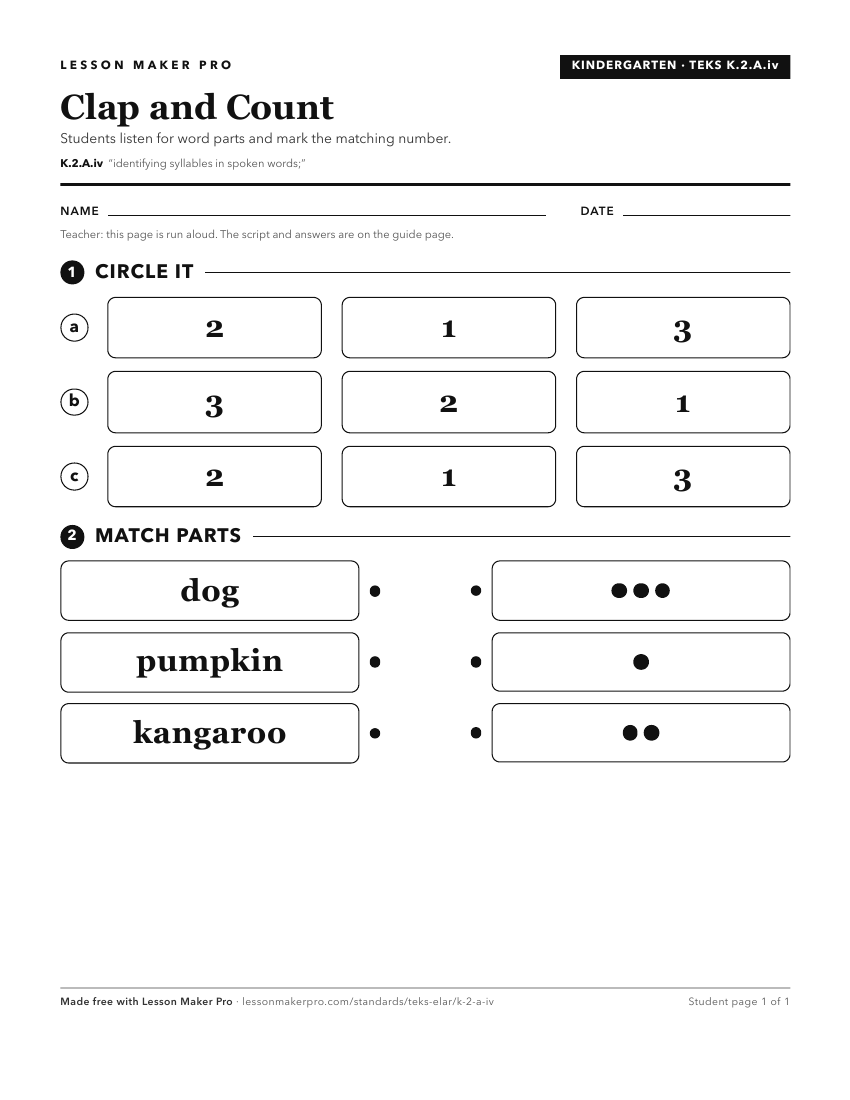
A ready-to-print activity worksheet aligned to K.2.A.iv, with an answer key for the teacher on its own page. No account needed.
PDF, US Letter, prints cleanly in black and white.
Download the worksheetKeep exploring
Related Standards
- 1.2.A.vii
segmenting spoken one-syllable words of three to five phonemes into individual phonemes, including words with initial and/or final consonant blends;
- K.2.A.vi
segmenting multisyllabic words into syllables;
- K.2.A.iii
identifying the individual words in a spoken sentence;
- K.2.A.x
segmenting spoken one-syllable words into individual phonemes;
Turn this exact standard into a lesson
Grade, subject, topic, and the complete standard are prefilled. Create one free, no account needed.
Also for this standard:Make a WorksheetMake a QuizMake a Sub Lesson