TEKS ELAR K.2.D.v
The Standard
identifying all uppercase and lowercase letters
Texas Essential Knowledge and Skills for English Language Arts and Reading · The student develops word structure knowledge through phonological awareness, print concepts, phonics, and morphology to communicate, decode, and spell.
Teacher's field guide
What This Standard Means
What Students Need to Do
- Students recognize and name every uppercase and lowercase letter. They connect the two forms of each letter, such as A with a.
What Mastery Looks Like
- Students quickly name each uppercase and lowercase letter in any order. They match both forms of the same letter, even when fonts look different.
Common Misconceptions
- Students may confuse letters with similar shapes, such as b and d, p and q, or M and W. They may also know one letter form but not connect it to the other case.
How to Assess It
- Show each student a shuffled deck of all uppercase and lowercase letter cards. Ask the student to name each letter, and record any missed forms.
Lesson moves
Ways to Teach It
Give students magnetic letters to sort into uppercase and lowercase groups, then match each uppercase letter with its lowercase partner.
Show a letter pair and ask, "What looks the same, and what looks different about these two forms?"
Play letter bingo by calling letter names while students cover uppercase and lowercase forms on mixed boards.
Have students hunt for uppercase and lowercase letters on food packages, classroom labels, signs, or book covers.
Free download
Printable K.2.D.v Worksheet
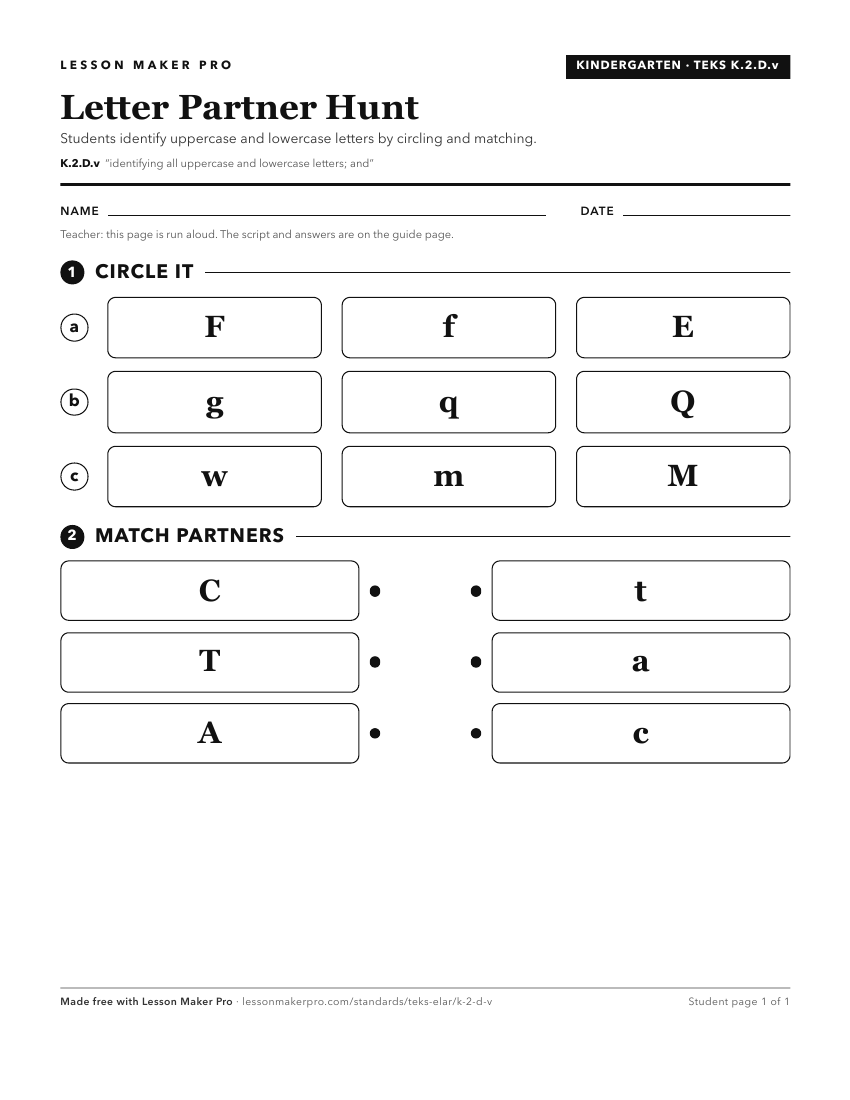
A ready-to-print activity worksheet aligned to K.2.D.v, with an answer key for the teacher on its own page. No account needed.
PDF, US Letter, prints cleanly in black and white.
Download the worksheetKeep exploring
Related Standards
Turn this exact standard into a lesson
Grade, subject, topic, and the complete standard are prefilled. Create one free, no account needed.
Also for this standard:Make a WorksheetMake a QuizMake a Sub Lesson