TEKS ELAR K.2.A.vii
The Standard
blending spoken onsets and rimes to form simple words
Texas Essential Knowledge and Skills for English Language Arts and Reading · The student develops word structure knowledge through phonological awareness, print concepts, phonics, and morphology to communicate, decode, and spell.
Teacher's field guide
What This Standard Means
What Students Need to Do
- Students listen to a word split into a beginning sound and an ending chunk. They combine the two spoken parts and say the whole word.
What Mastery Looks Like
- A student hears /c/ plus /at/ and says cat smoothly. The student can do this with several familiar one-syllable words without picture clues.
Common Misconceptions
- Students may separate every sound instead of treating the ending chunk as one part. They may also add a pause, drop the first sound, or guess a rhyming word.
How to Assess It
- Say, “Listen: /m/ and /ap/. What word?” Repeat with /s/ and /un/, then record whether the student answers map and sun without help.
Lesson moves
Ways to Teach It
Give students picture cards and two linking cubes, then have them push the cubes together while combining /b/ and /at/ to say bat.
Ask, “What word do /m/ and /op/ make, and what other words end with /op/?”
Play Onset-Rime Bingo by calling parts such as /h/ and /at/ for students to combine and cover the matching picture.
Use classroom labels such as map, clock, and door, then say each word in two parts for students to combine and locate.
Free download
Printable K.2.A.vii Worksheet
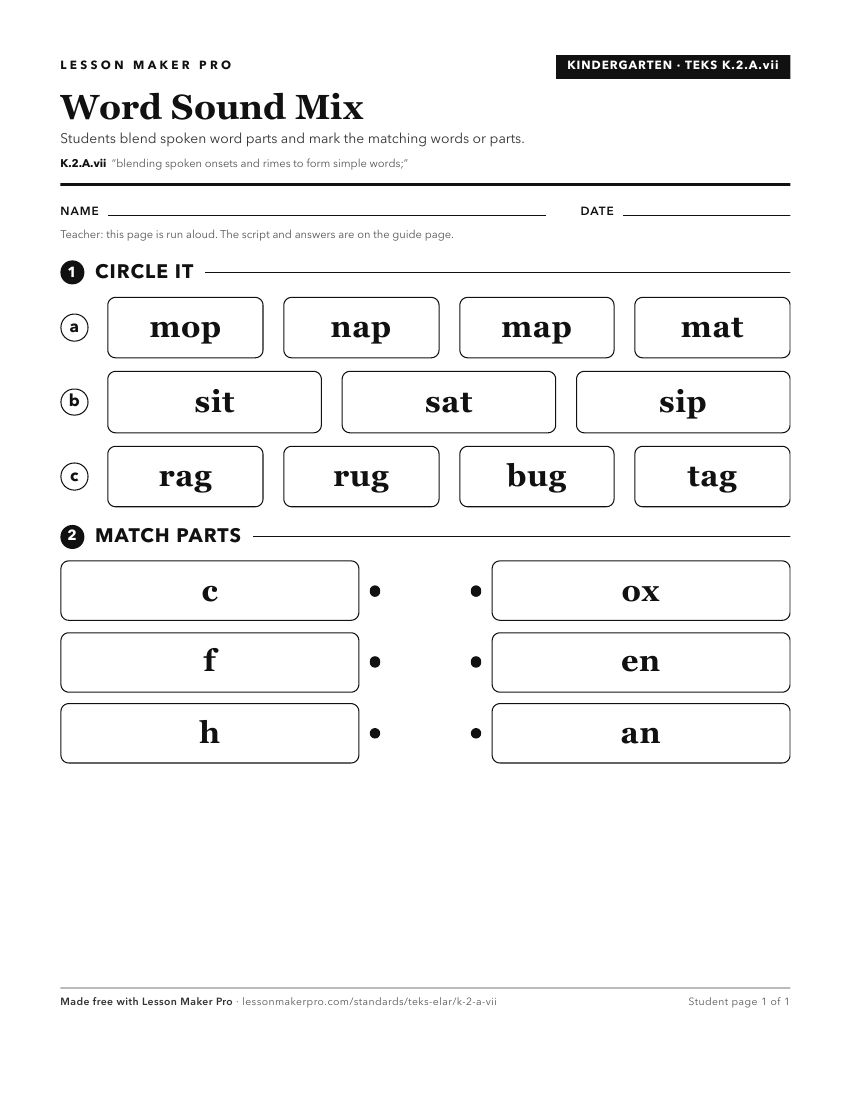
A ready-to-print activity worksheet aligned to K.2.A.vii, with an answer key for the teacher on its own page. No account needed.
PDF, US Letter, prints cleanly in black and white.
Download the worksheetKeep exploring
Related Standards
Turn this exact standard into a lesson
Grade, subject, topic, and the complete standard are prefilled. Create one free, no account needed.
Also for this standard:Make a WorksheetMake a QuizMake a Sub Lesson