Oklahoma Social Studies MWH.C.7
Standard Cluster
Evaluate post-World War II regional events leading to the transformations of the modern world. Evaluate the effects of World War II including the origins and escalation of the Cold War. Explain the major consequences of World War II, including physical and economic destruction, civilian loss of life, mass displacement and expulsion of ethnic minorities, and the accelerated decline of European colonial empires. Compare the ideological, political, and economic distinctions between the United States of America and Western bloc versus the Union of Soviet Socialist Republics (USSR) and the Eastern bloc, leading to the division of Europe and separation by an “Iron Curtain.” Explain how tensions escalated, fueled by the Berlin Blockade, Suez Canal Crisis, and subsequent uprisings by people in Soviet-dominated satellites (e.g., Poland, Hungary, Czechoslovakia). Compare military power shifts caused by the war and a proliferation of nuclear armaments, describing the impact of transnational organizations and alliances (e.g., United Nations, North Atlantic Treaty Organization, Warsaw Pact) and explaining the goals of the Non-Alignment Movement. Evaluate ongoing regional disputes of the Middle East. Describe the creation of the modern State of Israel, including the rationale for its establishment, the Zionist movement, increased migration of Jews to the British Mandate for Palestine, and the United Nations Partition Plan. Explain how the 1948 War between five Arab states and Israel unfolded, how it contributed to a refugee crisis, and how it led to future conflicts (e.g., Six-Day War, Yom Kippur War) as well as various peace initiatives. Examine the roots of the ongoing regional instability of the Middle East, including the rise of Islamic fundamentalism, the Iranian Revolution and its establishment of a theocracy, the Iran-Iraq conflict, and the invasion of Kuwait. Assess the impact of independence movements on human rights and the global expansion of democracy in South Asia. Describe the fall of the British Raj and the emergence of an independent India and Pakistan, including the influence, ideas, and acts of civil disobedience by Mohandas Gandhi. Describe the partitioning of India and subsequent international relations (e.g., Indo-Pakistani wars, Non-Aligned Movement, India’s secular constitution, experiences with socialism, free-market reforms). Analyze political and cultural transformations occurring in East and Southeast Asia during the postwar era. Explain how civil conflicts in Korea and French Indochina became proxy wars between superpowers during the Cold War. Describe significant political and economic change in China, including the influence of Sun Yat-Sen and the 1911 Revolution, and examine the consequences of the Chinese Civil War, resulting in the establishment of the People’s Republic of China and the Republic of China (Taiwan), and compare their subsequent political and economic development. Describe the effects of the Chinese Communist Revolution, including the repressive economic and social policies of Mao Zedong, the Great Leap Forward and resulting famine, and the Cultural Revolution and political persecution. Explain the significance of pro-democracy movements such as Tiananmen Square and evaluate how economic reforms under Deng Xiaoping contributed to China’s modernization, expanding global influence, and evolving relationship with the United States of America. Assess the impact of African independence movements on human rights and the global expansion of democracy.. Explain the effects of Pan-Africanism on changing political boundaries and the development of anticolonialism. Describe the struggle for self-government in Ghana, including the influence of Kwame Nkrumah. Analyze the political, economic, and social context of South Africa’s apartheid system, assessing the role of international pressure and internal resistance in dismantling it, including the leadership of Nelson Mandela and Desmond Tutu. Evaluate the conditions leading to the collapse of the Soviet Union and the consequences for Europe. Examine the goals of Poland’s Solidarity Movement and other civil resistance movements that challenged communist rule. Explain how internal pressures within the Soviet Union, including economic stagnation, the burdens of military commitments, and the policies of perestroika and glasnost under Mikhail Gorbachev destabilized the Soviet system and contributed to its breakup. Explain how the Revolutions of 1989 and the weakening of Soviet control contributed to the collapse of communist governments in the Eastern Bloc. Analyze the effect of the collapse of the Soviet Union on global power dynamics, including the emergence of new democracies in Eastern Europe. Describe European politics since the fall of the Soviet Union, including the expansion of the European Union and NATO, continued national loyalties, and the reemergence of Russia as a major power including conflicts such as the annexation of Crimea and the war in Ukraine. Assess the role of Western leadership, diplomacy, and dissident movements in weakening Soviet power and encouraging democratic transitions, including figures such as Ronald Reagan, Margaret Thatcher, Pope John Paul II, Willy Brandt, Václav Havel, and Lech Wa∤ęsa. Explore key components of Western Europe’s postwar rise in prosperity and stability (e.g., economic recovery and development, trade and innovation, rising living standards) and how these conditions shaped Europe’s post-Cold War trajectory. Analyze recent threats to global security and regional stability. Examine the religious, ethnic, and political origins and the lasting effects of ethnic conflict, modern genocide, and atrocities (e.g., Cambodia’s Khmer Rouge, Northern Ireland’s “Troubles”, Rwanda’s civil war, the Balkan’s ethnic cleansing). Identify conditions that have given rise to international terrorism and the rising threat of weapons of mass destruction, evaluating responses by governments and societies. Describe the challenges and impact of trade and increasing economic interdependence on modern economies.
Oklahoma Academic Standards for Social Studies (2026)
Cluster contents
Standards in This Cluster
MWH.C.7 is a cluster heading. These are the individual standards under it.
- MWH.C.7.1
Evaluate the effects of World War II including the origins and escalation of the Cold War.
- MWH.C.7.1.A
Explain the major consequences of World War II, including physical and economic destruction, civilian loss of life, mass displacement and expulsion of ethnic mi...
- MWH.C.7.1.B
Compare the ideological, political, and economic distinctions between the United States of America and Western bloc versus the Union of Soviet Socialist Republi...
- MWH.C.7.1.C
Explain how tensions escalated, fueled by the Berlin Blockade, Suez Canal Crisis, and subsequent uprisings by people in Soviet-dominated satellites (e.g., Polan...
- MWH.C.7.1.D
Compare military power shifts caused by the war and a proliferation of nuclear armaments, describing the impact of transnational organizations and alliances (e....
- MWH.C.7.2
Evaluate ongoing regional disputes of the Middle East.
- MWH.C.7.2.A
Describe the creation of the modern State of Israel, including the rationale for its establishment, the Zionist movement, increased migration of Jews to the Bri...
- MWH.C.7.2.B
Explain how the 1948 War between five Arab states and Israel unfolded, how it contributed to a refugee crisis, and how it led to future conflicts (e.g., Six-Day...
- MWH.C.7.2.C
Examine the roots of the ongoing regional instability of the Middle East, including the rise of Islamic fundamentalism, the Iranian Revolution and its establish...
- MWH.C.7.3
Assess the impact of independence movements on human rights and the global expansion of democracy in South Asia.
- MWH.C.7.3.A
Describe the fall of the British Raj and the emergence of an independent India and Pakistan, including the influence, ideas, and acts of civil disobedience by M...
- MWH.C.7.3.B
Describe the partitioning of India and subsequent international relations (e.g., Indo-Pakistani wars, Non-Aligned Movement, India’s secular constitution, experi...
- MWH.C.7.4
Analyze political and cultural transformations occurring in East and Southeast Asia during the postwar era.
- MWH.C.7.4.A
Explain how civil conflicts in Korea and French Indochina became proxy wars between superpowers during the Cold War.
- MWH.C.7.4.B
Describe significant political and economic change in China, including the influence of Sun Yat-Sen and the 1911 Revolution, and examine the consequences of the...
- MWH.C.7.4.C
Describe the effects of the Chinese Communist Revolution, including the repressive economic and social policies of Mao Zedong, the Great Leap Forward and result...
- MWH.C.7.4.D
Explain the significance of pro-democracy movements such as Tiananmen Square and evaluate how economic reforms under Deng Xiaoping contributed to China’s modern...
- MWH.C.7.5
Assess the impact of African independence movements on human rights and the global expansion of democracy..
- MWH.C.7.5.A
Explain the effects of Pan-Africanism on changing political boundaries and the development of anticolonialism.
- MWH.C.7.5.B
Describe the struggle for self-government in Ghana, including the influence of Kwame Nkrumah.
- MWH.C.7.5.C
Analyze the political, economic, and social context of South Africa’s apartheid system, assessing the role of international pressure and internal resistance in ...
- MWH.C.7.6
Evaluate the conditions leading to the collapse of the Soviet Union and the consequences for Europe.
- MWH.C.7.6.A
Examine the goals of Poland’s Solidarity Movement and other civil resistance movements that challenged communist rule.
- MWH.C.7.6.B
Explain how internal pressures within the Soviet Union, including economic stagnation, the burdens of military commitments, and the policies of perestroika and ...
- MWH.C.7.6.C
Explain how the Revolutions of 1989 and the weakening of Soviet control contributed to the collapse of communist governments in the Eastern Bloc.
- MWH.C.7.6.D
Analyze the effect of the collapse of the Soviet Union on global power dynamics, including the emergence of new democracies in Eastern Europe.
- MWH.C.7.6.E
Describe European politics since the fall of the Soviet Union, including the expansion of the European Union and NATO, continued national loyalties, and the ree...
- MWH.C.7.6.F
Assess the role of Western leadership, diplomacy, and dissident movements in weakening Soviet power and encouraging democratic transitions, including figures su...
- MWH.C.7.6.G
Explore key components of Western Europe’s postwar rise in prosperity and stability (e.g., economic recovery and development, trade and innovation, rising livin...
- MWH.C.7.7
Analyze recent threats to global security and regional stability.
- MWH.C.7.7.A
Examine the religious, ethnic, and political origins and the lasting effects of ethnic conflict, modern genocide, and atrocities (e.g., Cambodia’s Khmer Rouge, ...
- MWH.C.7.7.B
Identify conditions that have given rise to international terrorism and the rising threat of weapons of mass destruction, evaluating responses by governments an...
- MWH.C.7.7.C
Describe the challenges and impact of trade and increasing economic interdependence on modern economies.
Teacher's field guide
What This Cluster Means
What Students Need to Do
- Students put major postwar events in order and locate them on maps. They explain how war, rival political systems, and independence movements changed borders, governments, and people's lives.
What Mastery Looks Like
- Students can use maps and short sources to explain why the Cold War divided Europe. They can trace causes and effects in cases such as India's partition, African independence, and the Soviet Union's collapse without treating them as the same story.
Common Misconceptions
- Students may think U.S. and Soviet troops fought each other directly in Korea and Vietnam. They may assume independence always brought democracy or confuse India's partition with the UN partition plan for Palestine.
How to Assess It
- Show a map of occupied Germany. Ask: "Why was West Berlin vulnerable to the 1948 blockade, and how did the Western allies respond?" Require one map detail.
Lesson moves
Ways to Teach It
On a 1947 India-Pakistan map, trace migration in both directions and add two notes about risks faced by displaced families.
Compare a 1947 UN partition plan map with a 1949 armistice map; write two changes and one question about displaced civilians.
Sort event cards from the Berlin Blockade to the Soviet breakup into a timeline, then match three events to their consequences.
Compare a printed Ukraine news report with a 1991 Soviet republics map; mark Ukraine and summarize one current border dispute.
Free download
Printable MWH.C.7 Worksheet
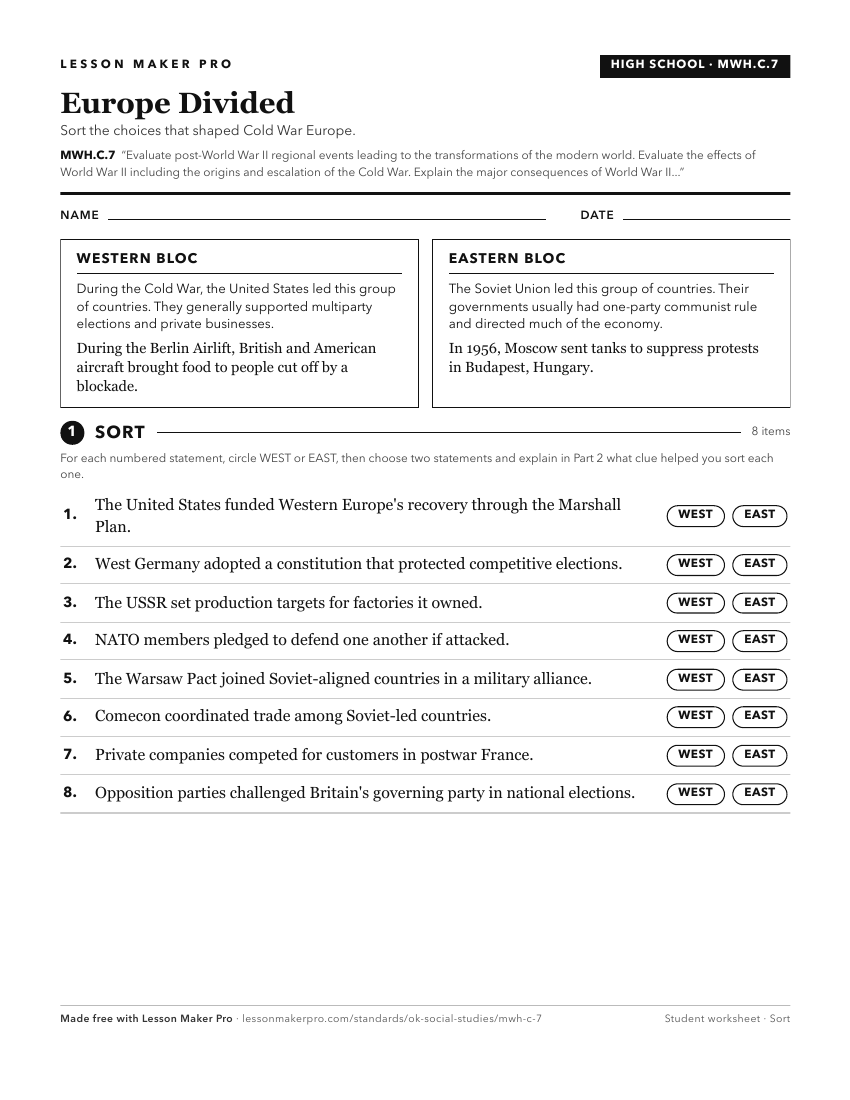
A ready-to-print activity worksheet aligned to MWH.C.7, with an answer key for the teacher on its own page. No account needed.
PDF, US Letter, prints cleanly in black and white.
Download the worksheetKeep exploring
Related Standards
Turn this cluster into a lesson
Grade, subject, topic, and the complete cluster are prefilled. Create one free, no account needed.
Also for this cluster:Make a WorksheetMake a QuizMake a Sub Lesson