Oklahoma Social Studies MWH.C.7.6.B
The Standard
- MWH.C.7
- Evaluate post-World War II regional events leading to the transformations of the modern world.
- MWH.C.7.6
- Evaluate the conditions leading to the collapse of the Soviet Union and the consequences for Europe.
Explain how internal pressures within the Soviet Union, including economic stagnation, the burdens of military commitments, and the policies of perestroika and glasnost under Mikhail Gorbachev destabilized the Soviet system and contributed to its breakup.
Oklahoma Academic Standards for Social Studies (2026) · MWH.C.7.6
Teacher's field guide
What This Standard Means
What Students Need to Do
- Students explain how a stalled economy and costly military commitments weakened the Soviet Union. They trace how perestroika changed the economy and glasnost allowed public criticism, making it harder for leaders to keep control.
What Mastery Looks Like
- A student can link shortages and military spending to public frustration. They can explain how Gorbachev's reforms gave people more room to challenge the government and demand independence, without claiming he planned the breakup.
Common Misconceptions
- Students often mix up perestroika and glasnost or assume Gorbachev wanted the Soviet Union to break apart. Others blame the breakup only on the war in Afghanistan and overlook economic problems and independence movements.
How to Assess It
- Exit ticket: How did slow economic growth, military costs, perestroika, and glasnost each weaken Soviet control? Give one specific effect for each.
Lesson moves
Ways to Teach It
Give groups cards labeled shortages, military spending, Afghanistan, perestroika, glasnost, and independence demands; have them arrange the cards with arrows showing cause and effect.
Ask students to write three sentences answering: Why might freer speech make an already struggling government harder to hold together?
Play a matching game with cause cards and effect cards, then have students defend one match using a historical example.
Show a 1991 Soviet republics map beside a current map; have students locate two former republics and mark when each became independent.
Free download
Printable MWH.C.7.6.B Worksheet
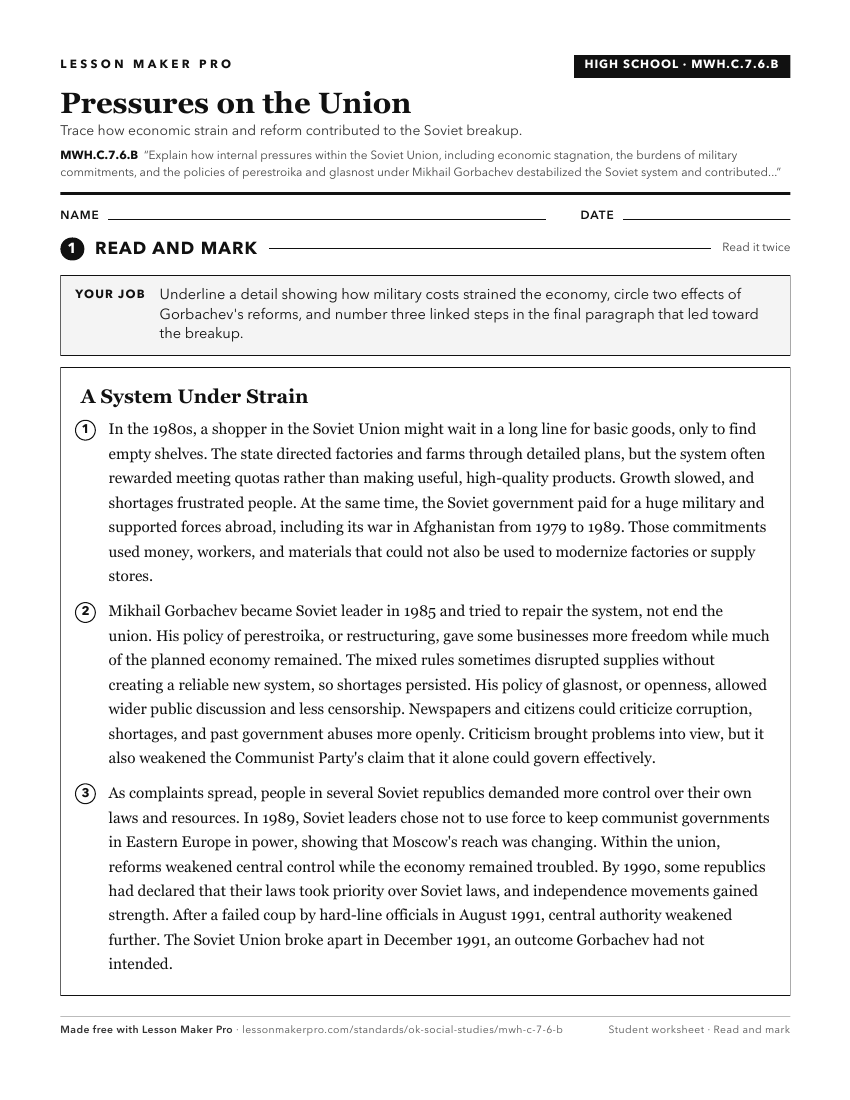
A ready-to-print activity worksheet aligned to MWH.C.7.6.B, with an answer key for the teacher on its own page. No account needed.
PDF, US Letter, prints cleanly in black and white.
Download the worksheetKeep exploring
Related Standards
- MWH.C.7.6
Evaluate the conditions leading to the collapse of the Soviet Union and the consequences for Europe.
- TOT.C.9.10
Examine the dissolution of the Union of Soviet Socialist Republics and the August Coup (e.g., the rise of Boris Yeltsin and the pluralist movement, uprisings in...
- TOT.C.9.8
Examine Gorbachev’s attempt to reform the Soviet Union, including the effects of perestroika and glasnost.
- MWH.C.7.6.C
Explain how the Revolutions of 1989 and the weakening of Soviet control contributed to the collapse of communist governments in the Eastern Bloc.
Turn this exact standard into a lesson
Grade, subject, topic, and the complete standard are prefilled. Create one free, no account needed.
Also for this standard:Make a WorksheetMake a QuizMake a Sub Lesson