Oklahoma Social Studies TOT.C.9.8
The Standard
Examine Gorbachev’s attempt to reform the Soviet Union, including the effects of perestroika and glasnost.
Oklahoma Academic Standards for Social Studies (2026)
Teacher's field guide
What This Standard Means
What Students Need to Do
- Students explain why Gorbachev tried to change the Soviet economy and government. They describe how economic restructuring and greater openness affected public life and Soviet control.
What Mastery Looks Like
- Students identify which reform allowed limited private business and which allowed more public criticism. They explain how criticism and demands for independence strained Soviet rule.
Common Misconceptions
- Students may confuse the two reforms and call glasnost an economic policy. They may think Gorbachev planned to end the Soviet Union or that his reforms alone caused its collapse.
How to Assess It
- Exit ticket: A newspaper criticizes food shortages, and a factory gets more control over production. Name the reform shown in each example and explain one possible political effect.
Lesson moves
Ways to Teach It
Give pairs six printed policy and newspaper cards to sort under perestroika or glasnost, then have them label one possible effect of each.
Ask students to write three sentences: Why might Gorbachev welcome public criticism, and how might it weaken his control?
Play a matching game with cards showing reforms and effects, such as new cooperatives and public criticism of officials.
Find a local news article criticizing a government decision; underline one claim and discuss how public criticism can pressure leaders to respond.
Free download
Printable TOT.C.9.8 Worksheet
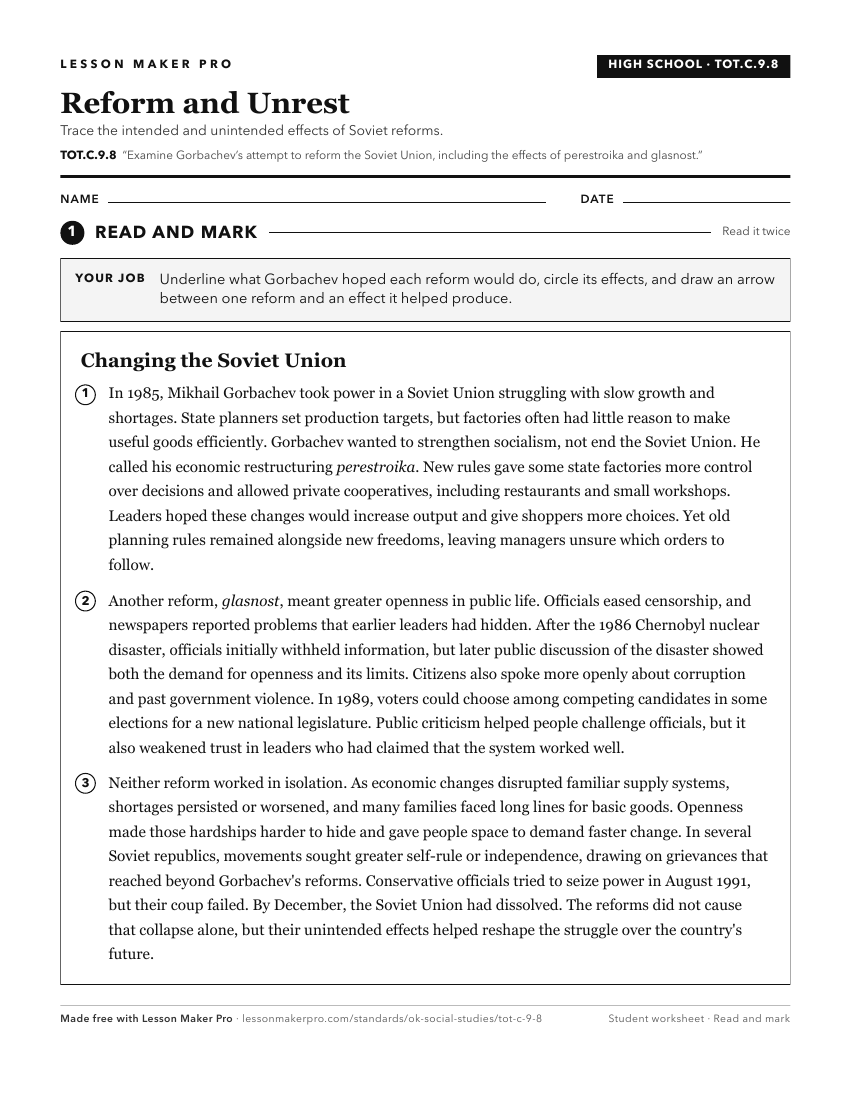
A ready-to-print activity worksheet aligned to TOT.C.9.8, with an answer key for the teacher on its own page. No account needed.
PDF, US Letter, prints cleanly in black and white.
Download the worksheetKeep exploring
Related Standards
- MWH.C.7.6.B
Explain how internal pressures within the Soviet Union, including economic stagnation, the burdens of military commitments, and the policies of perestroika and ...
- MWH.C.7.6.F
Assess the role of Western leadership, diplomacy, and dissident movements in weakening Soviet power and encouraging democratic transitions, including figures su...
- MWH.C.7.6.D
Analyze the effect of the collapse of the Soviet Union on global power dynamics, including the emergence of new democracies in Eastern Europe.
- TOT.C.9.10
Examine the dissolution of the Union of Soviet Socialist Republics and the August Coup (e.g., the rise of Boris Yeltsin and the pluralist movement, uprisings in...
Turn this exact standard into a lesson
Grade, subject, topic, and the complete standard are prefilled. Create one free, no account needed.
Also for this standard:Make a WorksheetMake a QuizMake a Sub Lesson