Oklahoma Social Studies MWH.C.7.6.F
The Standard
- MWH.C.7
- Evaluate post-World War II regional events leading to the transformations of the modern world.
- MWH.C.7.6
- Evaluate the conditions leading to the collapse of the Soviet Union and the consequences for Europe.
Assess the role of Western leadership, diplomacy, and dissident movements in weakening Soviet power and encouraging democratic transitions, including figures such as Ronald Reagan, Margaret Thatcher, Pope John Paul II, Willy Brandt, Václav Havel, and Lech Wa∤ęsa.
Oklahoma Academic Standards for Social Studies (2026) · MWH.C.7.6
Teacher's field guide
What This Standard Means
What Students Need to Do
- Students explain how diplomacy, Western pressure, and protests challenged Soviet control. They use specific events to show how people inside and outside Eastern Europe helped bring about democratic change.
What Mastery Looks Like
- Students can place Brandt's Ostpolitik, the pope's Poland visit, Solidarity's strikes, and Havel's protests in order. They can explain how those actions differed and why no single leader brought down Soviet power.
Common Misconceptions
- Students may treat Poland and the Soviet Union as the same country, or credit Reagan alone with ending Soviet rule. They may place Brandt's diplomacy in 1989, though it began much earlier.
How to Assess It
- Exit ticket: How did Reagan's arms talks and Wałęsa's Solidarity strikes challenge Soviet power in different ways? Name one action each took.
Lesson moves
Ways to Teach It
Place six event cards in date order: Brandt's Ostpolitik, the pope's Poland visit, Solidarity strikes, Thatcher's Gorbachev meeting, Reagan's arms talks, Havel's protests.
Ask: Did pressure from Western leaders or protests within Eastern Europe do more to weaken Soviet control? Defend your answer with two events.
Play a six-card match: pair each figure with an action, then label the action diplomacy, Western pressure, or protest.
Compare Solidarity's 1980 demand for independent unions with a recent Starbucks Workers United strike notice; circle the rights workers seek.
Free download
Printable MWH.C.7.6.F Worksheet
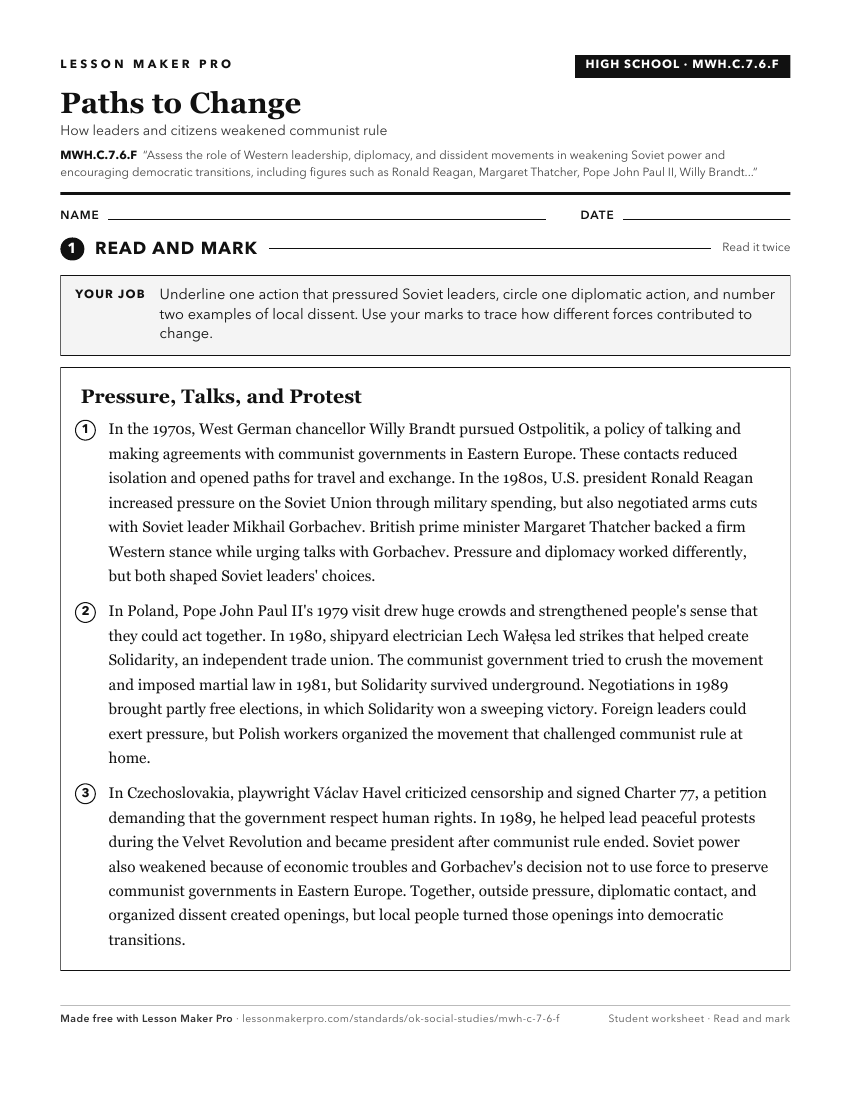
A ready-to-print activity worksheet aligned to MWH.C.7.6.F, with an answer key for the teacher on its own page. No account needed.
PDF, US Letter, prints cleanly in black and white.
Download the worksheetKeep exploring
Related Standards
- MWH.C.7.6.D
Analyze the effect of the collapse of the Soviet Union on global power dynamics, including the emergence of new democracies in Eastern Europe.
- TOT.C.9.8
Examine Gorbachev’s attempt to reform the Soviet Union, including the effects of perestroika and glasnost.
- MWH.C.7.6.C
Explain how the Revolutions of 1989 and the weakening of Soviet control contributed to the collapse of communist governments in the Eastern Bloc.
- TOT.C.9.7
Describe the decay and dissolution of the Union of Soviet Socialist Republics, including the effect of the Reagan Doctrine, American support for anti-communists...
Turn this exact standard into a lesson
Grade, subject, topic, and the complete standard are prefilled. Create one free, no account needed.
Also for this standard:Make a WorksheetMake a QuizMake a Sub Lesson