Oklahoma Social Studies MWH.C.7.6
Standard Cluster
- MWH.C.7
- Evaluate post-World War II regional events leading to the transformations of the modern world.
Evaluate the conditions leading to the collapse of the Soviet Union and the consequences for Europe. Examine the goals of Poland’s Solidarity Movement and other civil resistance movements that challenged communist rule. Explain how internal pressures within the Soviet Union, including economic stagnation, the burdens of military commitments, and the policies of perestroika and glasnost under Mikhail Gorbachev destabilized the Soviet system and contributed to its breakup. Explain how the Revolutions of 1989 and the weakening of Soviet control contributed to the collapse of communist governments in the Eastern Bloc. Analyze the effect of the collapse of the Soviet Union on global power dynamics, including the emergence of new democracies in Eastern Europe. Describe European politics since the fall of the Soviet Union, including the expansion of the European Union and NATO, continued national loyalties, and the reemergence of Russia as a major power including conflicts such as the annexation of Crimea and the war in Ukraine. Assess the role of Western leadership, diplomacy, and dissident movements in weakening Soviet power and encouraging democratic transitions, including figures such as Ronald Reagan, Margaret Thatcher, Pope John Paul II, Willy Brandt, Václav Havel, and Lech Wa∤ęsa. Explore key components of Western Europe’s postwar rise in prosperity and stability (e.g., economic recovery and development, trade and innovation, rising living standards) and how these conditions shaped Europe’s post-Cold War trajectory.
Oklahoma Academic Standards for Social Studies (2026) · MWH.C.7
Cluster contents
Standards in This Cluster
MWH.C.7.6 is a cluster heading. These are the individual standards under it.
- MWH.C.7.6.A
Examine the goals of Poland’s Solidarity Movement and other civil resistance movements that challenged communist rule.
- MWH.C.7.6.B
Explain how internal pressures within the Soviet Union, including economic stagnation, the burdens of military commitments, and the policies of perestroika and ...
- MWH.C.7.6.C
Explain how the Revolutions of 1989 and the weakening of Soviet control contributed to the collapse of communist governments in the Eastern Bloc.
- MWH.C.7.6.D
Analyze the effect of the collapse of the Soviet Union on global power dynamics, including the emergence of new democracies in Eastern Europe.
- MWH.C.7.6.E
Describe European politics since the fall of the Soviet Union, including the expansion of the European Union and NATO, continued national loyalties, and the ree...
- MWH.C.7.6.F
Assess the role of Western leadership, diplomacy, and dissident movements in weakening Soviet power and encouraging democratic transitions, including figures su...
- MWH.C.7.6.G
Explore key components of Western Europe’s postwar rise in prosperity and stability (e.g., economic recovery and development, trade and innovation, rising livin...
Teacher's field guide
What This Cluster Means
What Students Need to Do
- Students trace how economic stagnation, military costs, Gorbachev’s reforms, and protests weakened Soviet control. They explain the fall of communist governments in 1989 and the Soviet breakup in 1991. They connect those events to new democracies, EU and NATO expansion, and conflict with Russia.
What Mastery Looks Like
- A student can put Solidarity, the 1989 revolutions, and the 1991 breakup in order and explain how they connect. They can describe the distinct roles of dissidents, Western leaders, and Soviet reforms. They can explain how Western Europe’s earlier prosperity supported integration, while national loyalties and Russian power continued to shape politics.
Common Misconceptions
- Students may think Gorbachev meant to dissolve the Soviet Union, rather than reform it. They may treat the revolutions of 1989 and the breakup in 1991 as one event. They may also confuse the EU with NATO or assume every former communist country joined both.
How to Assess It
- On an exit ticket, ask students to link one Soviet economic or military problem, one reform, and one Eastern European protest to the 1991 breakup. Have them name one later change in Europe.
Lesson moves
Ways to Teach It
Give pairs dated cards for Solidarity, perestroika, the Berlin Wall, and the Soviet breakup, then have them arrange and connect the cards with arrows.
Ask students to write: Did Solidarity, Gorbachev’s reforms, or Reagan’s diplomacy do more to weaken Soviet power? Defend one choice.
Sort cards for military costs, glasnost, Solidarity, 1989 elections, NATO expansion, and Crimea’s annexation into pressures, turning points, or later effects.
Compare a 1990 Europe map with current EU and NATO maps, then mark Poland, Ukraine, and Crimea and discuss why borders still matter.
Free download
Printable MWH.C.7.6 Worksheet
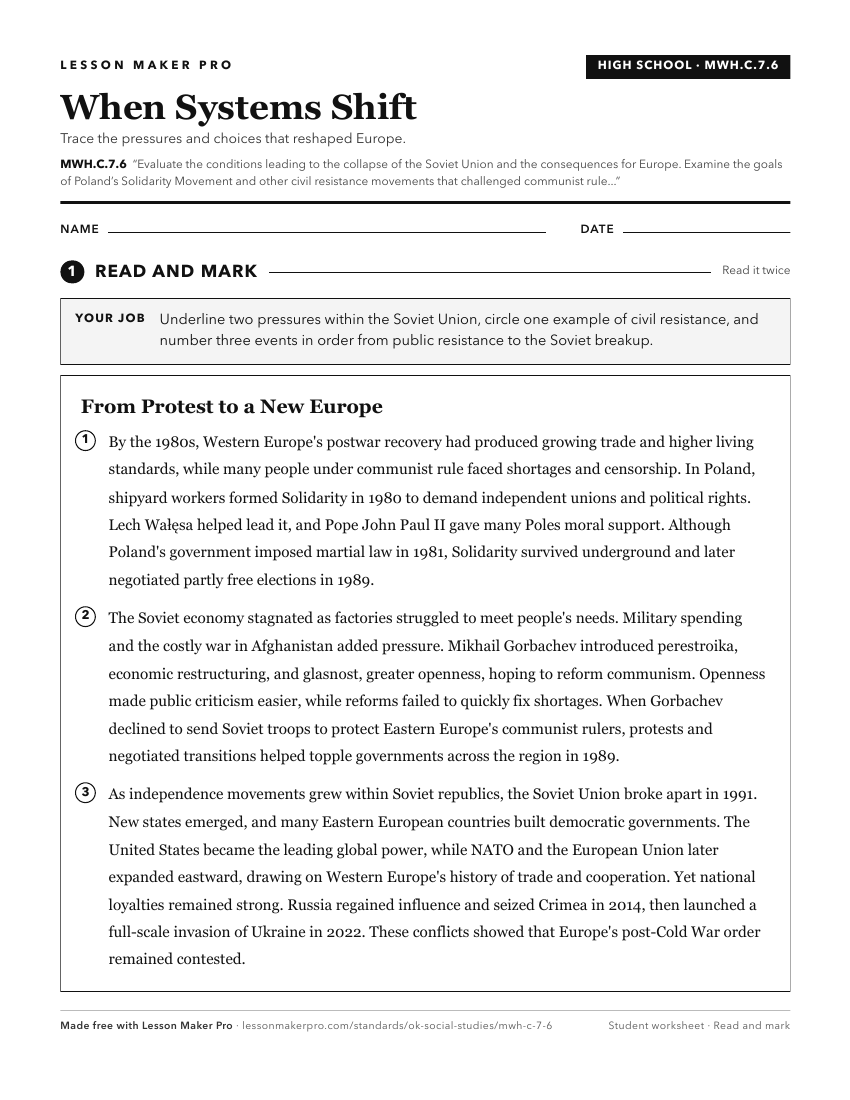
A ready-to-print activity worksheet aligned to MWH.C.7.6, with an answer key for the teacher on its own page. No account needed.
PDF, US Letter, prints cleanly in black and white.
Download the worksheetKeep exploring
Related Standards
Turn this cluster into a lesson
Grade, subject, topic, and the complete cluster are prefilled. Create one free, no account needed.
Also for this cluster:Make a WorksheetMake a QuizMake a Sub Lesson