Oklahoma Social Studies MWH.C.7.3
Standard Cluster
- MWH.C.7
- Evaluate post-World War II regional events leading to the transformations of the modern world.
Assess the impact of independence movements on human rights and the global expansion of democracy in South Asia. Describe the fall of the British Raj and the emergence of an independent India and Pakistan, including the influence, ideas, and acts of civil disobedience by Mohandas Gandhi. Describe the partitioning of India and subsequent international relations (e.g., Indo-Pakistani wars, Non-Aligned Movement, India’s secular constitution, experiences with socialism, free-market reforms).
Oklahoma Academic Standards for Social Studies (2026) · MWH.C.7
Cluster contents
Standards in This Cluster
MWH.C.7.3 is a cluster heading. These are the individual standards under it.
- MWH.C.7.3.A
Describe the fall of the British Raj and the emergence of an independent India and Pakistan, including the influence, ideas, and acts of civil disobedience by M...
- MWH.C.7.3.B
Describe the partitioning of India and subsequent international relations (e.g., Indo-Pakistani wars, Non-Aligned Movement, India’s secular constitution, experi...
Teacher's field guide
What This Cluster Means
What Students Need to Do
- Students explain how Gandhi’s civil disobedience challenged British rule before independence in 1947. They map the partition of British India into India and Pakistan and describe its effects on people and relations between the countries. They judge how independence changed human rights and democracy.
What Mastery Looks Like
- A student can explain how the Salt March challenged British authority and why partition displaced millions. They can weigh India’s secular constitution against violence during partition when judging gains and limits for rights. They can connect wars with Pakistan, India’s nonalignment, and its later market reforms to choices made after independence.
Common Misconceptions
- Students may think Gandhi alone won independence or that all resistance was nonviolent. Some imagine partition drew a clean line between religious groups and overlook the violence and mass displacement. Others assume independence brought equal rights and stable democracy to both countries right away.
How to Assess It
- Exit ticket: Name one way Gandhi challenged British rule. Then give one gain for democracy after independence and one human rights cost of partition, with a specific example of each.
Lesson moves
Ways to Teach It
Give pairs a 1947 partition map and migration arrows; have them mark Punjab and Bengal and note where families fled.
Ask: Did independence guarantee equal rights? Write a claim using a partition refugee account and a passage from India’s secular constitution.
Match four event cards, Salt March, partition, nonalignment, and market reforms, to four consequence cards, then defend each match.
On a current map of South Asia, locate Kashmir and explain how the dispute that began in 1947 still shapes India-Pakistan relations.
Free download
Printable MWH.C.7.3 Worksheet
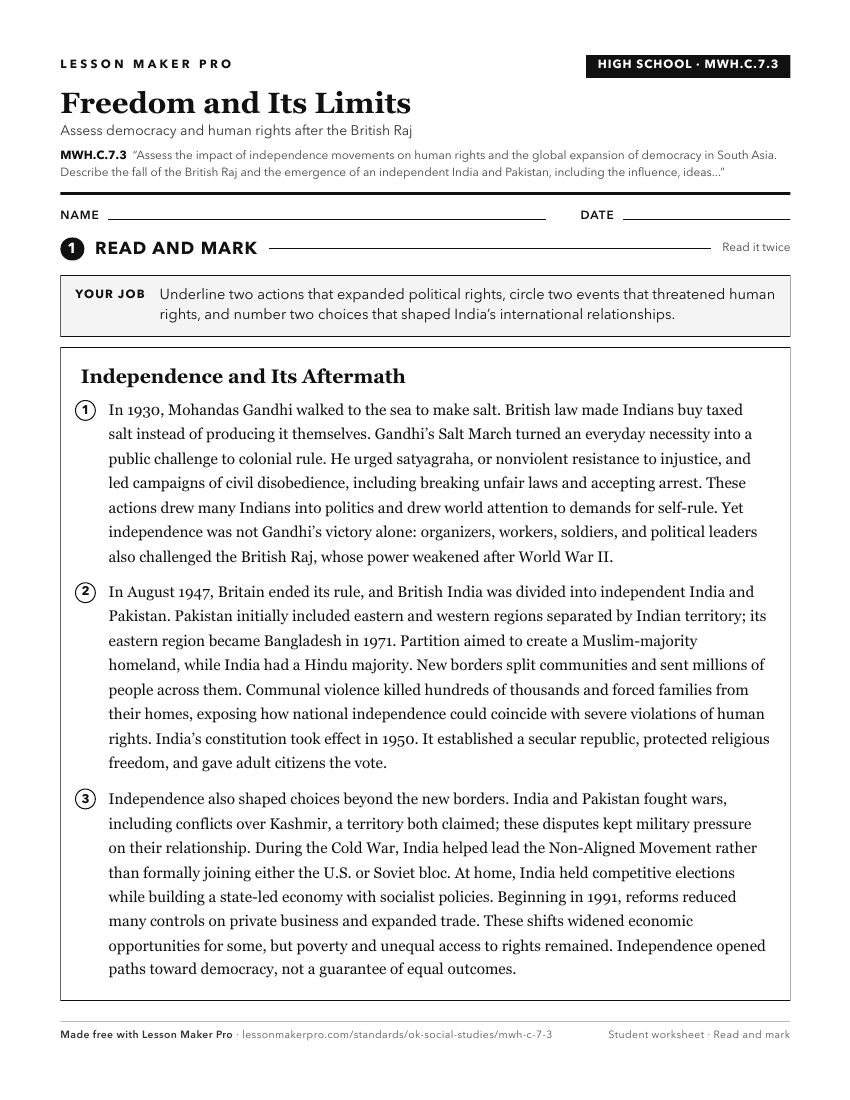
A ready-to-print activity worksheet aligned to MWH.C.7.3, with an answer key for the teacher on its own page. No account needed.
PDF, US Letter, prints cleanly in black and white.
Download the worksheetKeep exploring
Related Standards
- MWH.C.7.4
Analyze political and cultural transformations occurring in East and Southeast Asia during the postwar era.
- MWH.C.7.6.D
Analyze the effect of the collapse of the Soviet Union on global power dynamics, including the emergence of new democracies in Eastern Europe.
- MWH.C.7.5
Assess the impact of African independence movements on human rights and the global expansion of democracy..
Turn this cluster into a lesson
Grade, subject, topic, and the complete cluster are prefilled. Create one free, no account needed.
Also for this cluster:Make a WorksheetMake a QuizMake a Sub Lesson