Oklahoma Social Studies MWH.C.7.3.A
The Standard
- MWH.C.7
- Evaluate post-World War II regional events leading to the transformations of the modern world.
- MWH.C.7.3
- Assess the impact of independence movements on human rights and the global expansion of democracy in South Asia.
Describe the fall of the British Raj and the emergence of an independent India and Pakistan, including the influence, ideas, and acts of civil disobedience by Mohandas Gandhi.
Oklahoma Academic Standards for Social Studies (2026) · MWH.C.7.3
Teacher's field guide
What This Standard Means
What Students Need to Do
- Explain how Gandhi used nonviolent protest to challenge British rule. Describe how World War II weakened Britain and why the Muslim League pushed for Pakistan. Explain how Partition displaced people in 1947.
What Mastery Looks Like
- A student places the Salt March, World War II, and independence in order. They explain Gandhi's methods and the Muslim League's goal. They connect Partition to mass migration and violence.
Common Misconceptions
- Students may think Gandhi alone ended British rule or wanted Pakistan created. They may assume his nonviolent protests meant Partition was peaceful, or that Pakistan formed years after India became independent.
How to Assess It
- Exit ticket: Explain how the Salt March challenged British rule, why Pakistan formed, and one effect of Partition on people.
Lesson moves
Ways to Teach It
Give pairs a 1946 British India map and a 1947 borders map to trace new borders and two migration routes.
Ask students to write: How did Gandhi's public salt making challenge British rule without using force?
Hand out cards for the 1930 Salt March, 1939 war outbreak, 1942 Quit India campaign, and 1947 Partition; teams sort them.
Use a current map to find Lahore and Amritsar, then explain how the border still separates these nearby cities.
Free download
Printable MWH.C.7.3.A Worksheet
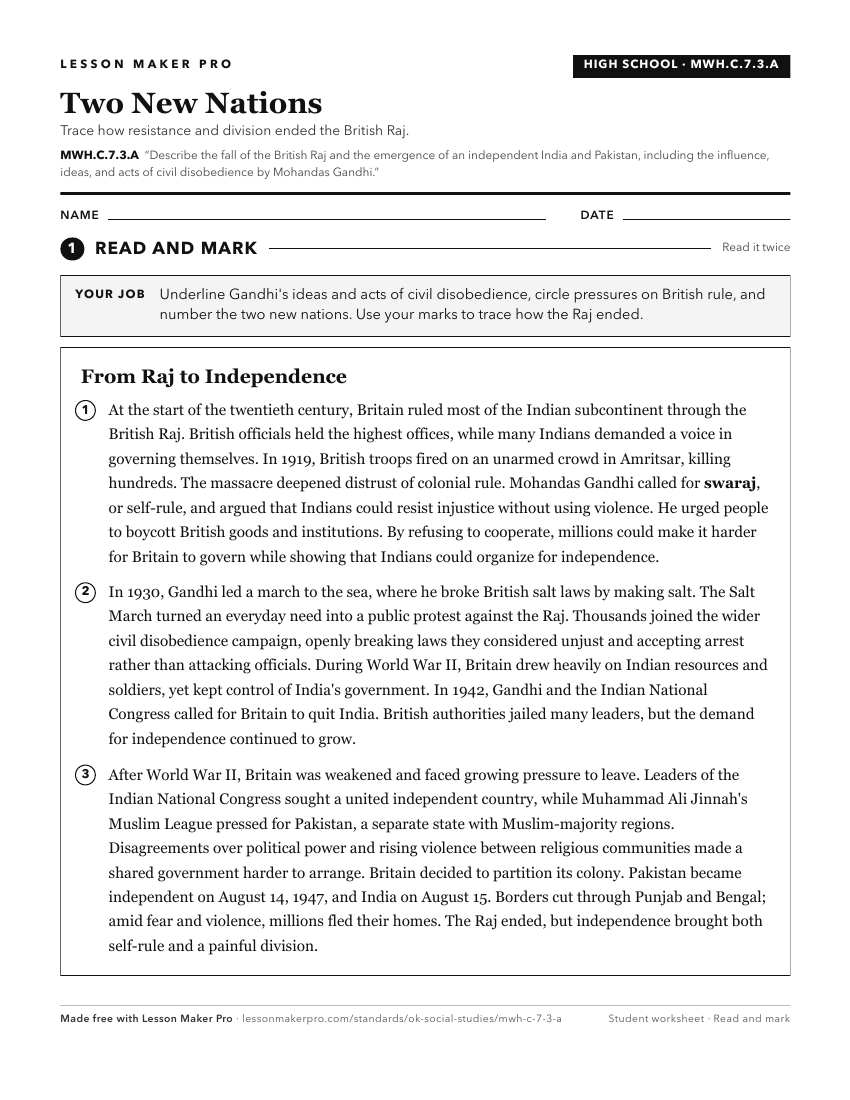
A ready-to-print activity worksheet aligned to MWH.C.7.3.A, with an answer key for the teacher on its own page. No account needed.
PDF, US Letter, prints cleanly in black and white.
Download the worksheetKeep exploring
Related Standards
- MWH.C.5.3.D
Assess the political, economic, and cultural impact of the British Raj, Britain’s subordination of India, as characterized by economic, educational, and infrast...
- MWH.C.7.3.B
Describe the partitioning of India and subsequent international relations (e.g., Indo-Pakistani wars, Non-Aligned Movement, India’s secular constitution, experi...
- 8.C.2.3
Evaluate the challenges and reasons for the colonial victory over the British Empire.
- AWH.C.11.2
Describe the rise and fall of the Mughal Empire, including important political, economic, and cultural aspects of early modern Indian history (e.g., rise and de...
Turn this exact standard into a lesson
Grade, subject, topic, and the complete standard are prefilled. Create one free, no account needed.
Also for this standard:Make a WorksheetMake a QuizMake a Sub Lesson