Oklahoma Social Studies AWH.C.11.2
The Standard
Describe the rise and fall of the Mughal Empire, including important political, economic, and cultural aspects of early modern Indian history (e.g., rise and development of the Sikh religion and states, Portuguese maritime hegemony, Mughal rule and persecution of Hindus).
Oklahoma Academic Standards for Social Studies (2026)
Teacher's field guide
What This Standard Means
What Students Need to Do
- Students trace how Mughal rulers gained and lost control of northern India. They explain how taxes, trade, religion, and art shaped life under Mughal rule. They place Portuguese sea trade and the growth of Sikh communities and states on the same timeline.
What Mastery Looks Like
- Students can place Babur’s 1526 victory, Akbar’s rule, and the weakening of Mughal power after Aurangzeb in order. They can explain how land taxes supported the empire and how costly wars weakened it. They can name an example of Mughal art and explain that rulers differed in their treatment of Hindus.
Common Misconceptions
- Some students think every Mughal ruler treated Hindus the same way. Others think Sikhism began after Aurangzeb or that the Portuguese ruled all of India. Students may mistake the decline after 1707 for the empire’s formal end in 1858.
How to Assess It
- Exit ticket: Put Babur, Akbar, Aurangzeb, and the rise of Sikh states in order. Then name one Mughal revenue policy, one difference in religious policy, and one role played by Portuguese traders.
Lesson moves
Ways to Teach It
Give pairs maps of South Asia around 1600 and 1750; have them mark Mughal territory, Goa, and later Sikh states.
Give students short textbook passages on Akbar and Aurangzeb; ask, “How did their policies toward Hindus differ?”
Run a timeline relay with cards for Guru Nanak, Portuguese Goa, Babur’s victory, Akbar’s reign, Aurangzeb’s death, and Sikh states.
On a current map, find Goa, Agra, and Amritsar; connect each place to Portuguese trade, Mughal architecture, or Sikh history.
Free download
Printable AWH.C.11.2 Worksheet
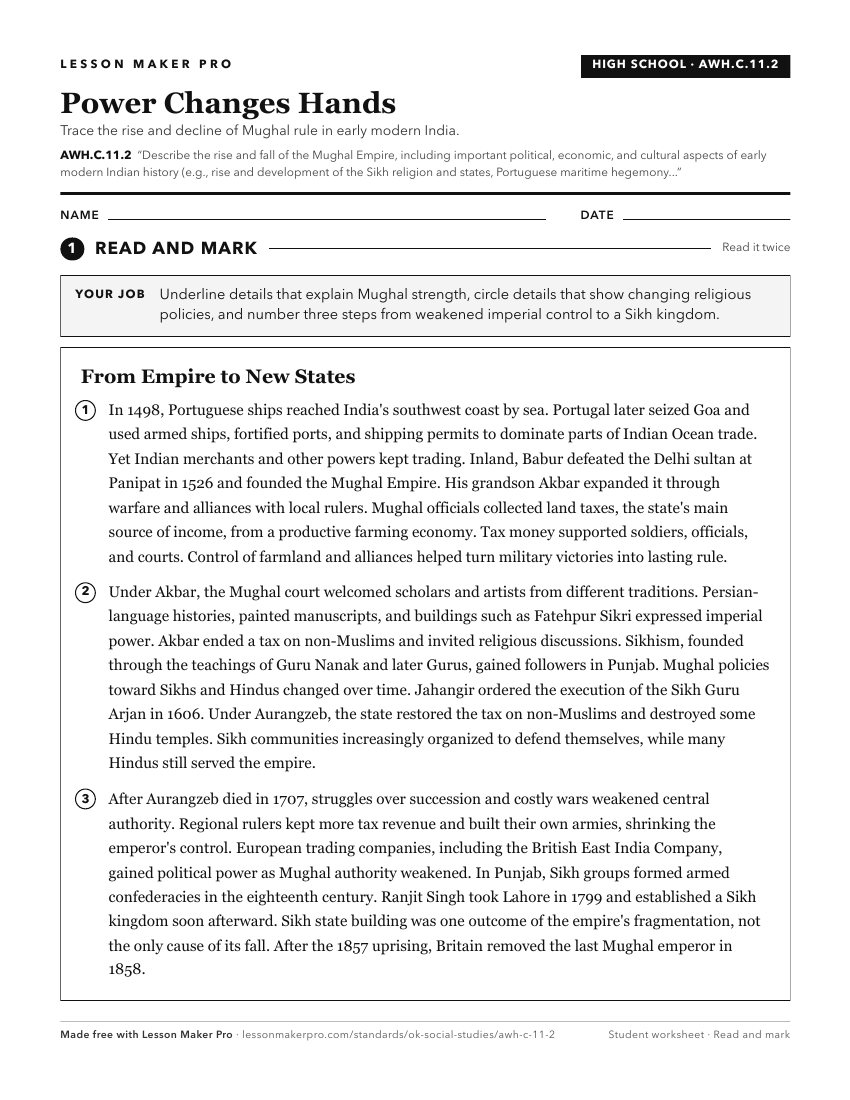
A ready-to-print activity worksheet aligned to AWH.C.11.2, with an answer key for the teacher on its own page. No account needed.
PDF, US Letter, prints cleanly in black and white.
Download the worksheetKeep exploring
Related Standards
- AWH.C.8.2
Explain the origins and significant aspects of Buddhism, including the life and teachings of Siddhartha Gautama, the evolution and central principles of Buddhis...
- MWH.C.7.3.A
Describe the fall of the British Raj and the emergence of an independent India and Pakistan, including the influence, ideas, and acts of civil disobedience by M...
- AWH.C.11.1
Explain the significance of Indian and Chinese civilizations from 1000-1500 (e.g., the expansion of Islam into India, Delhi Sultanate) and political, economic, ...
- AWH.C.8.3
Describe important political, economic, and cultural aspects of Indian history, including the Maurya and Kushan Empires, the Gupta Empire, Golden Age of India, ...
Turn this exact standard into a lesson
Grade, subject, topic, and the complete standard are prefilled. Create one free, no account needed.
Also for this standard:Make a WorksheetMake a QuizMake a Sub Lesson