Oklahoma Social Studies AWH.C.8.3
The Standard
Describe important political, economic, and cultural aspects of Indian history, including the Maurya and Kushan Empires, the Gupta Empire, Golden Age of India, Indian mathematics, and maritime expansion.
Oklahoma Academic Standards for Social Studies (2026)
Teacher's field guide
What This Standard Means
What Students Need to Do
- Students compare Maurya, Kushan, and Gupta rule, trade, and culture. They explain Indian contributions to mathematics and trace sea trade routes across the Indian Ocean.
What Mastery Looks Like
- A student can place Ashoka, Kushan trade networks, and Gupta achievements in the right order and explain each. They can map a sea route to Southeast Asia and explain how place value and zero work. They can explain why a golden age did not benefit everyone equally.
Common Misconceptions
- Students may put Ashoka in the Gupta period or treat all three empires as one state. They may assume a golden age meant everyone prospered. Some think Indian trade stayed on land or that zero and place value appeared all at once.
How to Assess It
- Exit ticket: Name one accurate fact about each empire, identify one Indian math contribution, and mark one Indian Ocean trade route on a small map.
Lesson moves
Ways to Teach It
Give groups Ashoka edict excerpts, Kushan coin images, and Gupta temple photos; have them place each on a paper timeline.
Read a short account of Gupta scholars and farmers, then ask: Who gained from the golden age, and who might not?
Run a card match pairing Ashoka, Kushan coins, Gupta art, place value, and Indian Ocean ports with short descriptions.
Trace a shipping route from Mumbai to Singapore on a map, then compare it with an ancient route from India to Southeast Asia.
Free download
Printable AWH.C.8.3 Worksheet
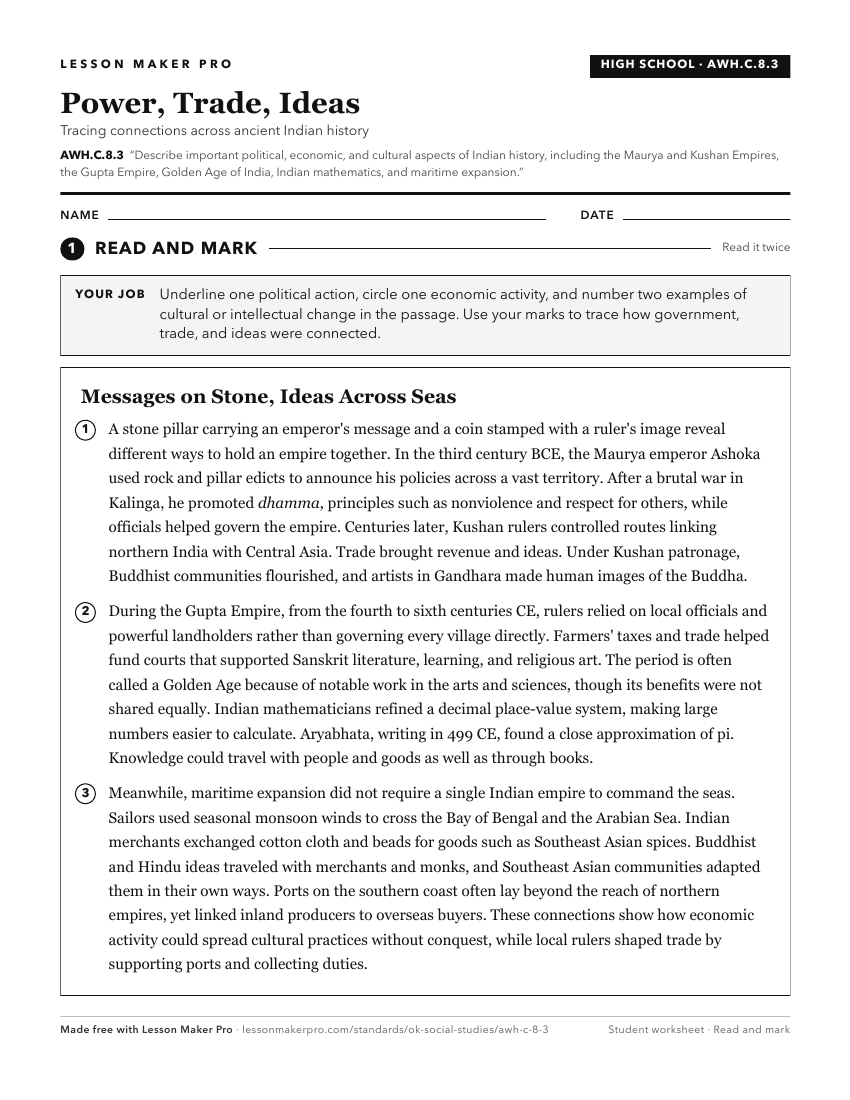
A ready-to-print activity worksheet aligned to AWH.C.8.3, with an answer key for the teacher on its own page. No account needed.
PDF, US Letter, prints cleanly in black and white.
Download the worksheetKeep exploring
Related Standards
- AWH.C.8.1
Describe the origins of Indian civilizations such as those of the Indus Valley, the evolution and central principles of Hinduism and the development of early In...
- AWH.C.11.1
Explain the significance of Indian and Chinese civilizations from 1000-1500 (e.g., the expansion of Islam into India, Delhi Sultanate) and political, economic, ...
- AWH.C.11.2
Describe the rise and fall of the Mughal Empire, including important political, economic, and cultural aspects of early modern Indian history (e.g., rise and de...
- AWH.C.8.6
Assess the significance and legacy of political, economic, and cultural aspects of the Qin, Han, and Tang dynasties (e.g., unification of China, construction of...
Turn this exact standard into a lesson
Grade, subject, topic, and the complete standard are prefilled. Create one free, no account needed.
Also for this standard:Make a WorksheetMake a QuizMake a Sub Lesson