Oklahoma Social Studies AWH.C.8.1
The Standard
Describe the origins of Indian civilizations such as those of the Indus Valley, the evolution and central principles of Hinduism and the development of early Indian societies and their organizational structures.
Oklahoma Academic Standards for Social Studies (2026)
Teacher's field guide
What This Standard Means
What Students Need to Do
- Students use maps and artifacts to explain how farming, trade, and rivers supported Indus cities. They explain how Vedic and other traditions shaped Hindu beliefs about dharma, karma, rebirth, and moksha. They describe how social groups and rulers organized later societies.
What Mastery Looks Like
- A student places Indus cities before the Vedic period and uses street plans or drains as evidence of organized city life. They explain karma and rebirth in their own words without claiming these beliefs are proven for the Indus civilization. They describe how varna ranked social groups in later societies.
Common Misconceptions
- Students may treat Indus artifacts as proof that people there held later Hindu beliefs. They may think karma means instant punishment or that every early Indian community had the same social structure.
How to Assess It
- Exit ticket: Place Indus cities, the Vedic period, and early kingdoms in order. Name one piece of Indus evidence, explain karma and rebirth, and identify one way a later society was organized.
Lesson moves
Ways to Teach It
Use graph paper and tiles to build an Indus street grid, then add wells and drains from a Mohenjo-daro site diagram.
Ask students: What can a city drain tell us about Indus society, and what can it not tell us about religion?
Sort source cards into two groups, Indus artifacts and Vedic texts; have students explain where each card belongs.
Compare a current satellite image of the Indus basin with an ancient city map; circle where rivers support farming today.
Free download
Printable AWH.C.8.1 Worksheet
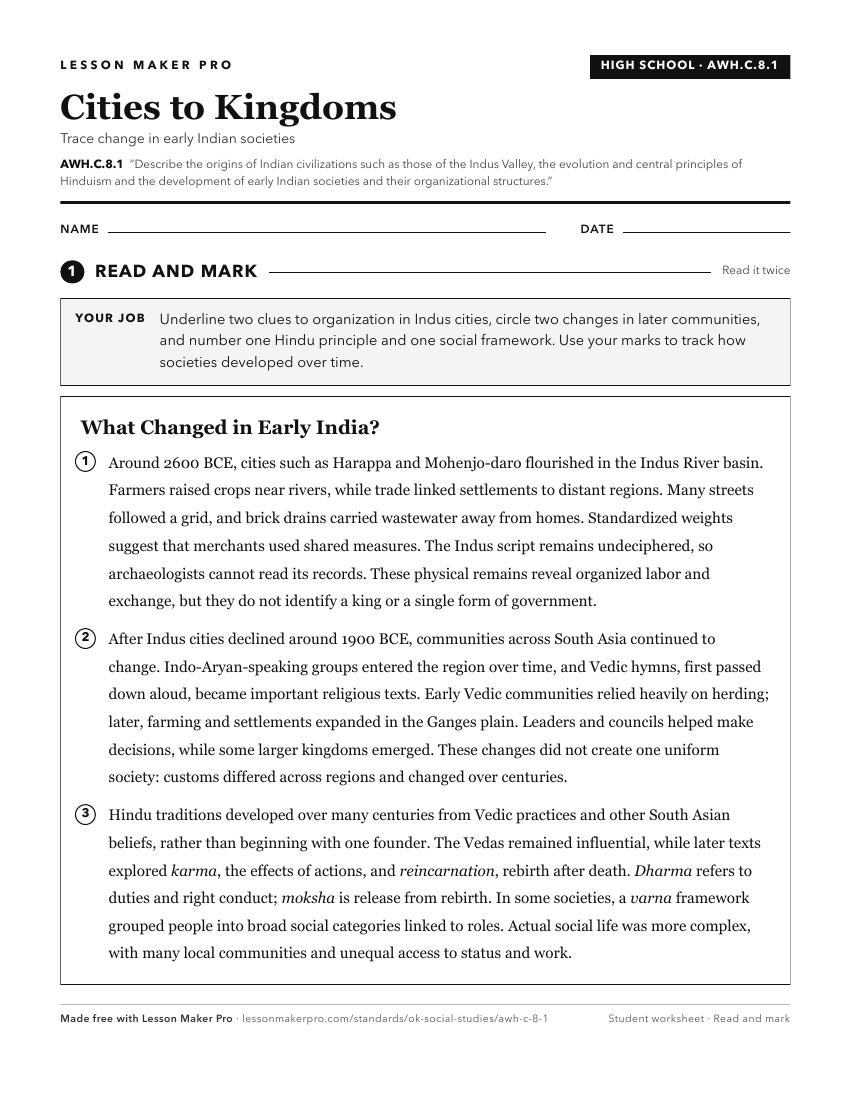
A ready-to-print activity worksheet aligned to AWH.C.8.1, with an answer key for the teacher on its own page. No account needed.
PDF, US Letter, prints cleanly in black and white.
Download the worksheetKeep exploring
Related Standards
- AWH.C.8.2
Explain the origins and significant aspects of Buddhism, including the life and teachings of Siddhartha Gautama, the evolution and central principles of Buddhis...
- AWH.C.11.1
Explain the significance of Indian and Chinese civilizations from 1000-1500 (e.g., the expansion of Islam into India, Delhi Sultanate) and political, economic, ...
- AWH.C.1.6
Identify the major characteristics of civilizations (e.g., geographic boundaries and political institutions, economies that produce food surpluses, the formatio...
- AWH.C.8.3
Describe important political, economic, and cultural aspects of Indian history, including the Maurya and Kushan Empires, the Gupta Empire, Golden Age of India, ...
Turn this exact standard into a lesson
Grade, subject, topic, and the complete standard are prefilled. Create one free, no account needed.
Also for this standard:Make a WorksheetMake a QuizMake a Sub Lesson