Oklahoma Social Studies AWH.C.1.6
The Standard
Identify the major characteristics of civilizations (e.g., geographic boundaries and political institutions, economies that produce food surpluses, the formation of cities and states, social classes and hierarchical organization, developed systems of religion, learning, art, and architecture, and systems of writing and record keeping).
Oklahoma Academic Standards for Social Studies (2026)
Teacher's field guide
What This Standard Means
What Students Need to Do
- Students use maps and artifacts to identify where early civilizations grew and how people organized them. They explain how extra food supported cities, specialized jobs, and governments.
What Mastery Looks Like
- Given a map and artifacts, a student marks a civilization's area and finds evidence of leaders, social ranks, beliefs, buildings, and records. They explain how stored grain allowed some people to work outside farming.
Common Misconceptions
- Students may call any farming village a civilization just because people grew crops. They may assume everyone had equal power or that a society without surviving writing had no government.
How to Assess It
- Give students this description: “A river town stores extra grain, has a council and temple, and keeps clay records.” Ask them to name three signs of a civilization and explain how stored grain could support city jobs.
Lesson moves
Ways to Teach It
Give groups a Sumer map, grain tally, temple picture, and ruler's seal; have them place each on a paper city sketch and label its role.
Ask, “How might a full grain store change who works as farmers?” Have students write two possible jobs and explain their choices.
Play evidence bingo with cards showing a city wall, tax record, temple, and farm; students name the feature each card supports.
Give students a grocery receipt and city council agenda; compare them with a printed Sumer grain tablet and ruler's law.
Free download
Printable AWH.C.1.6 Worksheet
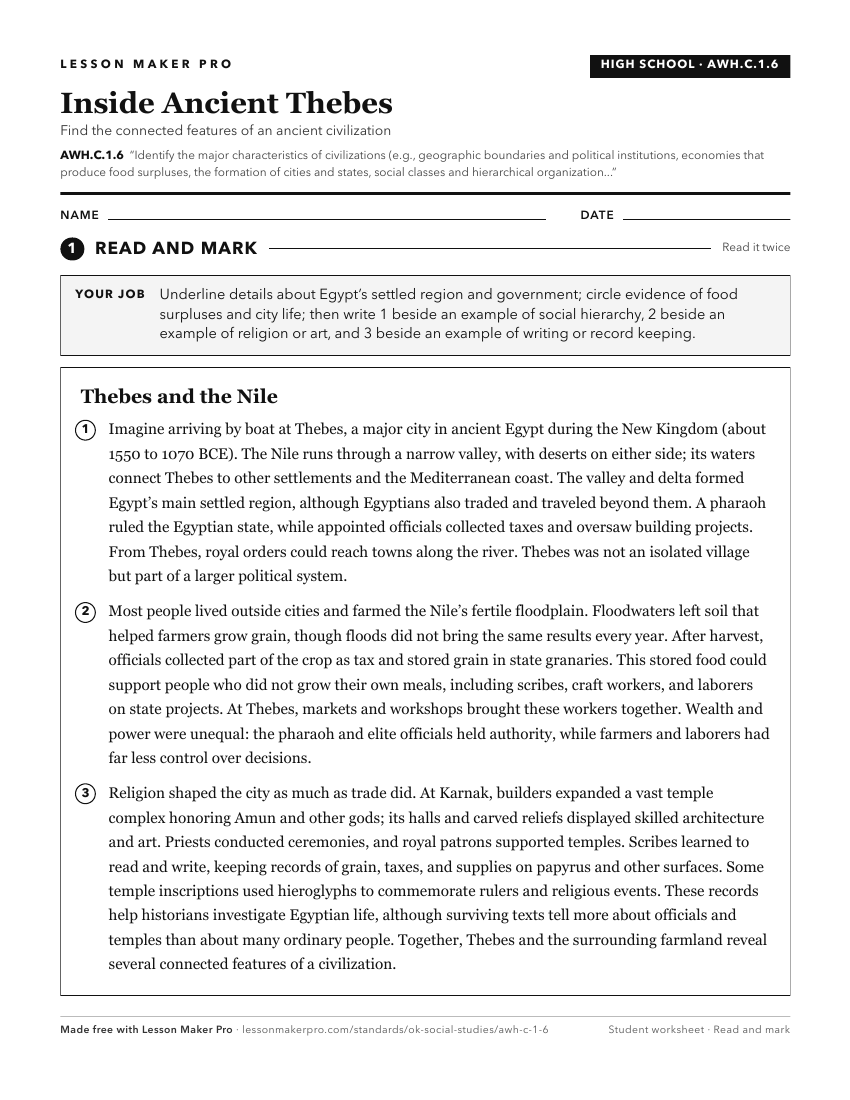
A ready-to-print activity worksheet aligned to AWH.C.1.6, with an answer key for the teacher on its own page. No account needed.
PDF, US Letter, prints cleanly in black and white.
Download the worksheetKeep exploring
Related Standards
- 7.C.5.2.B
Explain that complex societies and civilizations in different regions share common characteristics (e.g., agricultural innovations, written language, and early ...
- AWH.C.2.1
Locate on a historical map the Tigris and Euphrates Rivers, identifying Sumer, Babylon, and Assyria as successive civilizations and explaining why the region is...
- AWH.C.3.5
Summarize important achievements of Egyptian civilization (e.g., agricultural system, invention of a calendar, monumental architecture and art, hieroglyphic wri...
- AWH.C.2.4
Describe the important achievements of Mesopotamian civilization (e.g., system of writing and its importance in record keeping and tax collection, monumental ar...
Turn this exact standard into a lesson
Grade, subject, topic, and the complete standard are prefilled. Create one free, no account needed.
Also for this standard:Make a WorksheetMake a QuizMake a Sub Lesson