Oklahoma Social Studies AWH.C.11.1
The Standard
Explain the significance of Indian and Chinese civilizations from 1000-1500 (e.g., the expansion of Islam into India, Delhi Sultanate) and political, economic, and cultural aspects of Indo-Persian culture.
Oklahoma Academic Standards for Social Studies (2026)
Teacher's field guide
What This Standard Means
What Students Need to Do
- Students explain how Islamic rule grew in parts of India and how Persian and Indian traditions mixed under the Delhi Sultanate. They describe changes in government, trade, and culture during Song, Yuan, and Ming rule in China.
What Mastery Looks Like
- Students can show where the Delhi Sultanate overlaps the Song, Yuan, and Ming periods on a timeline. They explain Persian's use at court and Indian craftsmanship in Sultanate buildings. They show how Indian textiles and Chinese ceramics reached buyers across Asia.
Common Misconceptions
- Students may think the Delhi Sultanate controlled all of India throughout this period. They may assume Persian court culture replaced local customs, or put the Song, Yuan, and Ming dynasties in the wrong order.
How to Assess It
- Exit ticket: Name one way the Delhi Sultanate changed government or culture in India and one way Song, Yuan, or Ming China changed trade. Give a specific example for each.
Lesson moves
Ways to Teach It
Give pairs a blank Asia map and yarn to trace overland routes from Delhi and sea routes from Quanzhou.
Ask students: 'How might using Persian in Delhi's government change who could work at court?'
Have teams place dated cards for the Delhi Sultanate's founding, Song paper money, Yuan rule, and Ming voyages on a classroom timeline.
Compare visitor photos of Delhi's Qutb complex and Beijing's Forbidden City; mark features their rulers used to show power.
Free download
Printable AWH.C.11.1 Worksheet
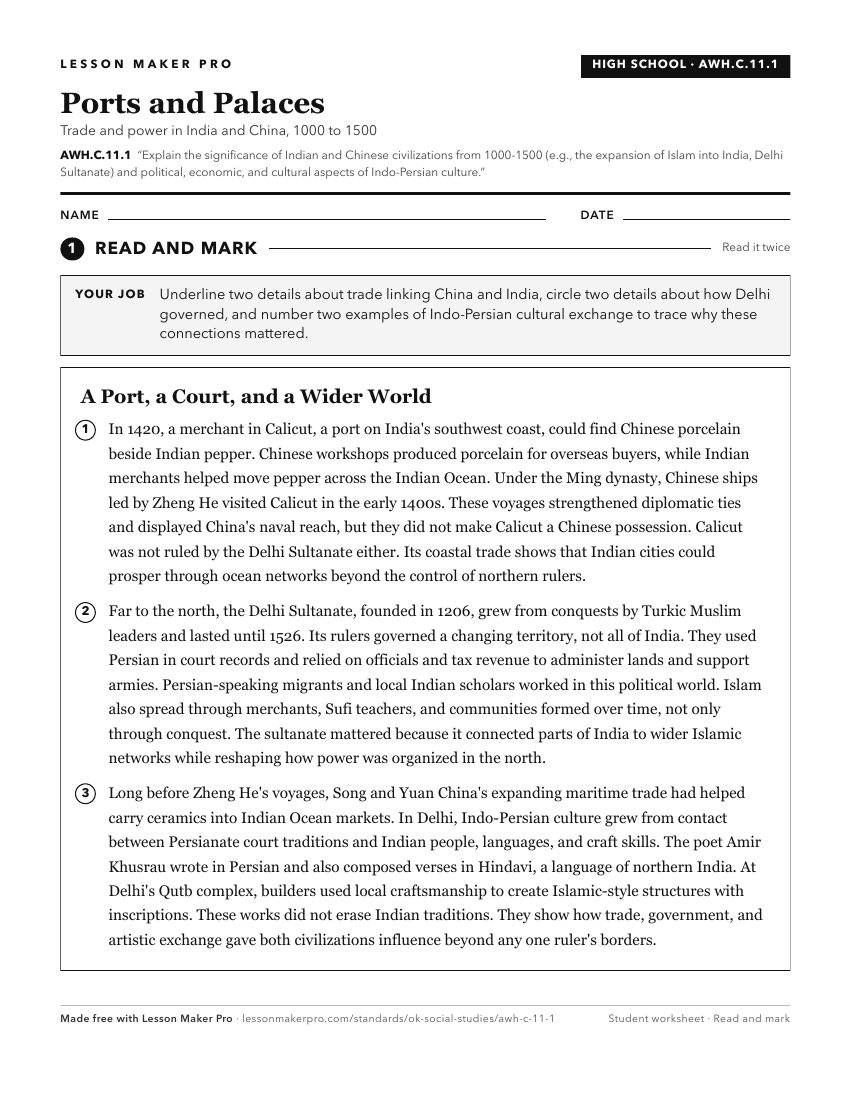
A ready-to-print activity worksheet aligned to AWH.C.11.1, with an answer key for the teacher on its own page. No account needed.
PDF, US Letter, prints cleanly in black and white.
Download the worksheetKeep exploring
Related Standards
- AWH.C.8.1
Describe the origins of Indian civilizations such as those of the Indus Valley, the evolution and central principles of Hinduism and the development of early In...
- AWH.C.11.2
Describe the rise and fall of the Mughal Empire, including important political, economic, and cultural aspects of early modern Indian history (e.g., rise and de...
- AWH.C.8.3
Describe important political, economic, and cultural aspects of Indian history, including the Maurya and Kushan Empires, the Gupta Empire, Golden Age of India, ...
- AWH.C.8.6
Assess the significance and legacy of political, economic, and cultural aspects of the Qin, Han, and Tang dynasties (e.g., unification of China, construction of...
Turn this exact standard into a lesson
Grade, subject, topic, and the complete standard are prefilled. Create one free, no account needed.
Also for this standard:Make a WorksheetMake a QuizMake a Sub Lesson