Oklahoma Social Studies AWH.C.8.6
The Standard
Assess the significance and legacy of political, economic, and cultural aspects of the Qin, Han, and Tang dynasties (e.g., unification of China, construction of the Great Wall of China, conquest of southern China, introduction of Buddhism through cultural exchange with India, agriculture and transportation, redistribution systems, and inventions of the compass, gunpowder, papermaking, and printing).
Oklahoma Academic Standards for Social Studies (2026)
Teacher's field guide
What This Standard Means
What Students Need to Do
- Students identify major changes under the Qin, Han, and Tang dynasties. They explain how policies, trade, beliefs, and inventions affected people at the time and in later periods.
What Mastery Looks Like
- Students can place Qin centralization, Han papermaking, and Tang land policies in the right periods. They can explain a lasting effect of each and use specific evidence to judge which mattered most.
Common Misconceptions
- Students may think the Great Wall seen today was built entirely under the Qin. They may put every invention in the same dynasty or assume Buddhism began in China. They may overlook the costs of conquest for people in southern China.
How to Assess It
- Exit ticket: Compare Qin centralization with Han papermaking or Tang Buddhism. Give one lasting effect of each, then explain which had the greater impact.
Lesson moves
Ways to Teach It
Give groups dynasty and change cards to sort onto a timeline, then have them add one lasting effect to each card.
Ask students to write: Did Qin centralization or Han papermaking have the longer impact? Use one specific result of each.
Play a source-match game with short descriptions of Qin walls, Han trade, and Tang land policies; teams name the dynasty and defend each match.
Show a printed page and a phone compass; use source cards to trace their early Chinese forms and later uses.
Free download
Printable AWH.C.8.6 Worksheet
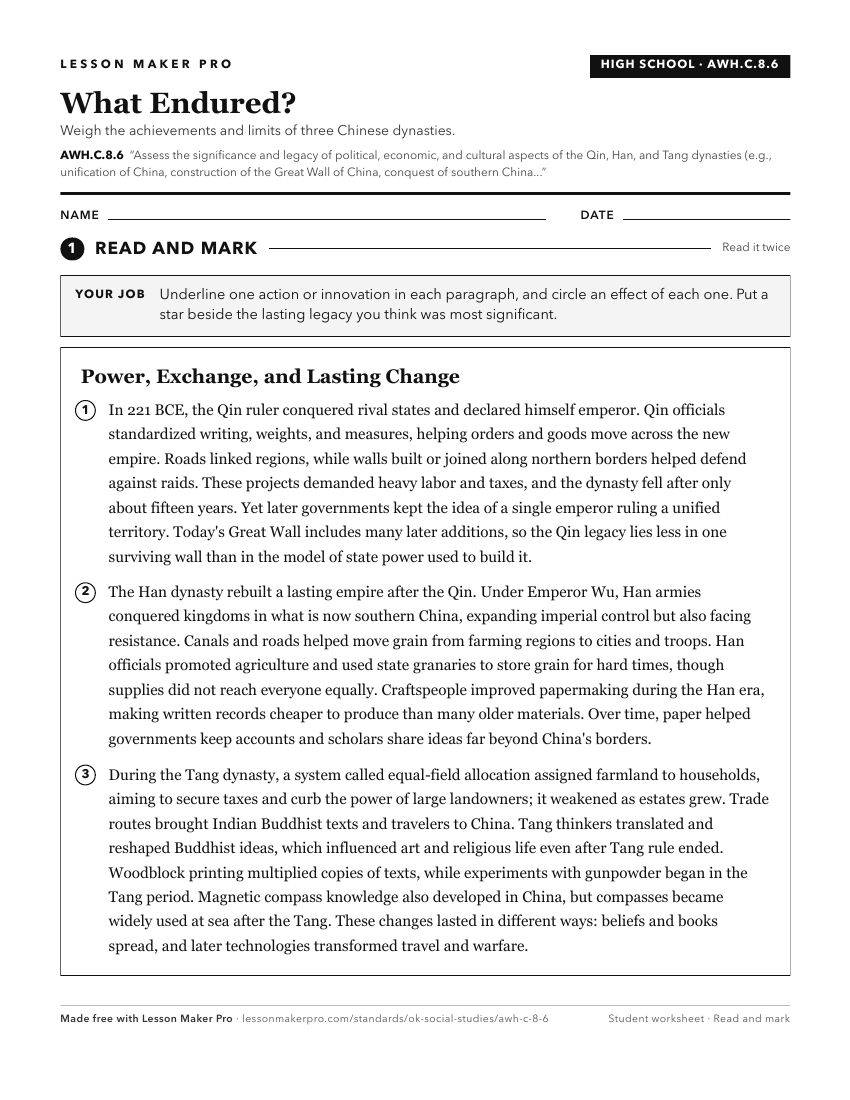
A ready-to-print activity worksheet aligned to AWH.C.8.6, with an answer key for the teacher on its own page. No account needed.
PDF, US Letter, prints cleanly in black and white.
Download the worksheetKeep exploring
Related Standards
- AWH.C.8.5
Examine significant aspects of Confucian philosophy and its role in the continuity of Chinese civilization, focusing on the life and teachings of Confucius, the...
- MWH.C.7.4.B
Describe significant political and economic change in China, including the influence of Sun Yat-Sen and the 1911 Revolution, and examine the consequences of the...
- AWH.C.11.1
Explain the significance of Indian and Chinese civilizations from 1000-1500 (e.g., the expansion of Islam into India, Delhi Sultanate) and political, economic, ...
- AWH.C.11.3
Examine the significant political, economic, and cultural aspects of the history of the Song, Yuan, and Ming dynasties (e.g.,the civil service, Mongol conquest,...
Turn this exact standard into a lesson
Grade, subject, topic, and the complete standard are prefilled. Create one free, no account needed.
Also for this standard:Make a WorksheetMake a QuizMake a Sub Lesson