Oklahoma Social Studies AWH.C.8.5
The Standard
Examine significant aspects of Confucian philosophy and its role in the continuity of Chinese civilization, focusing on the life and teachings of Confucius, the significance of individual ethics, and maintenance of order, hierarchy, and political power.
Oklahoma Academic Standards for Social Studies (2026)
Teacher's field guide
What This Standard Means
What Students Need to Do
- Students identify Confucius as a teacher in the late Zhou period. They explain how his teachings about personal conduct shaped family duties and expectations for rulers. They show how later Chinese governments used those ideas to support their authority.
What Mastery Looks Like
- A student can explain why Confucius expected rulers to set a good example, not just demand obedience. They can use a passage from the Analects and explain how later civil service exams kept Confucian learning in government.
Common Misconceptions
- Students may think Confucius was an emperor or that he created the civil service exams. They may think hierarchy meant only that children and subjects had to obey, missing the duties of parents and rulers.
How to Assess It
- Exit ticket: Give students this paraphrase of Analects 2.1: “A virtuous ruler is like the North Star, with other stars turning toward it.” Ask what the ruler must do and how an emperor might use this idea to support his authority.
Lesson moves
Ways to Teach It
Give pairs role cards and short Analects excerpts; have them link each role to a duty and mark who holds more power.
Ask, “Should a ruler who fails to act fairly still expect obedience?” Have students defend an answer using one Analects passage.
Play a scenario match: students pair ren, li, and filial piety with actions on cards, then explain how each action keeps order.
Have students compare a classroom rule and its enforcement with an Analects passage about how leaders set an example.
Free download
Printable AWH.C.8.5 Worksheet
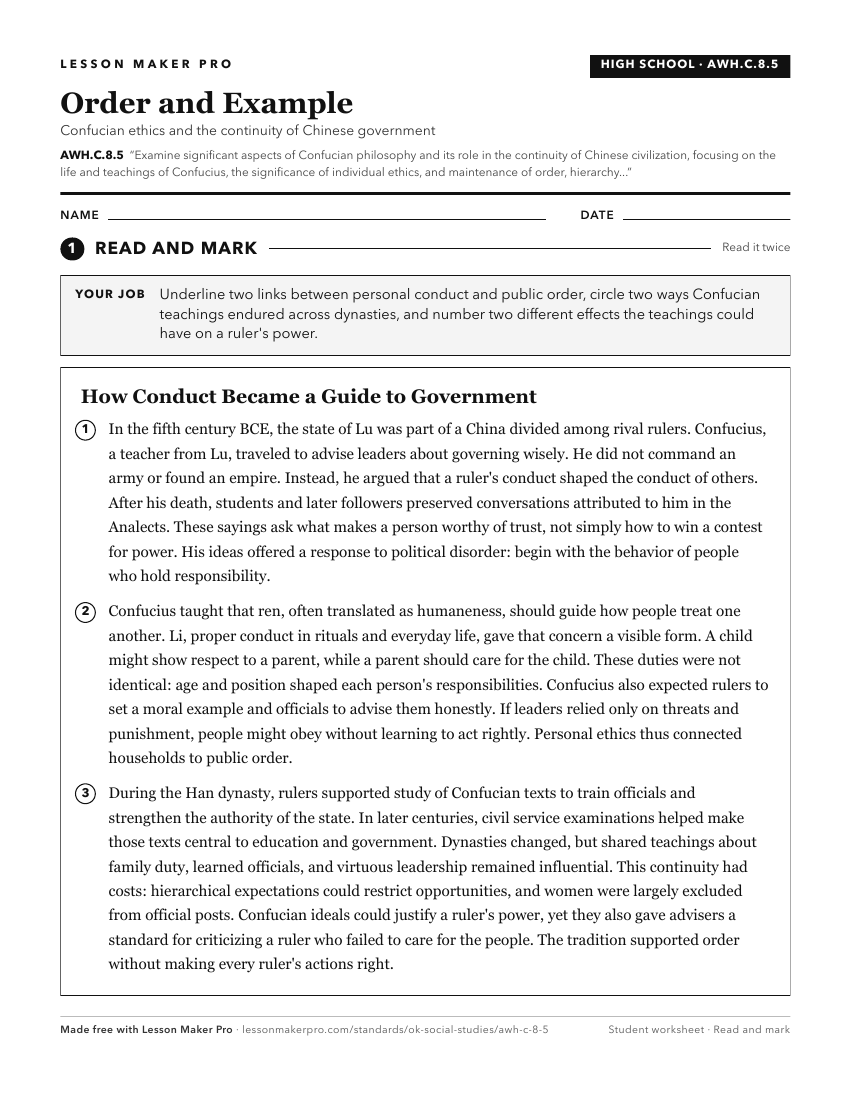
A ready-to-print activity worksheet aligned to AWH.C.8.5, with an answer key for the teacher on its own page. No account needed.
PDF, US Letter, prints cleanly in black and white.
Download the worksheetKeep exploring
Related Standards
- MWH.C.1.1.E
Compare the impact of Greek and Roman philosophers (e.g., Plato, Aristotle and Cicero) including their lasting influence on principles of government.
- AWH.C.11.3
Examine the significant political, economic, and cultural aspects of the history of the Song, Yuan, and Ming dynasties (e.g.,the civil service, Mongol conquest,...
- USG.C.8.2.B
Examine how components of civil society (e.g., active communities, individual self-reliance, ethics, religion) contribute to the maintenance of limited governme...
- AWH.C.8.6
Assess the significance and legacy of political, economic, and cultural aspects of the Qin, Han, and Tang dynasties (e.g., unification of China, construction of...
Turn this exact standard into a lesson
Grade, subject, topic, and the complete standard are prefilled. Create one free, no account needed.
Also for this standard:Make a WorksheetMake a QuizMake a Sub Lesson