Oklahoma Social Studies AWH.C.11.3
The Standard
Examine the significant political, economic, and cultural aspects of the history of the Song, Yuan, and Ming dynasties (e.g., the civil service, Mongol conquest, Construction of the Forbidden City, voyages of Zheng He, Ming political collapse, inventions such as movable-type printing, the cannon, and paper currency).
Oklahoma Academic Standards for Social Studies (2026)
Teacher's field guide
What This Standard Means
What Students Need to Do
- Students trace how government, trade, and culture changed across three Chinese dynasties. They use civil service exams, Mongol rule, paper money, sea voyages, and palace building to explain those changes.
What Mastery Looks Like
- Students explain how Song paper money supported trade, how the Yuan conquest changed who ruled China, and how Ming voyages expanded overseas contact. They identify the Forbidden City as a Ming palace and name a cause of Ming collapse, such as rebellion or financial strain.
Common Misconceptions
- Students may place Zheng He's voyages in the Song rather than the Ming. Some think the Mongol conquest ended civil service exams for good, though Yuan rulers later restored them. Others mistake the Forbidden City for a Yuan palace.
How to Assess It
- Exit ticket: Sort Song paper money, Yuan Mongol conquest, and Ming Forbidden City by dynasty. Under each, write one effect on trade, government, or culture.
Lesson moves
Ways to Teach It
Give pairs event cards for paper money, the Mongol conquest, and Zheng He's voyages; have them sort by dynasty and label each political, economic, or cultural.
Ask: How did Song civil service exams and Yuan Mongol rule affect who could gain government power? Use one fact for each.
Play three-clue challenge: read 'Mongol rulers, Marco Polo, Silk Road trade'; students name the dynasty and explain which clue helped.
Show a photo of Beijing's Forbidden City beside a current map; students locate it and explain what the palace reveals about Ming rulers.
Free download
Printable AWH.C.11.3 Worksheet
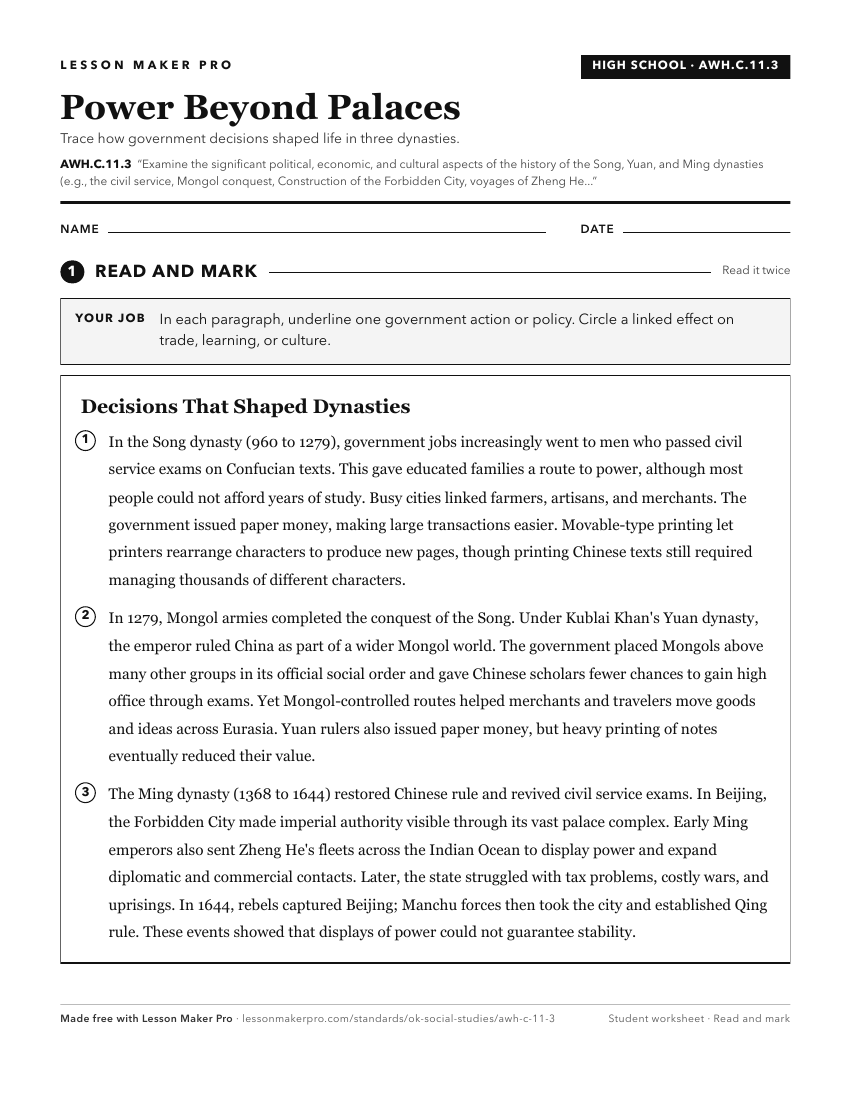
A ready-to-print activity worksheet aligned to AWH.C.11.3, with an answer key for the teacher on its own page. No account needed.
PDF, US Letter, prints cleanly in black and white.
Download the worksheetKeep exploring
Related Standards
- AWH.C.8.5
Examine significant aspects of Confucian philosophy and its role in the continuity of Chinese civilization, focusing on the life and teachings of Confucius, the...
- MWH.C.7.4.B
Describe significant political and economic change in China, including the influence of Sun Yat-Sen and the 1911 Revolution, and examine the consequences of the...
- AWH.C.8.3
Describe important political, economic, and cultural aspects of Indian history, including the Maurya and Kushan Empires, the Gupta Empire, Golden Age of India, ...
- AWH.C.8.6
Assess the significance and legacy of political, economic, and cultural aspects of the Qin, Han, and Tang dynasties (e.g., unification of China, construction of...
Turn this exact standard into a lesson
Grade, subject, topic, and the complete standard are prefilled. Create one free, no account needed.
Also for this standard:Make a WorksheetMake a QuizMake a Sub Lesson