Oklahoma Social Studies MWH.C.1.1.E
The Standard
- MWH.C.1
- Analyze the impact of the patterns of ancient political, economic, and cultural development.
- MWH.C.1.1
- Analyze the influence of religious, political, and philosophical ideas on society.
Compare the impact of Greek and Roman philosophers (e.g., Plato, Aristotle and Cicero) including their lasting influence on principles of government.
Oklahoma Academic Standards for Social Studies (2026) · MWH.C.1.1
Teacher's field guide
What This Standard Means
What Students Need to Do
- Students compare Plato's call for wise rulers, Aristotle's emphasis on laws, and Cicero's support for shared power. They connect these ideas to later debates about leaders, laws, and government power.
What Mastery Looks Like
- A student can explain how Plato's ideal ruler differs from Aristotle's rule of law and Cicero's mixed government. They can point to a feature of a later government and explain which idea it resembles.
Common Misconceptions
- Students may assume all three thinkers supported modern elections, though Plato distrusted democracy. They may also confuse rule of law with shared power or assume a later government copied one thinker's ideas exactly.
How to Assess It
- Exit ticket: How do Plato, Aristotle, and Cicero differ on who or what should govern, and where does one of their ideas appear in a later government?
Lesson moves
Ways to Teach It
Give pairs six cards naming Plato, Aristotle, Cicero, philosopher rulers, rule of law, and mixed government, and ask them to match and explain.
Have students write three sentences on whether Plato's philosopher rulers or Cicero's mixed government would better prevent abuse of power, citing both thinkers.
Play a clue game: read 'wise ruler,' 'law above officials,' and 'shared power,' then have teams name the thinker and justify each answer.
Read the U.S. Constitution's opening articles and have students mark one example of shared power, then connect it to Cicero's mixed government.
Free download
Printable MWH.C.1.1.E Worksheet
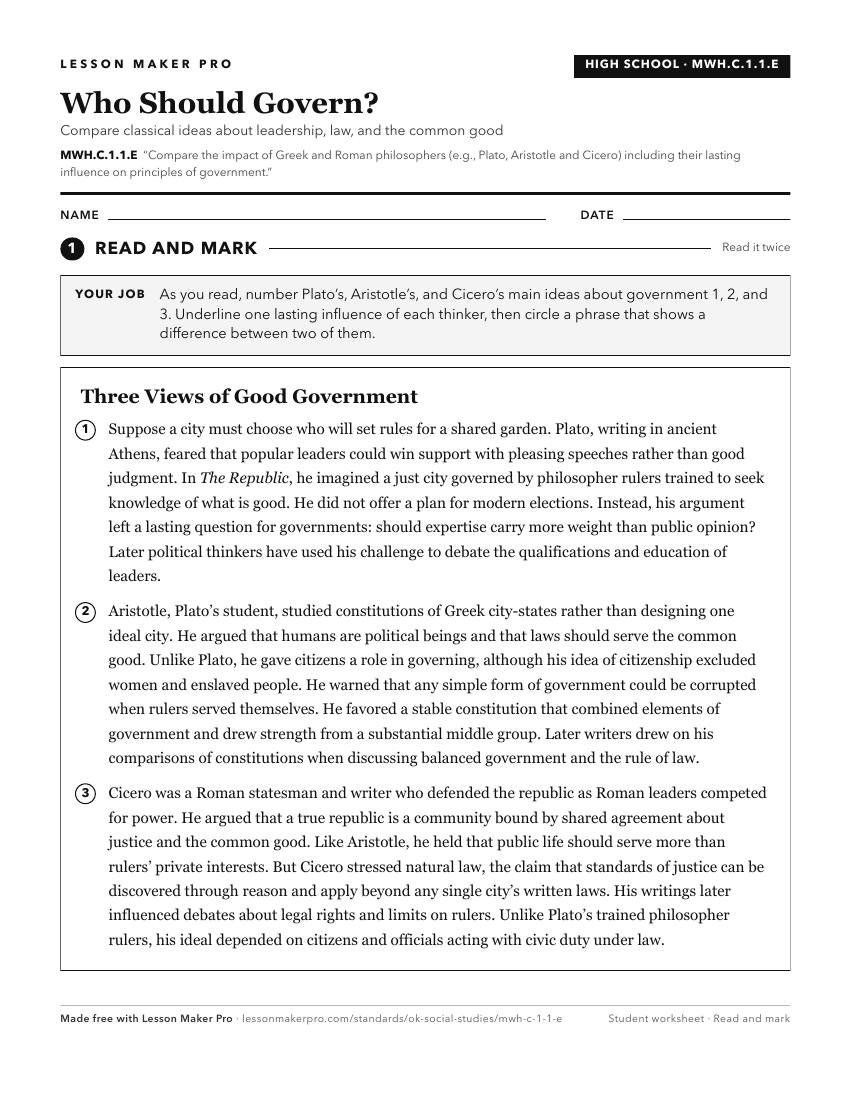
A ready-to-print activity worksheet aligned to MWH.C.1.1.E, with an answer key for the teacher on its own page. No account needed.
PDF, US Letter, prints cleanly in black and white.
Download the worksheetKeep exploring
Related Standards
- MWH.C.1.1.D
Evaluate the contributions of the Roman civilization to law and government by describing the Roman Republic’s development of the principle of separation of powe...
- AWH.C.6.4
Describe the lasting impact of major accomplishments of the ancient Greeks.
- AWH.C.7.4
Analyze the influence of Greek civilization on Roman art, literature, society, and government.
- AWH.C.7.3
Examine the government of the Roman Republic and its contribution to the development of republican self-government (e.g., the concepts of separation of powers, ...
Turn this exact standard into a lesson
Grade, subject, topic, and the complete standard are prefilled. Create one free, no account needed.
Also for this standard:Make a WorksheetMake a QuizMake a Sub Lesson