Oklahoma Social Studies AWH.C.6.4
Standard Cluster
Describe the lasting impact of major accomplishments of the ancient Greeks: Greek institutions: the lyceum, the gymnasium, the Library of Alexandria Mathematics: Pythagoras and Euclid Medicine: Hippocrates Science and Engineering: Archimedes, Ptolemy History, Poetry, Drama: Herodotus, Homer, Aeschylus Language: development of a complete alphabet, ancestor of the Latin alphabet.
Oklahoma Academic Standards for Social Studies (2026)
Cluster contents
Standards in This Cluster
AWH.C.6.4 is a cluster heading. These are the individual standards under it.
- AWH.C.6.4.A
Greek institutions: the lyceum, the gymnasium, the Library of Alexandria
- AWH.C.6.4.B
Mathematics: Pythagoras and Euclid
- AWH.C.6.4.C
Medicine: Hippocrates
- AWH.C.6.4.D
Science and Engineering: Archimedes, Ptolemy
- AWH.C.6.4.E
History, Poetry, Drama: Herodotus, Homer, Aeschylus
- AWH.C.6.4.F
Language: development of a complete alphabet, ancestor of the Latin alphabet.
Teacher's field guide
What This Cluster Means
What Students Need to Do
- Students explain how the Lyceum, gymnasium, and Library of Alexandria supported learning. They connect Greek work in math, medicine, science, writing, and the alphabet to later ideas and practices.
What Mastery Looks Like
- Students use a right triangle to show Pythagoras's rule and explain Euclid's use of proofs. They connect Hippocrates to medical observation, Archimedes to levers, and Ptolemy to an Earth-centered model that was later rejected. They link Herodotus to history, Homer to epic poetry, Aeschylus to tragedy, and Greek letters to Latin letters through Etruscan.
Common Misconceptions
- Students may think a gymnasium was only for sports or place the Library of Alexandria in Athens. They may think Ptolemy's Earth-centered model is still accepted. They may assume Latin letters came directly from Greek.
How to Assess It
- On an exit ticket, ask: “Choose one Greek institution and one thinker or writer. For each, name a specific contribution and explain one later use or influence.”
Lesson moves
Ways to Teach It
Give pairs square tiles and a drawn 3-4-5 triangle; have them build squares on each side and compare areas.
Read excerpts from Herodotus's Histories, Homer's Iliad, and Aeschylus's Persians; write which treats war as inquiry, epic, or drama.
Hand out cards labeled Lyceum, gymnasium, Library of Alexandria, Hippocrates, Archimedes, and Ptolemy; students match each to a contribution and explain it.
Have students compare Greek and Latin letter charts, circle shared shapes, then trace Greek letters through Etruscan to letters on their keyboards.
Free download
Printable AWH.C.6.4 Worksheet
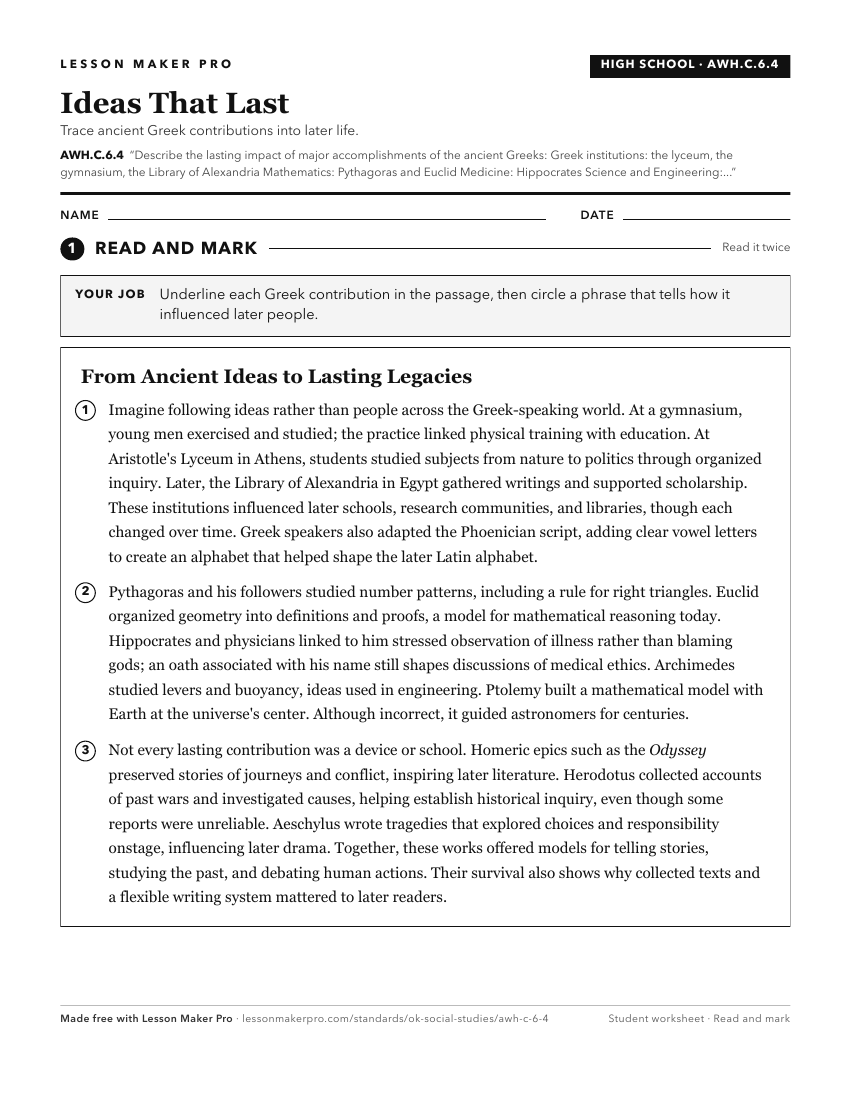
A ready-to-print activity worksheet aligned to AWH.C.6.4, with an answer key for the teacher on its own page. No account needed.
PDF, US Letter, prints cleanly in black and white.
Download the worksheetKeep exploring
Related Standards
- MWH.C.1.1.E
Compare the impact of Greek and Roman philosophers (e.g., Plato, Aristotle and Cicero) including their lasting influence on principles of government.
- AWH.C.7.4
Analyze the influence of Greek civilization on Roman art, literature, society, and government.
- AWH.C.6.6
Describe the rise of Alexander the Great and the spread of Greek culture, evaluating major contributions of Hellenistic art, philosophy, science, and political ...
- AWH.C.6.1
Locate on a historical map of the Mediterranean area, Ancient Greece, tracing the extent of its influence to 300 BC, including the locations and historical sign...
Turn this cluster into a lesson
Grade, subject, topic, and the complete cluster are prefilled. Create one free, no account needed.
Also for this cluster:Make a WorksheetMake a QuizMake a Sub Lesson