Oklahoma Social Studies AWH.C.6.6
The Standard
Describe the rise of Alexander the Great and the spread of Greek culture, evaluating major contributions of Hellenistic art, philosophy, science, and political thought.
Oklahoma Academic Standards for Social Studies (2026)
Teacher's field guide
What This Standard Means
What Students Need to Do
- Students explain how Alexander gained power and how his conquests helped Greek language and customs spread. They examine Hellenistic art, philosophy, science, and ideas about government. They judge the impact and limits of those changes.
What Mastery Looks Like
- A student connects Alexander’s conquests to the growth of Greek-speaking cities. They explain contributions such as realistic sculpture, Stoicism, and Eratosthenes’s work on Earth’s size. They can also explain how rule by kings differed from earlier ideas about city-state self-rule.
Common Misconceptions
- Students may think Alexander was king of Greece rather than Macedon, or that he ruled his empire for many years. They may assume everyone adopted Greek customs or that Hellenistic kingdoms were democracies.
How to Assess It
- Ask on an exit ticket: “How did Alexander’s conquests spread Greek culture? Give one Hellenistic example each from art, philosophy, science, and political thought, then explain the impact or limit of one example.”
Lesson moves
Ways to Teach It
Give pairs a blank map and cards for Alexandria, Antioch, and Pergamon; have them place each city and mark Alexander’s route.
Ask: “Did conquest or the growth of new cities do more to spread Greek culture? Use Alexandria as evidence.”
Set up four labeled corners; read cards on Winged Victory, Stoicism, Eratosthenes, and kingship, then have students move and explain.
Show Eratosthenes’s estimate of Earth’s size beside a modern figure; have students calculate the difference and discuss why the estimate mattered.
Free download
Printable AWH.C.6.6 Worksheet
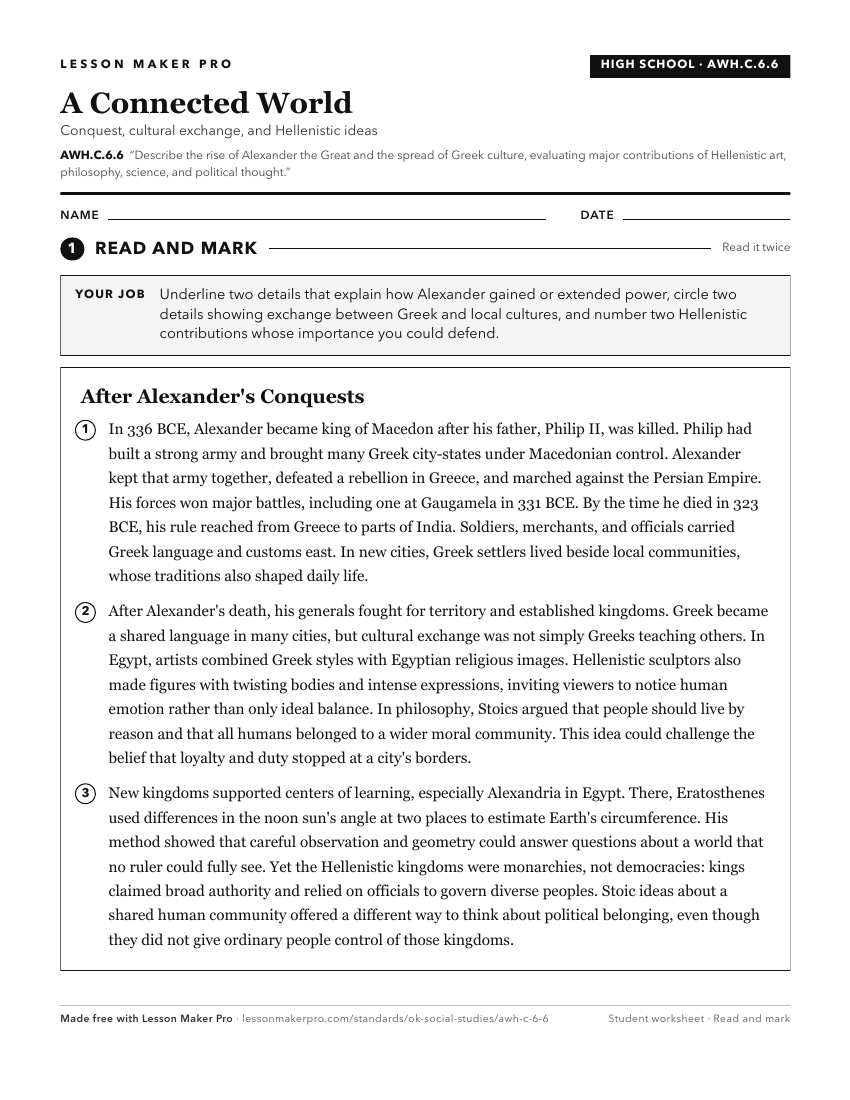
A ready-to-print activity worksheet aligned to AWH.C.6.6, with an answer key for the teacher on its own page. No account needed.
PDF, US Letter, prints cleanly in black and white.
Download the worksheetKeep exploring
Related Standards
- AWH.C.6.4
Describe the lasting impact of major accomplishments of the ancient Greeks.
- MWH.C.1.1.E
Compare the impact of Greek and Roman philosophers (e.g., Plato, Aristotle and Cicero) including their lasting influence on principles of government.
- AWH.C.7.4
Analyze the influence of Greek civilization on Roman art, literature, society, and government.
- AWH.C.6.2
Explain how the geographical location of Athens and other city-states contributed to their role in maritime trade, colonies in the Mediterranean, and the expans...
Turn this exact standard into a lesson
Grade, subject, topic, and the complete standard are prefilled. Create one free, no account needed.
Also for this standard:Make a WorksheetMake a QuizMake a Sub Lesson