Oklahoma Social Studies AWH.C.7.4
The Standard
Analyze the influence of Greek civilization on Roman art, literature, society, and government.
Oklahoma Academic Standards for Social Studies (2026)
Teacher's field guide
What This Standard Means
What Students Need to Do
- Students find Greek influences in Roman statues, poems, education, and political writing. They use examples to explain what Romans borrowed and what they changed.
What Mastery Looks Like
- A student can connect Roman sculpture to Greek statues and Virgil’s Aeneid to Homer’s epics. They can explain why wealthy Roman families hired Greek tutors and how Cicero drew on Greek political ideas without calling Rome a Greek democracy.
Common Misconceptions
- Students may treat Roman statues and poems as exact copies of Greek works. They may call Rome a Greek-style direct democracy or assume all Roman children had Greek tutors.
How to Assess It
- Exit ticket: Name one Greek influence on Roman sculpture, epic poetry, schooling, and Cicero’s political writing. For one example, explain what Romans changed.
Lesson moves
Ways to Teach It
Pairs sort eight printed cards into Greek and Roman matches: statue images, Homer and Virgil lines, schooling descriptions, and Plato and Cicero excerpts.
Ask: Did Romans copy Greek culture or change it? Defend your answer using one statue pair and one Homer and Virgil excerpt.
Read four clues aloud: a Greek-style statue, a Virgil epic, a Greek tutor, and Cicero on government; students point to labeled domain cards.
Show a photo of a courthouse with Greek-style columns beside a Roman temple image; ask which design details survived across both.
Free download
Printable AWH.C.7.4 Worksheet
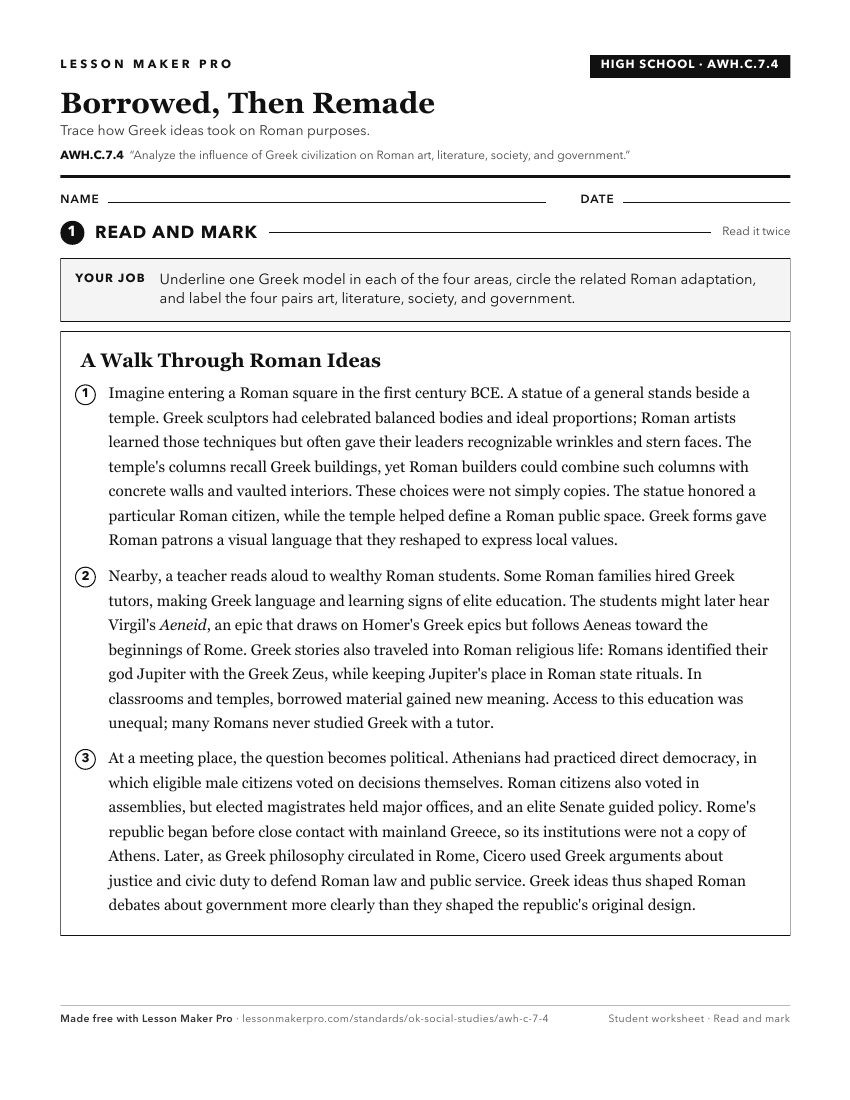
A ready-to-print activity worksheet aligned to AWH.C.7.4, with an answer key for the teacher on its own page. No account needed.
PDF, US Letter, prints cleanly in black and white.
Download the worksheetKeep exploring
Related Standards
- MWH.C.1.1.D
Evaluate the contributions of the Roman civilization to law and government by describing the Roman Republic’s development of the principle of separation of powe...
- MWH.C.1.1.E
Compare the impact of Greek and Roman philosophers (e.g., Plato, Aristotle and Cicero) including their lasting influence on principles of government.
- AWH.C.7.10
Explain the contribution of Roman civilization to law, literature, architecture, engineering, and technology, including the spread and influence of the Latin la...
- AWH.C.7.3
Examine the government of the Roman Republic and its contribution to the development of republican self-government (e.g., the concepts of separation of powers, ...
Turn this exact standard into a lesson
Grade, subject, topic, and the complete standard are prefilled. Create one free, no account needed.
Also for this standard:Make a WorksheetMake a QuizMake a Sub Lesson