Oklahoma Social Studies AWH.C.7.3
The Standard
Examine the government of the Roman Republic and its contribution to the development of republican self-government (e.g., the concepts of separation of powers, liberty, the rule of law, representative government, civic duty).
Oklahoma Academic Standards for Social Studies (2026)
Teacher's field guide
What This Standard Means
What Students Need to Do
- Students identify what consuls, the Senate, assemblies, and tribunes did. They explain how voting, written laws, and checks on officials shaped later governments. They also identify who was excluded from political life.
What Mastery Looks Like
- A student can explain that citizen assemblies voted on laws and elected officials, while tribunes could veto actions. They can name a later government idea shaped by Rome and a group barred from voting.
Common Misconceptions
- Students may think senators were directly elected to pass laws, like modern legislators. They may assume women and enslaved people could vote, or that consuls ruled without checks.
How to Assess It
- Exit ticket: A consul proposes a law that harms plebeians. Who votes on it, who could veto it, and name one group that could not vote?
Lesson moves
Ways to Teach It
Give students consul, Senate, assembly, and tribune cards; have them match each to a power and a limit.
Ask: Did the Republic give ordinary Romans a voice? Write four sentences using the assemblies and one group excluded from voting.
Stage a road-tax vote: assign consuls, citizen voters, and tribunes; have the assembly vote and a tribune decide whether to veto.
Pass out a sample local election ballot and a Roman voter list; have students circle who could vote in each.
Free download
Printable AWH.C.7.3 Worksheet
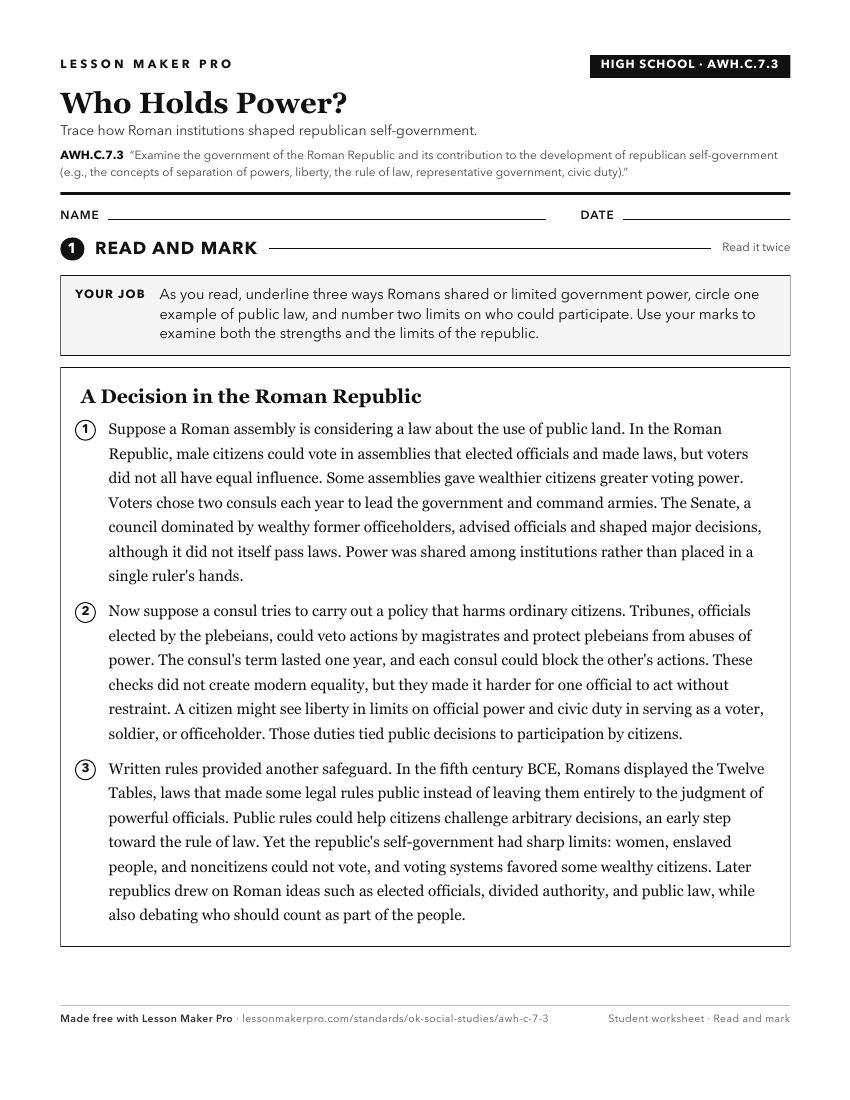
A ready-to-print activity worksheet aligned to AWH.C.7.3, with an answer key for the teacher on its own page. No account needed.
PDF, US Letter, prints cleanly in black and white.
Download the worksheetKeep exploring
Related Standards
- MWH.C.1.1.D
Evaluate the contributions of the Roman civilization to law and government by describing the Roman Republic’s development of the principle of separation of powe...
- 7.C.6.2.B
Describe the government of the Roman Republic and its contribution to the development of representative self-government, including separation of powers, liberty...
- USG.C.2
Describe the historical and philosophical foundations of the republican system of government in the United States of America.
- USG.C.8.2.B
Examine how components of civil society (e.g., active communities, individual self-reliance, ethics, religion) contribute to the maintenance of limited governme...
Turn this exact standard into a lesson
Grade, subject, topic, and the complete standard are prefilled. Create one free, no account needed.
Also for this standard:Make a WorksheetMake a QuizMake a Sub Lesson