Oklahoma Social Studies 7.C.6.2.B
The Standard
- 7.C.6
- Analyze systems of government by examining their source of authority, principles, structures, and processes.
- 7.C.6.2
- Trace the historic roots of constitutional republics.
Describe the government of the Roman Republic and its contribution to the development of representative self-government, including separation of powers, liberty, the rule of law, and the concept of civic duty.
Oklahoma Academic Standards for Social Studies (2026) · 7.C.6.2
Teacher's field guide
What This Standard Means
What Students Need to Do
- Students explain what consuls, the Senate, assemblies, and tribunes did. They connect shared power, written laws, citizen rights, and civic duties to later representative government.
What Mastery Looks Like
- A student can explain how assemblies elected officials and how a tribune could block an action. They can describe how the Twelve Tables made laws public and how citizens took part through voting or military service. They can name groups barred from voting, including women and enslaved people.
Common Misconceptions
- Students may think all Romans could vote or that everyone elected the Senate. They may picture three modern branches of government, though Romans divided power differently. They may also assume public laws gave everyone equal rights.
How to Assess It
- On an exit slip, ask: Name two Roman offices or groups, explain how one could limit another's power, and name one group that could not vote.
Lesson moves
Ways to Teach It
Give students consul, Senate, tribune, and assembly role cards; debate a grain tax, vote, and test a veto.
Ask students to write: Who could vote in Rome, and how did that limit Roman self-government?
Match cards labeled consul, Senate, assembly, tribune, and Twelve Tables to job cards, then check answers with a partner.
Print a local council agenda and city ordinance; compare how laws are made public with the Roman Twelve Tables.
Free download
Printable 7.C.6.2.B Worksheet
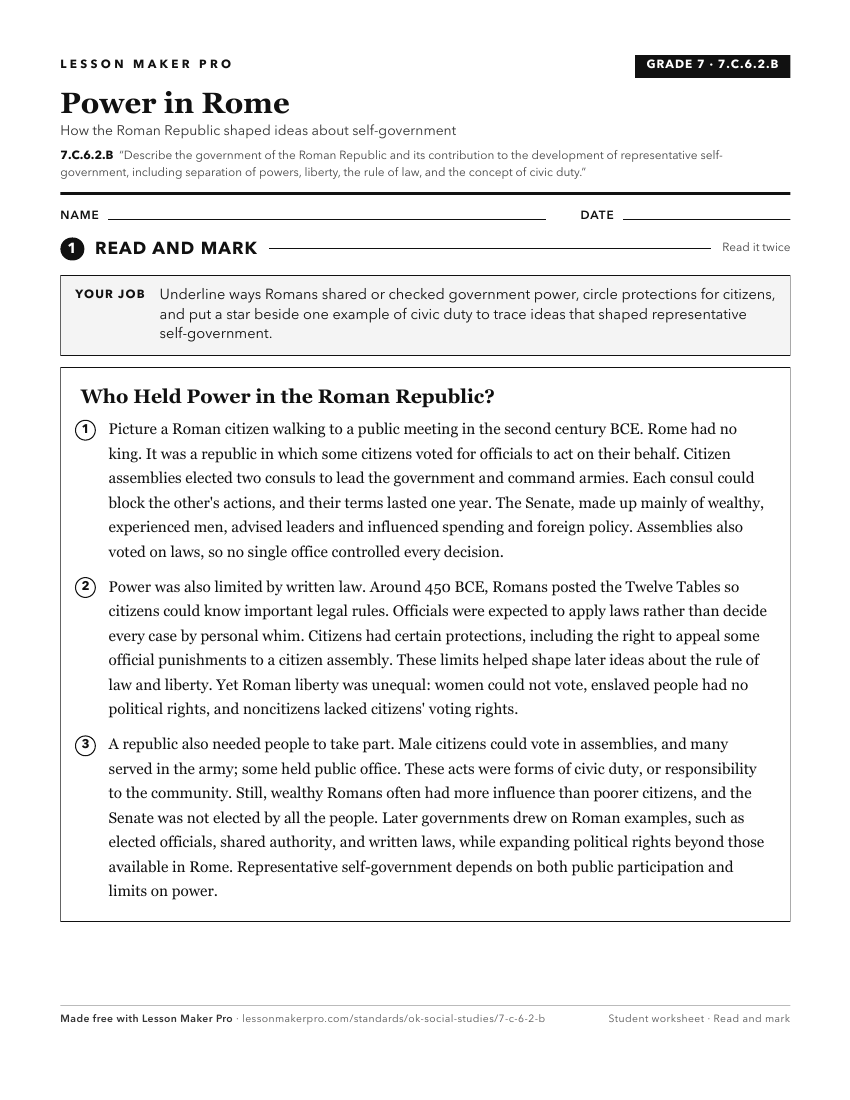
A ready-to-print activity worksheet aligned to 7.C.6.2.B, with an answer key for the teacher on its own page. No account needed.
PDF, US Letter, prints cleanly in black and white.
Download the worksheetKeep exploring
Related Standards
- MWH.C.1.1.D
Evaluate the contributions of the Roman civilization to law and government by describing the Roman Republic’s development of the principle of separation of powe...
- 7.C.6.2.A
Explain why the government of ancient Athens is considered the beginning of democratic government and examine Greek political concepts, including the “polis” or...
- USG.C.2
Describe the historical and philosophical foundations of the republican system of government in the United States of America.
- AWH.C.7.3
Examine the government of the Roman Republic and its contribution to the development of republican self-government (e.g., the concepts of separation of powers, ...
Turn this exact standard into a lesson
Grade, subject, topic, and the complete standard are prefilled. Create one free, no account needed.
Also for this standard:Make a WorksheetMake a QuizMake a Sub Lesson