Oklahoma Social Studies 7.C.6.2.A
The Standard
- 7.C.6
- Analyze systems of government by examining their source of authority, principles, structures, and processes.
- 7.C.6.2
- Trace the historic roots of constitutional republics.
Explain why the government of ancient Athens is considered the beginning of democratic government and examine Greek political concepts, including the “polis” or city-state, rule of law, liberty, civic participation and voting rights, legislative bodies, and written constitutions.
Oklahoma Academic Standards for Social Studies (2026) · 7.C.6.2
Teacher's field guide
What This Standard Means
What Students Need to Do
- Students explain why Athens counts as an early democracy: eligible citizens voted directly in a lawmaking assembly. They describe a polis, written rules for government, rule of law, and the limits on citizen freedom and participation.
What Mastery Looks Like
- A student can explain what the assembly did and why women, enslaved people, and resident foreigners could not vote. They can describe how written rules shaped government, laws applied to officials, and citizens could speak on public decisions.
Common Misconceptions
- Students may think everyone in Athens could vote or that citizens elected lawmakers to vote for them. They may assume every Greek polis worked like Athens or that written rules gave everyone equal rights.
How to Assess It
- Exit ticket: Why is Athens called an early democracy? Name the assembly, say who could vote, and explain one way written rules shaped its government.
Lesson moves
Ways to Teach It
Give pairs cards labeled male citizen, woman, enslaved person, and resident foreigner; have them sort voting eligibility and tally ballots on an assembly proposal.
Ask, 'Can a government be democratic if most residents cannot vote?' Have students cite the Athenian assembly and excluded groups.
Read descriptions of a polis, assembly, law, and constitution; have students hold up the matching term card.
Show a school council's written rules and meeting agenda; have students compare who votes and who must follow rules with Athens.
Free download
Printable 7.C.6.2.A Worksheet
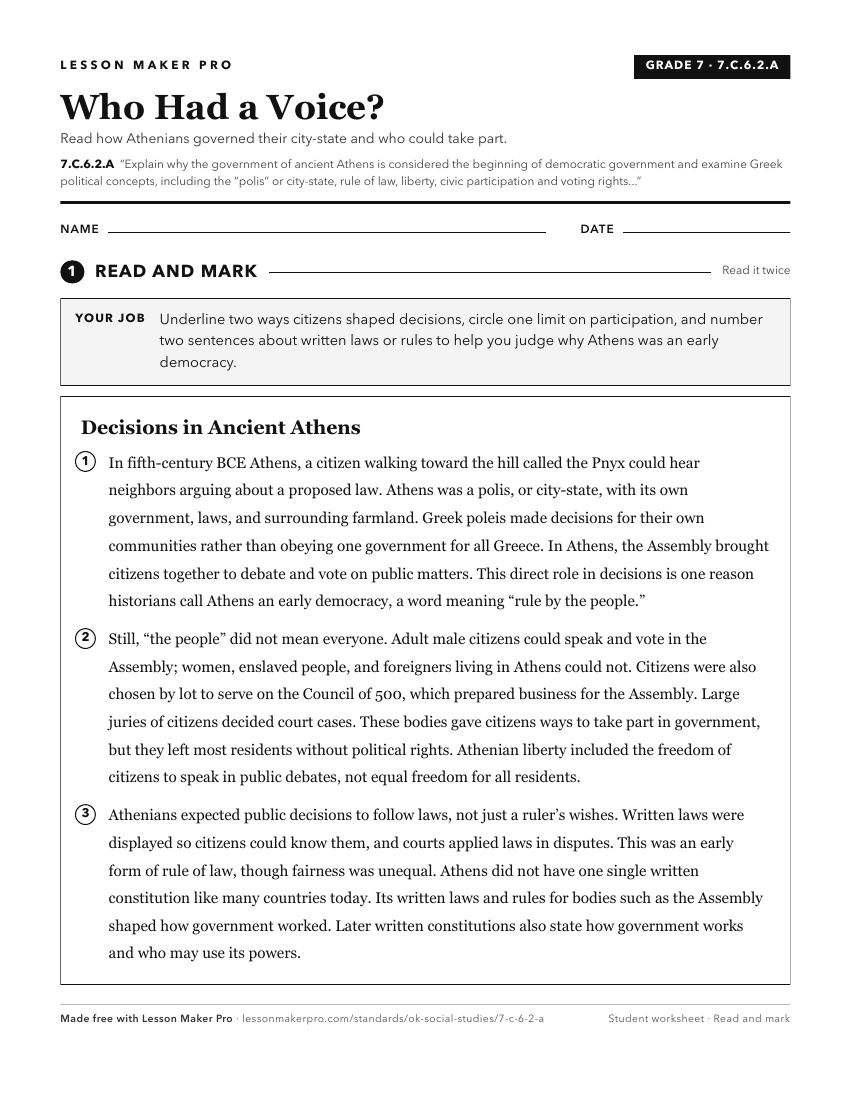
A ready-to-print activity worksheet aligned to 7.C.6.2.A, with an answer key for the teacher on its own page. No account needed.
PDF, US Letter, prints cleanly in black and white.
Download the worksheetKeep exploring
Related Standards
- AWH.C.6.3
Analyze why the government of ancient Athens is considered the beginning of democratic government, by explaining the political concepts developed in ancient Gre...
- 7.C.6.2.B
Describe the government of the Roman Republic and its contribution to the development of representative self-government, including separation of powers, liberty...
- MWH.C.1.1.C
Explain ancient Athens’ experience with direct democracy and identify modern political principles which developed in ancient Greece (e.g., the city-state, civic...
- AWH.C.7.3
Examine the government of the Roman Republic and its contribution to the development of republican self-government (e.g., the concepts of separation of powers, ...
Turn this exact standard into a lesson
Grade, subject, topic, and the complete standard are prefilled. Create one free, no account needed.
Also for this standard:Make a WorksheetMake a QuizMake a Sub Lesson