Oklahoma Social Studies MWH.C.1.1.C
The Standard
- MWH.C.1
- Analyze the impact of the patterns of ancient political, economic, and cultural development.
- MWH.C.1.1
- Analyze the influence of religious, political, and philosophical ideas on society.
Explain ancient Athens’ experience with direct democracy and identify modern political principles which developed in ancient Greece (e.g., the city-state, civic participation through voting, law-making bodies).
Oklahoma Academic Standards for Social Studies (2026) · MWH.C.1.1
Teacher's field guide
What This Standard Means
What Students Need to Do
- Students explain how eligible Athenians voted on laws in an assembly. They connect Greek city-states, citizen voting, and lawmaking bodies to governments today.
What Mastery Looks Like
- A student can describe Athens as an independent city-state and name who could and could not vote. They can explain why a modern ballot measure is closer to Athenian voting than electing a lawmaker.
Common Misconceptions
- Students may think women, enslaved people, and resident foreigners could vote in Athens. They may confuse voting on a law with electing someone to vote on laws. Some assume every Greek city-state had a democracy.
How to Assess It
- Ask on an exit ticket: Who voted on laws in Athens? How does that differ from a modern legislature? Name one group excluded from voting in Athens.
Lesson moves
Ways to Teach It
Give pairs Athenian resident cards to sort by voting eligibility, then have them tally eligible cards on a proposed harbor tax.
Ask students to write: How is an Athenian assembly vote different from electing a city council member, and whose voices were missing?
Play 'Athens or today?': teams sort cards describing assemblies, elected lawmakers, citizen votes, and city-states, then explain two choices.
Show a local ballot measure and a city council agenda; students mark who makes each decision and compare both with Athens.
Free download
Printable MWH.C.1.1.C Worksheet
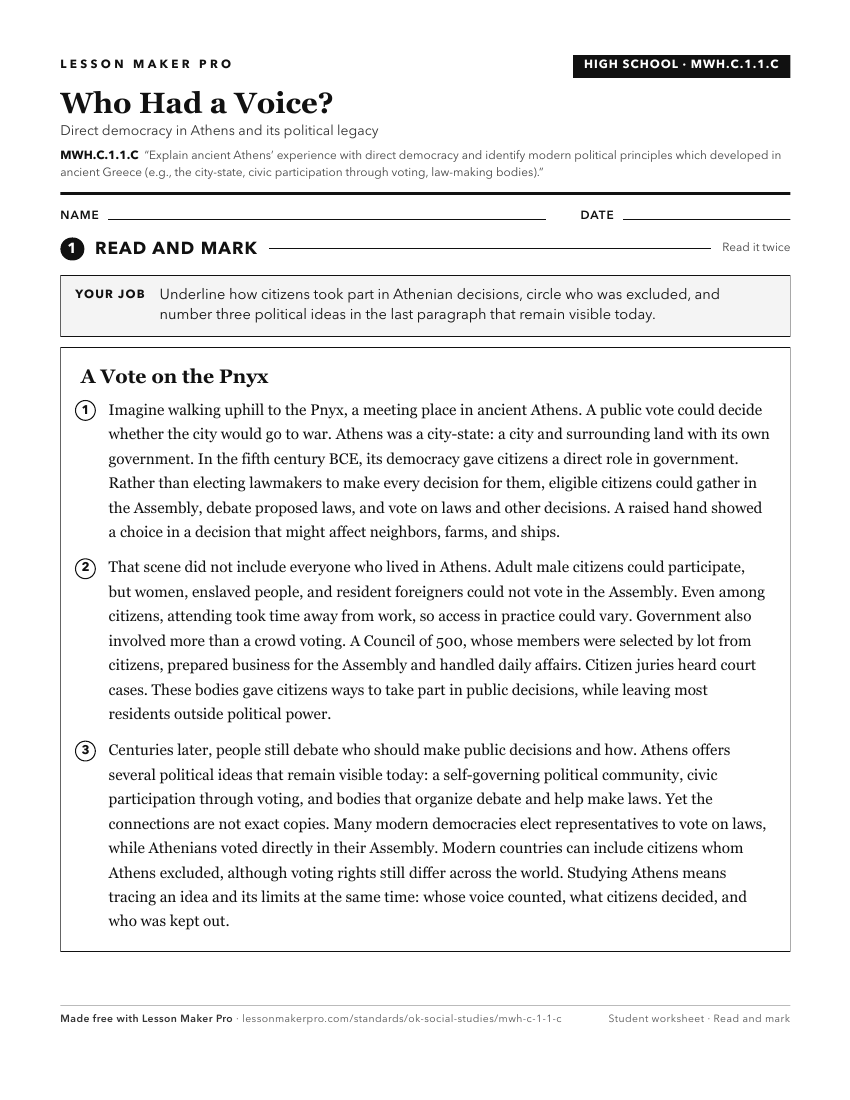
A ready-to-print activity worksheet aligned to MWH.C.1.1.C, with an answer key for the teacher on its own page. No account needed.
PDF, US Letter, prints cleanly in black and white.
Download the worksheetKeep exploring
Related Standards
- AWH.C.6.3
Analyze why the government of ancient Athens is considered the beginning of democratic government, by explaining the political concepts developed in ancient Gre...
- 7.C.6.2.A
Explain why the government of ancient Athens is considered the beginning of democratic government and examine Greek political concepts, including the “polis” or...
- 5.P.2.1.A
Explain democratic principles in historic documents by identifying examples of civic virtues and principles at work in state and national settings.
- 4.P.2.1.A
Explain democratic principles in historic documents by identifying examples of civic virtues and principles at work in state and national settings.
Turn this exact standard into a lesson
Grade, subject, topic, and the complete standard are prefilled. Create one free, no account needed.
Also for this standard:Make a WorksheetMake a QuizMake a Sub Lesson